Review: My Year of Rest and Relaxation

36552920
Review for "My Year of Rest and Relaxation" by Ottessa Moshfegh (2018)
Rating: 5 out of 5 stars

I’ll say this and I’ll say it again–at this point in my life I will read anything that Ottessa Moshfegh writes. I’ve read all of her novels (McGlue, Eileen, and her short story collection Homesick for Another World) and I consider them not just reading, but something that, for me, is more of an experience. You find yourself entering another world through her words, a parallel universe. Most of the time the universe that Moshfegh writes about is full of ugly and repulsive people who are trapped somehow–in drinking, drugs, self-loathing.

“My Year of Rest and Relaxation” follows the same theme of unlikable characters that Moshfegh is known for. The unnamed narrator is young, thin, blonde, and pretty and reminds you of this every 10 pages or so. She is wealthy, lives in a great apartment in NYC and works in a hip art gallery. However, she is depressed. Under a “mask” of having it all, she grows up with cold and unloving parents. Her boyfriend treats her like a doormat. The one friend that she has, Reva, is not really her friend, but a punching bag for her passive-aggressive anger.

In response, the narrator decides to take a year off to sleep, and, in her words, ‘hibernate.’ She finds a psychiatrist in a phone book and tells elaborate lies to get every drug imaginable to sleep and stay that way. For an entire year, the narrator exists in this dreamlike, comatose state of waking, sleeping, recalling periodic visits with her friend, watching old movies, pondering the past, and sleeping some more. She comes up occasionally for air to get coffee, or realize that she’s done weird things while under (partying, shopping, talking to strangers online, etc). When she emerges from her year of sleep, the results are quite profound and (dare I say it) bittersweet.

As with Moshfegh’s last novel, Eileen, the plot is not the strong suit here. This is more of a character study with a depressed, highly unlikable character at the center. As with Moshfegh’s other novels, I could not stop reading this book, even as the character’s behavior completely repulsed me. That’s the gift of this writer though, she makes the ugly somehow appealing.

Definitely read this one. 5 stars.

Review: Fever Dream

30763882

Review for "Fever Dream" by Samanta Schweblin (2017)

Rating: 4 out of 5 stars

The experience of reading “Fever Dream” is like sitting in a room with a blindfold on. You can’t see anything but you can definitely feel emotion–fear, anger, dread. Every now and then the blindfold lifts and you get an image of Something, but it’s indistinct and unexplainable. You sit in the dark some more and you get another image, different from the last one. Eventually you attempt to put together what you’ve seen into a narrative, but you can’t. It’s unsettling and wild. Confusing.

It’s hard to describe this novel because it really isn’t about anything. On the surface it is about a young mother, dying in a hospital. Her daughter is missing and she is not sure how she got there. The entire book is a conversation between this woman and a little boy who is not hers about what has happened to her and her daughter. But you know that that’s not really it, it’s just window dressing on a deeper layer of meaning. Through the bits and pieces of the conversation between these two characters you get that this book explores parental fear, transference and counter-transference, environmental contamination, issues of trust, and some heavy duty psychoanalysis. The dialogue between the main character and the little boy is maddeningly circular and strange. It’s weird, but I was totally in for the ride.

I’ve said here before that books that are confusing are not good ones. After reading this, I realize that I may need to walk back that statement. There is so much to unpack here that I will probably reread this, and I’ll be happy when I do that. “Fever Dream” is definitely worth reading, but be aware that it is not a traditional story with neat characters, a detailed plot, and a conclusive ending. This is bizarre and murky and all over the place. If you are into dark and somewhat experimental reads and don’t mind doing a little brain work, I recommend this.

This is a short book, so I would advise letting it hit you all at once. Read it in as few sittings as possible.

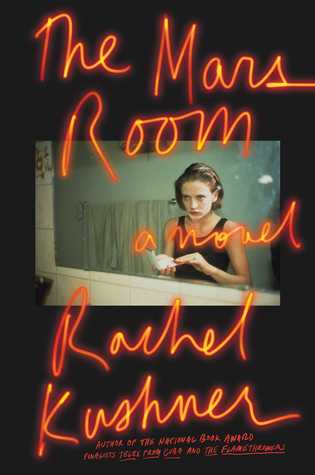
Review: The Mars Room

36373648
Review for "The Mars Room" by Rachel Kushner (2018)
Rating: 3 out of 5 stars

It took me almost a month to read this book. Based on its glowing reviews and my initial enthusiasm when I first picked it up, this should have been a book that I breezed right through. It wasn’t.

“The Mars Room” opens with the story of Romy Hall, a single mother shackled on a bus and headed to a remote women’s prison in California to begin two life sentences without parole. In the time before, we learn that her young life was full of trauma and neglect–drugs, hustling, and working as a dancer at a strip club that bears the book’s title, The Mars Room. The novel begins with details of Romy’s adjustment to prison life, the harsh conditions of confinement, and the connections she makes on the inside. Interspersed with Romy’s narrative are the stories of other characters in the facility and beyond: Sammy, her cell mate, Gordon, a teacher in the prison who falls for Romy, Doc, a crooked cop in a separate facility that’s loosely connected to the story’s events, and at last, Kurt, Romy’s victim.

The story started out well, but as it continued I found it harder and harder to engage with. Romy, in my opinion, was far too distant and aloof. There is a sense of empathy that you feel for Romy’s circumstances, but nothing was felt as far as a personal connection to her. The other perspectives fare no better—they absentmindedly jump around between first and third pov’s in short, vignette-style chapters. Also problematic was the reason behind the inclusion of several of them–Doc, for instance (as I mentioned before, he is only loosely connected to the events of the story). There are also excerpts from Ted Kaczynski’s diary, lengthy quotes from Henry David Thoreau. I’m still not sure what either of those perspectives were doing here.

There are also plot events that were so predictable that I knew how they would play out before even starting the book. Beyond setting up the basics of the story, nothing significant seems to really happen until the end and by then it’s too much, too late.

And finally…I know that women in prison make great stories, but it bothers me that this novel really doesn’t break any new ground here. What I’m saying is that there really isn’t anything in this book that we haven’t heard or seen already that hasn’t appeared in an episode of “Orange is the New Black.” What, then, is the point of this novel? If it is to stress how women on the lower end of the socioeconomic scale end up incarcerated, then we are already well familiar with this through investigative reporting on this issue, OITNB, and a multitude of other books out there. If it is to make a larger point beyond this (hence the inclusion of Kaczynski and Thoreau), then count me among those that simply didn’t get “it.”

Overall, I think that “The Mars Room” is a book with a lot of potential but doesn’t really have anything new to say.

I rate this as 3 stars, and that’s being more than nice.

Review: How to Love a Jamaican

35395301
Review for "How to Love a Jamaican" by Alexia Arthurs (2018)
Rating: 4.5 out of 5 stars

“How to Love a Jamaican” is an engaging collection of eleven short stories from debut author Alexia Arthurs. These are not your “typical” immigrant stories, however. Arthurs is not afraid to delve deeply into the lives of her characters and discuss complex issues of sex, class, and race both in Jamaica and within the lives of Jamaicans living in America.

All of these stories are about Jamaicans and cover a wide variety of their lives–male and female, straight and gay, old, young, and middle aged, on the island and in America. The characters are not linked, but this is definitely a cohesive collection of stories. In “Mash Up Love,” a set of identical male twins vie for the attention of their mother and loved ones. “The Ghost of Jia Yi” is about a young college student’s adjustment to America and her realization that she is an outsider. “Light Skinned Girls and Some Kelly Rowlands” is about the class conflicts within a friendship between two college girls, one Jamaican born, the other U.S. born with Jamaican born parents. “Bad Behavior” is about a free-spirited teenage girl sent to the island for disobeying her parents, with the hope that her stern Jamaican grandmother will ‘straighten’ out her wayward behavior. I also liked “Shirley from a Small Place,” about a Jamaican American pop star who finds international success and deals with the pitfalls of fame.

It’s hard to choose a favorite story here, I really liked every single selection. Even though the stories share similar themes, there were no repeats and not a single word was wasted.

4.5 stars. I will definitely read the next thing that Alexia Arthurs writes.

[NOTE: An electronic copy of this book was provided by the publisher and NetGalley in exchange for an honest review.]

Review: Animals Eat Each Other

32073130
Review for "Animals Eat Each Other" by Elle Nash (2018)

Rating: 4.5 out of 5 stars

Ok, I’ll admit it…the intriguing title–“Animals Eat Each Other”–of this book pulled me in. There is no animal on the cover, only a mirrored, vintage 1970’s style photo of a smiling woman. So I picked this up and read it, having never heard before of the author, Elle Nash. About 10 pages in, I realized that I was reading something quite special. Needless to say, I loved every moment of this book.

The unnamed 19-year-old narrator lives with her mother and works at a Radio Shack. She spends her extra time consuming Robitussin, taking her mom’s Percocets, and having empty, loveless sex with the people around her to boost her self-esteem. She is self-destructive and knows this, her narrative never condemns or denies this fact. The main character’s self-hate and need for physical and emotional pain lead her into becoming involved in a three-way sadomasochistic relationship with a man named Matt and his girlfriend, Frankie. Immediately we know that three is a crowd here, and it isn’t going to end well. The ‘darkness’ of the situation does not stop the narrator, who becomes obsessed with Matt and her behavior spirals further downward out of control.

What I loved about this book most was its sense of rawness and its lack of shame. You feel what the main character feels with her body, and it’s OK. I think this book speaks to where a lot of young women (me included) find themselves in their 20’s: passionate, energetic, vulnerable, and driven by a deep need to be desired. It is this vulnerability that takes the narrator to dark places, which she does not resist. There is a kind of madness in human attraction, pleasure in pain.

This novel is careful not to preach or moralize. It is not a cautionary tale. You’re not told what to do when you finish it. When I got to the last page I just let out a breath because…well, because. Immediately I wished this had been longer, but then again I think the short length here (120 pages) is appropriate because the narrator’s self-loathing is quite intense. As much as I loved this, this book is a dark, dark place. The author’s choice to get in there, tell the story in as few pages as possible, and move on is a good one.

The transgressive stuff in this book will turn off some readers (lots and lots of sex, drugs, Satanism) but these are not the ones who this book is for. I definitely recommend this if you are into darker stories that explore human nature and relationships.

Review: A Lucky Man

36480133

Review for "A Lucky Man" by Jamel Brinkley (2018)

Rating: 5 out of 5 stars

This is one of the most profound short story collections I’ve read over the past few years. I say that with no hesitation, because let’s face it–most short story offerings these days ain’t that good, unevenly written at best. Very rarely are ALL of the stories in a collection readable and relatable pieces of literature. “A Lucky Man” is one of the few exceptions.

In this volume are nine stories, all featuring Black men and boys in the Bronx who are dealing with life and its societal pressures. There is a focus on masculinity here, specifically Black masculinity–how Black men view the women in their lives, their families, and how they justify their behavior toward them. There are definitely depictions of unhealthy relationships here, but it’s not just sexism on display. The nuances of what it means to be a Black man are explored here in a variety of different settings: in some cases, the choice to reject traditional “male” behavior has disastrous consequences, but in others, the character finds peace.

The powerful story “J’ouvert 1996” was my favorite in this collection, which tells the story of a young boy’s coming of age during an all-night street festival. “Everything the Mouth Eats” is the tale of two brothers’ healing of the past during a capoeira festival. “A Family” is about one man’s quest to come to terms with his actions, many years after a terrible act. “A Lucky Man” is an interesting exploration of public spaces and male desire.

Overall, this is a beautiful collection of tales. It is hard to believe that this is Jamel Brinkley’s first book, he writes with a talent that is rare and unique. I look forward to any future writing projects he has. Definitely recommend!

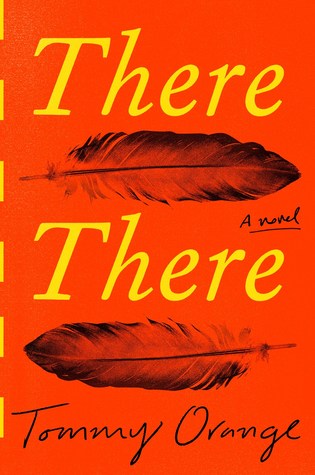
Review: There There

36692478

Review for "There There" by Tommy Orange (2018)

Rating: 4 out of 5 stars

Here’s a fact about me: whenever I see a book by a Native American author other than Sherman Alexie winning loads of critical praise, I’m going to read it. Tommy Orange’s There There is one such book–much praise, reviews in major publications. I reserved it months back and finally jumped on it when my copy came up on reserve at the library. I read this in about 4 sittings over a 4 day period.

There There is a unique narrative in that it explores a group that has never really been given a voice–urban Native Americans. In this novel, the characters come from various tribes and live in and around the city of Oakland, California. Orange writes about their search for identity and explores the ‘old’ problems that surround this community (alcoholism, domestic violence), as well as modern ones (cultural appropriation, loss of traditions, etc). The author uses an ensemble approach, telling the interconnected stories of various attendees headed to a local powwow.

Unfortunately though, this is a book loaded with problems. For one, there are about a dozen different perspectives in this book. Even though the same characters are visited over and over again leading up to the powwow, I felt there were far too many perspectives, too many voices here to keep up with. I kept having to look back at other sections to remember who was talking, and at about 50% into the book I gave up trying to connect all of the dots. You never really get to know any of these people before their 8-10 pages is over and it’s on again to another person. I would have much rather the author focused on less people and fully fleshed out his characters more.

Also, I didn’t feel the writing was anything to write home about. The dialogue was bland, the descriptions too stripped back. A lot of telling, as my creative writing teachers would say, and not enough showing. In many places, a person’s entire life was contained within less than 5 paragraphs. It seemed too rushed, like a false start. In other places the writing was mad awkward, like the two times we’re told that a character has his head “on a swivel.” (*eyeroll*)

The ending is anti-climatic and the book simply just…ends. It’s weird. We’re never told what happens to any of the characters. I just turned a page near the end, and that was it.

Strangely, the prologue to this book was quite beautiful. It’s a thoughtful meditation about the attempted genocide of indigenous people, told historically and figuratively through the motif of the infamous Indian-head test tv pattern. I was kinda disappointed when this part was over, ’cause I could have read this for another 50 pages. It’s never OK when the prologue is better than the story, but I’ll digress here.

As much as I didn’t really care for this book, I won’t go lower than 4 stars. There is a story here, somewhere in the rubble of all of this. I respect what Tommy Orange is attempting to do by giving us an alternate perspective of Native American life that’s outside of the images of dusty reservations and old stereotypes. I just don’t think this was executed well. This is his first book, however, so the structural issues are forgivable.

I definitely recommend this book, perhaps you’ll like it more than I did.

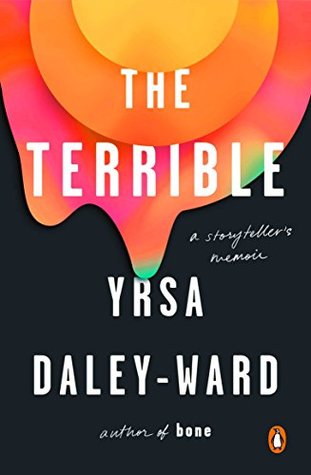
Review: The Terrible

36316300
Review for "The Terrible" by Yrsa Daley Ward (2018)

Rating: 4 out of 5 stars

This is a very unique memoir. It is written in prose, but large parts of it are written in verse. There’s no pattern to what the next page is going to be (a poem or prose), but that was perfectly OK. I was too wrapped up in the author’s words. Needless to say, I loved this book.

Yrsa Daley-Ward, author of bone, tells a very honest story about her life. Her and her younger brother grow up in a very strict, very religious Seven-Day Adventist household with her mother’s parents. With her father absent, her and her brother go to live with their mother later in her childhood. The relationship between her and her mother is dysfunctional as well. Eventually Ward drifts into a life of drugs, drinking, depression, and sex work. There is a lot of pain invoked in this novel, along with an exploration on inter-generational conflicts, pain not healed that is passed from parent to children.

I won’t tell you too much more about this book because I don’t want to spoil it. It is definitely worth your time to read it. Four stars.

Review: Convenience Store Woman

36739755

Review for "Convenience Store Woman" by Sayaka Murata (2018)

Rating: 4.5 out of 5 stars

Wow, I loved this book! Deceptively simple story, yet subversive to the core.

As a child, Keiko Furukura recalls that she was always an odd person, attracting disgust for her behavior. She doesn’t understand these reactions (in her mind, her behavior is logical), but knows that to be a ‘normal’ person, she must change. This change is achieved when, as an 18-year-old student, she is “reborn” as a convenience store worker. Keiko finds that the routine and the monotony of the job is perfectly suited for her. She takes enthusiastic pride in her work: always on time, working extra shifts, keeping her body in perfect shape for store work, just as the store manual instructs her to do. Keiko’s love for her job goes beyond obsession–it is literally her religion, her only desire.

18 years later, Keiko is 36 and still working at her beloved convenient store. She has learned to appear ‘normal’ to friends and family by observing store colleagues and imitating their speech styles and dress. She finds it harder to field the concerns of friends and her sister, who don’t understand why, at her age, she has still not married or gotten a ‘proper’ job. Eventually Keiko does decide to go for ‘normal’ in her love life, and the results are not what she intended.

This is a short novel (about 163 pages), but it packs a helluva punch. There’s a lot being said here about Japanese society and its crushing conformity, social pressures, as well as the peculiarities of what’s considered ‘normal’ behavior. There’s also the self-confessed ‘strangeness’ of Keiko, whose behavior throughout the novel had all of the hallmarks of someone on the autism spectrum (in my opinion), though this is never named. It’s also a love story, not with a person but with the order and routines of retail work. Keiko takes to this lulling sense of sameness like a fish to water. Of course it makes sense that Keiko, who has no other desire but to be ‘normal,’ doesn’t want to do anything else but stock pork dumplings and set store displays five days a week. Of course.

Ya’ll have to read this book. I will go so far as to say that it’s probably one of the best reads I’ve read so far this summer. 4.5 stars.

Review: The Best We Could Do

29936927
Review for "The Best We Could Do" by Thi Bui (2017)

Rating: 4.5 out of 5 stars

When I finished reading this on a Saturday morning at 3:20 am, I cried like a baby.

The Best We Could Do is a beautifully drawn graphic novel that completely hooked me from the first few pages. In it, the author Thi Bui begins her journey as a first time mother, seeking to understand the complex political and personal history of which she is a part. She talks to her parents, Vietnamese immigrants who came to America in the aftermath of the Vietnam War, as well as her brother and sisters to construct a story that’s engaging and unique.

This story is not linear, there are various dates and timelines before, during, after the Vietnam War jumping all over the place. It’s quite alright, the complicated nature of the story necessitates this format. The story of the author’s life begins in pre-war Vietnam, with the lives of her parents. They meet, marry, and have six children, two of which don’t survive infancy. They struggle through poverty, war, and conflict going on around them until they decide to escape by boat to a refugee camp in Malaysia. After several months they find themselves in America, living in the Midwest. The cold eventually forces them to California, where the author spends the rest of her childhood.

The story doesn’t end there, however. There are struggles with assimilation in a new country, of a family navigating the waters of what it really means to be ‘American.’ There is also the hauntings of the ghosts of the past, which Thi Bui attempts to rectify through this book.

With the current rhetoric going on right now around immigration and who or what is considered “legal,” I felt it was necessary to read this book. We hear about and see pictures of people coming to American soil by boat, by foot. Send them back home, they say. Children coming on their own, entire families crossing fences clearly marked “Keep Out.” Split them up and that’ll teach them. Yet they still come. They die coming here. Smart people will look past the fluff and the politics and attempt to understand their lives, the question of why they risk so much to come here in the first place. This book is a good place to start in explaining the complexities of human location and the desperation it can breed–and why legality is a small price to pay when your life is a living hell and your children won’t make it past their 12th birthdays. Deep questions with no answers. How can you go home when there’s literally nothing to go home to? This book will help you understand that.

For those that don’t like graphic novels, I would recommend that you give this book a try. It is so revelatory and timely that one would be surprised. Four and a half stars.