Review: Where the Dead Sit Talking

35663633

Review for “Where the Dead Sit Talking” by Brandon Hobson (2018)

Rating: 4 out of 5 stars

Set in late 1980’s rural Oklahoma, “Where the Dead Sit Talking” is the sad, dark tale of a 15-year-old Native American teenager named Sequoyah, sent to live with a foster family after his mother’s imprisonment. From the outset of the novel, it is evident that Sequoyah carries many emotional scars, having dealt with his mother’s alcoholism and abuse in previous detention settings.

Harold and Agnes Troutt are also the foster parents of two other children: George, a younger, also emotionally damaged boy (his behavior strongly suggests that he’s possibly on the autism spectrum), and Rosemary, an older Native American girl with whom Sequoyah becomes obsessed. They bond over their shared heritage (he is Cherokee, she is Kiowa), smoking cigarettes in her bedroom at night and sharing their deepest secrets with each other. Their relationship is equal parts platonic and disturbing, with Sequoyah’s violent fantasies and obsessive thoughts of Rosemary taking up much of the novel.

This book has a very dark, brooding tone all throughout. There is no happy ending or ‘triumph’ by the main character. What is here is an unsettling silence at the heart of the story that betrays the notion that even though everything seems ok on the surface, it’s apparent that it isn’t. Despite the Troutts kindness and “good” intentions, they are powerless to stop the human catastrophe that simmers beneath the surface of their home. I think the author does a great job of depicting how even the most well-intentioned acts of goodness can be misdirected and to the complete detriment of the individual.

I highly recommend this book.
Review: I Stop Somewhere

29751533

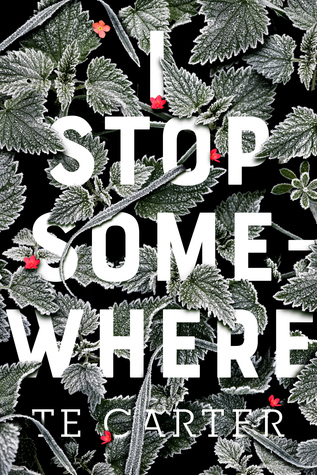
Review for "I Stop Somewhere" by T.E. Carter (to be published on 28 February 2018)
Rating: 2 out of 5 stars

I didn’t like this book. It’s kind of a mashup between “The Lovely Bones” and “13 Reasons Why,” neither of which I liked either. I read this fairly quickly, not because I was engaged with it, but out of desperation to get it over and done with.

Ellie is a quiet, shy teenage girl in a small New York town being raised by a single father. She comes from a working class background and quickly becomes enamored with a wealthy local businessman’s son, Caleb. From frequent flashbacks, we know that Caleb is not what he seems. He is cruel and sadistic, as well as the main perpetrator in a string of brutal assaults and rapes of local girls, one of which ends Ellie’s life.

The first 100 pages of this book are unbearable. Ellie is a spirit, trapped in the location of the last moments of her life, watching from the afterlife as girl after girl is taken to the same abandoned house and brutally assaulted and raped. She drifts back and forth between each act of violence she witnesses to narrate events in her former life, which quite frankly, doesn’t have much plot depth or character development.

Let’s pause and talk about this for a moment. This is one of my greatest pet peeves in fiction–authors who overemphasize rape and acts of violence through excessive narrative detail, with very little to no character development (the film equivalent to this is known as “torture porn”). It’s gratuitous, it’s voyeuristic, and worse, it does absolutely nothing to challenge the rape or the rapist, nor does it shift power in favor of the victim. You cannot conquer rape culture or violence through “torture porn”- style writing. It only serves its own end, which is to capitulate on the sexist notion that to keep people interested, women must die or be somewhere in the act of dying. It’s wrong.

Thankfully, the tone of the book does shift in the second part, which turns to the voices of the victims. There is a kind of reckoning in the end that’s somewhat hopeful, along with a thoughtful commentary on victim-blaming and why Ellie’s disappearance was ignored for so long (i.e., she’s from a lower social class and not from the “better” side of the tracks). I still don’t like this book though. Even though the sun does comes out in the end, there was too much bleakness, too much of a lingering dark cloud here. If I hadn’t have read the first part I think I would have felt better about it, or maybe even given this a higher rating.

This book is categorized as YA, btw. If I was troubled greatly by reading this, I cannot imagine what it does to the psyche of a younger person, who may or may not possess the insights to deal with this level of realism. Proceed with caution.

[Note: I received an advance digital copy of this book from the publisher and NetGalley, in exchange for an honest review.]

Review: Brass

34837009
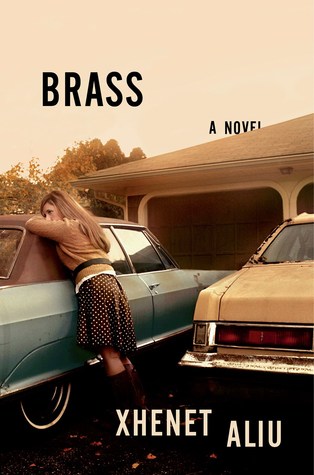
Review for "Brass" by Xhenet Aliu (2018)

Rating: none (DNF)

DNF. Got to about the 35% mark before deciding not to continue.

In the 90’s, Elsie is a working class teenage waitress who falls for a married Albanian cook at the diner where she works. In the present day, her daughter, Luljeta, gets an rejection letter from NYU. The novel is told in the dual perspectives of both mother and daughter, living and loving in the their working class Connecticut town.

It’s not the writing here–it’s actually quite gorgeous. It’s just the story itself that I didn’t find very compelling. I kept putting the book down after several pages or so and coming back to it, not quite remembering what had happened before. It then occurred to me that perhaps this story is less about the plot and more of a character study–which is fine, but I think that sometimes that approach has its drawbacks, the down side being that I couldn’t seem to get into the characters either. The 2nd person perspective of the daughter also threw me for a loop. Instead of drawing me in, it completely distanced me from her story.

I may try this book again at a later time. For right now, though, I’m going to have to pass on this one.

Review: My Name is Venus Black

35340556

Review for "My Name is Venus Black" by Heather Lloyd (to be published on 27 February 2018)

Rating: 2 out of 5 stars

Meh, I didn’t care for this book.

“My Name is Venus Black” opens with 13-year-old Venus locked up for a crime that she refuses to elaborate on. For the sake of not spoiling the novel I won’t tell you what the crime is either, other than to say that she spends a little over five years in a juvenile facility for it. During Venus’ incarceration, her younger brother Leo, who is developmentally disabled, is kidnapped by a family member (this is not a spoiler–part of the novel is told from his perspective). Her mother Inez, with whom Venus has a contentious relationship, blames her for Leo’s disappearance and the police do not succeed in locating him. Eventually, Venus emerges as an adult from juvenile prison. She proceeds to get a fake name, a job, rents a room in a boarding house, and tries to acquire some sense of normalcy. She does not get past her longing to find her brother, which grows as the story goes on.

This is a novel about moving on from the past and finding forgiveness. There are problems here though, and none of them have anything to do with the plot. First, this book has an identity problem. The publisher is clearly marketing it as literary/general fiction, but the tone, characterization, the language (and yes, the plot) very much read like a YA novel. Not that I have a problem with YA–I love YA–but this book does not seem as if it were written for adults. As a matter of fact, I could put this book and pretty much any YA novel out right now side by side and find about 10 points of similarity to rest my case on. The categorization of this book seems like an glaring error, like maybe it was originally intended as YA and someone stuck it in the general lit category at the last minute.

There’s also strange shifts in points of view here. Venus’ POV is always first person, but everyone else’s thoughts are presented in a third person omniscient voice, which changes often–sometimes in the same chapter. And oddly enough, at least 3 of the perspectives told consistently here are of adults. Which brings me back to the genre problem I was just talking about. Could it be that some editor made a suggestion and stuck this in the general lit category just because of the inclusion of adult perspectives? If so, that was an ill-advised decision.

And oh yeah, the ending. The details of Venus’ crime aren’t revealed until the last few pages of the book. By then, with all the hints dropped, I pretty much already knew what had happened anyway. This delay seemed unnecessary, like bad suspense. The end was also kinda Lifetime movie-ish. You know, like when you’ve watched the drama go down and then all the so-angry-at-each-other characters end up sitting around drinking lemonade together while the credits roll? Zzzz.

Overall, it’s not a bad book, but there were too many issues here to give it more than 2 stars.

This book has a pretty cover. I like stars.

[Note: An advance electronic copy of this book was provided to me by the publisher, Dial Press, as well as NetGalley in exchange for an honest review.]

Review: Annihilation

17934530

Review for “Annihilation” by Jeff VanderMeer (2014)

Rating: None (DNF)

I DNF’d this at about 50% percent.

I have to admit that this novel did spark my curiosity at first. The setting has a definite creep factor and it fits squarely in the sci-fi genre, two things that I like. As far as the story itself, “Annihilation” is about four women explorers–a biologist, a psychologist, a surveyor, and an anthropologist–commissioned by a presumed government agency known as the “Southern Reach.” The team is the 12th expedition to the area, all other efforts to explore the region have failed and ended in the deaths of the explorers. The names for the women are never given, they are only there to work together, explore Area X, and report back to the agency with their findings. The story, however, is told by the biologist, who writes her findings in a journal.

Immediately upon entering Area X you know that things are not what they appear to be. The land is uninhabited, though there is evidence that humans lived there. Upon entering, the team discovers a tower (or is it a tunnel?) that is not on the map, with strange plant-like spores and cryptic writing inside. The mystery of the tower (tunnel?) is obviously the crux of the book (there are pages and pages of descriptions about it, veering dangerously into Big Dumb Object territory) but it all got so boring that it just wasn’t enough to sustain my interest in continuing.

For the first 10%, I was willing to suspend my disbelief long enough to give this a chance but by the middle, it no longer seemed worth it. The characters have no real personality and are so frustratingly neutral that I was disengaged from about the 10% mark onward. For my time invested, I felt like all of the weirdness went nowhere. Hence, I stopped reading.

I probably will see the movie for this one, which is due in theaters in a few days. Though I am in the the “I Didn’t Get It” crowd, I’m still, in some ways, curious about the Area X mystery. I probably won’t read the rest of this series though to find out. I do want to know what it is, I’m not that damn curious. Not by a long-shot.

Review: The House of Impossible Beauties

35068748

Rating for "The House of Impossible Beauties" by Joseph Cassara (2018)
Rating: 4.5 stars

Aye, this book will simultaneously soothe your heart and break it into a million pieces.

“The House of Impossible Beauties” is a fictionalized account of the House of Xtravaganza, the first legendary all-Latinx ballroom house immortalized in the seminal 1990 documentary Paris is Burning. We follow a cast of gay and trans women performers on the Harlem ball circuit as they escape abusive homes, love and lose one another, and deal with the devastation of the early AIDS epidemic. Some of the characters are instantly recognizable from the the film (Dorian Corey and Venus Xtravaganza, for starters) while others appear to be composites of other known characters in the film.

I loved the beginning of this book, which starts in 1979. Angel is a young Puerto Rican teen who realizes that she is transgender. She feuds often with her mother, who refuses to accept her for who she is. She is taken under the tutelage of a well-known local drag queen, Dorian, and later falls in love with Hector, a dancer. Hector eventually recruits Angel to start their own house in the ballroom scene and the iconic House of Xtravaganza is born. Back stories are also given for other house members–Venus Xtravaganza, a trans girl who escapes a miserable home life, Juanito, an abused gay teen with a knack for sewing beautiful clothes, and Daniel, a banjee boy with major issues.

While the beginning of the book pulses with energy, the middle of it is terribly dull, veering dangerously close to misery porn territory. There is no way this should be so, given the vibrant real-life characters that this book is based on. I also have issue with the fact that, other than one scene in the middle of the book, we never actually SEE the inside of a ball. This is unacceptable. For a book that claims to be so much about the key people of this particular fashion and dance era, shouldn’t we be at the ball with them too? I’m outraged.

*flips hair*

If you’re familiar with Paris is Burning, then you know that most of the individuals featured in it are now deceased–mostly casualties of the AIDS epidemic, and, in one case, murder. Thankfully the author handles this and other subjects surrounding them with care and a compassionate heart, which shows in the writing.

Also: to those who haven’t seen the documentary Paris is Burning, please do. It’s on Netflix and YouTube, the last time I checked. Whether or not you see it before reading this book is your choice, but I think that the film serves as a good companion piece to this novel. The film grounds you in the knowledge and illuminates the characters of the ballroom scene, while the book gives you the back story of their lives.

Needless to say, I love this subject too much to give it a bad rating. 4.5 stars, dahlings

Review: Freshwater

35412372

Review for "Freshwater" by Akwaeke Emezi (to be published on 13 February 2018)

Rating: 5 out of 5 stars

Wow.

I have no better way to start this review, so I’ll say it again: Wow.

Reading a novel like “Freshwater” was a completely new experience for me. To step into its pages was to venture into a beautifully strange, dark world, the realm of something amazing: ancient gods, beauty, life, death. “Freshwater” is also the world of a young woman’s troubled mind.

Ada, whose life is the focus of the story, is just one of the characters here. She is conjured through her father’s prayers and born into a middle-class Nigerian family with “one foot on the other side.” Early on, you come to realize that the ‘side’ is the spiritual realm and the ‘foot’ that the author is referring to is a pathway through which primordial gods freely enter and inhabit Ada’s physical body. Much of the story is narrated by these gods, who are birthed and rebirthed several times and call themselves “we” throughout the novel. Also present in Ada’s body are two distinct spirits: Asughara and Saint Vincent, the former being the more powerful of the two. As Ada grows older, Asughara begins to control more of her actions and her voice fades into the background. Very little of the book is narrated by Ada, she lives instead through a smaller, fractured self.

The spirits that inhabit Ada’s body desire to pass back over to the other side–the only limitation being that they are attached to Ada’s physical self. As the book progresses, Asughara, Saint Vincent, and the “we” become protectors to Ada, taking over when the current situation and/or the people in her life are too much for her to handle. They also push her to dangerous extremes. I loved the way in which this book completely detaches you from what you think you know about mental illness and cleverly uses spirituality to frame the narrative instead. Through Ada’s ‘spirits’ multiple themes are explored: racism, addiction, self-mutilation, gender nonconformity, and religion, among others.

There is a brutalness in this writing that comes through in the multi-layered narration the author has chosen for this book. In the end, this is a book about coming into one’s own voice, despite what that voice says and how many lives it has lead in the past.

This is not light reading, folks. Come to this novel prepared to underline passages, expand your mind, and think outside of the box. When I arrived at the end of this book, I realized that there was nothing I had previously read that I could rightfully compare this to. “Freshwater” stands on its own as a creative work that is uniquely beautiful. It fights labels and categories, it truly stands in a genre by itself.

Five stars.

[Note: An advance electronic copy of this book was provided to me by the publisher, Grove Press, as well as NetGalley in exchange for an honest review.]

Review: Green

34927956
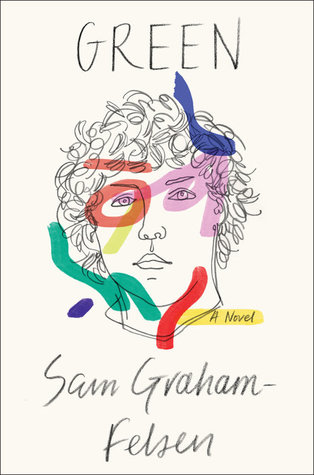
Review for "Green" by Sam Graham-Felsen (2018)

Rating: none

No rating. I DNF’d this. I just couldn’t take the main character anymore. And it’s totally not the character’s fault, he’s a 12 year old boy. The tragedy of this one is 100% on the author.

David Greenfeld is a white, middle class kid living in Boston in 1992. His Jewish, hippie parents are gentrifiers, living comfortably on the borders of a mostly Black housing project. They decide that Dave should go to the local middle school instead of a private school to be exposed to all of life’s “perspectives.” Dave explains all of this in the first few pages of the book, and I admit that his POV interested me immediately.

As far as Dave himself goes, he is socially inept, attempting to survive in a school environment where he is an outsider. His younger brother does not talk (there’s a strong suggestion that he’s on the autism spectrum) and his parents refuse to buy him the latest clothes. He succeeds in getting his Mom to buy him a trendy Charlotte Hornets tracksuit, only to get robbed near his neighborhood. He’s teased about the robbery at school. He eventually takes up with a black student named Marlon, and they bond over their nerdiness and love of the Boston Celtics. Both want to get into prep school. Dave learns, however, that race and class are far more powerful forces in his friend and his own life than he imagined.

So let’s get to why I DNF’d this. THE LANGUAGE. Dave speaks with a over the top, 90’s hip hop slang that’s reminiscent of corny minstrel movies such as “Malibu’s Most Wanted.” Clothes are “gear,” items are “rocked,” shit is “wack,” girls are “shorties,” and so on. It’s all over the book, even Dave’s thoughts are presented this way. It has no authenticity whatsoever. I was in the 8th grade in ’92 and I don’t remember the slang we used being as pervasive as this book makes it out to be, to the point to where it was in every. single. line. of our speech. I can certainly understand what the author was TRYING to do by showing us that Dave is trying too hard by performing what he thinks is a display of “blackness,” if you will, but it’s just too much. At first I skimmed, then I stopped reading after 200 pages. Plus it wasn’t like there was anything happening anyway (plotwise, that is) to compel me to read any further.

Also, even though this book is about a 12-year-old boy, it is not a YA book. You’ve been forewarned.

This could have been one of the most important books of 2018 had it not been for technicalities, namely, its language execution. Read at your own risk.

Review: A Kind of Freedom

33946142
Review for "A Kind of Freedom" by Margaret Wilkerson Sexton (2017)
Rating: 4 out of 5 stars

This is a really good book. Set in New Orleans, it’s a family saga that spans three generations and roughly about 70 years, from 1944 to 2011. There are three distinct third person narrators from each generation: Evelyn, the well to do daughter of a Creole family, Jackie, Evelyn’s daughter, and T.C, Jackie’s son.

Evelyn is a middle class girl from a family with high hopes. Her father is one of the first Black doctors to practice in the city of New Orleans. She falls for Renard, a sincere but working class man who her parents strongly disapprove of. Their disapproval continues even as he goes off to fight in WWII. The second story is that of Jackie, Evelyn and Renard’s youngest daughter. The year is 1986 and although Blacks officially now have equal “rights,” low wages and lack of job opportunities is the catalyst that pulls Jackie’s husband, Terry, into crack cocaine addiction. The last story is that of T.C., Jackie’s son. As the story begins, he is being released from county jail for yet another criminal charge. He decides to make money for his upcoming son’s birth by selling home-grown marijuana. He soon discovers that leaving ‘the game,’ however, is a lot harder than he imagined.

There are three story lines in this book, and they switch back and forth. Because this was such a short book (less than 250 pages), there’s only plot and not much else. At the end of the day, I felt like I really didn’t get the depth with the characters I wanted. By the time I was reading one section, the switch was made and the time period and character had changed. Bummer.

This is a good book though, so I won’t go under 4 stars. New Orleans always makes a captivating tale, and Margaret Wilkerson Sexton is definitely a writer a watch.

Review: Good Me, Bad Me

25365530

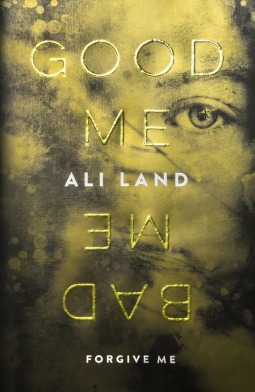
Review for "Good Me, Bad Me" by Ali Land (2017)

Rating: 2 out of 5 stars

I finished this book a few days ago and gave it three stars. I’ve since lowered it to 2 stars.

Annie is a fifteen year old with a mommy who’s a serial murderer known as the Peter Pan Killer. After her mother lures nine children to their deaths in her home, Annie has enough and finally reports her mother to the police. She is given a new name, Milly, and promptly taken in by a foster family, a psychiatrist named Mike, his wife, Saskia, and their daughter, Phoebe. Supposedly only Mike knows Milly’s mother’s true identity, but this doesn’t make her adjustment to life after her ordeal any easier. From the start, Milly is an outsider in her new home and school and is targeted for bullying by Phoebe and her friends.

The story is narrated by Milly, who often addresses her mother throughout the novel. She wants to be normal, yet fears she is more like her mother than she cares to admit. She wants to stay with her foster family, though it is apparent that staying long-term will not be the case. Without giving away everything in this book, I will say that the narration here is a jumbled mess. Short sentences. Strung together. A bit like stream of consciousness. Kind of writing. But not really. Ugh.

The characters in this book are your stock actors: Saskia is a desperate housewife-bot who stays at home all day shopping and doing yoga and lacks any kind of maternal instinct, Mike is a goody-goody father who naively only sees the good in the people around him and plans to write a book about Milly’s case, and Phoebe is a mean girl and a rude, contentious bully. The bullying scenes were numerous and over the top and could have come from any YA book written in the last 15 years. At one point I put the book down, thinking: my god, what else is left to be done to this girl? I get the point that the author was trying to make, but 80% of this book just seems like one long episode of “Mean Girls.” Not impressive.

I did manage to get to the end of the book whilst skipping pages. Predictable, of course.

There is little graphic violence here, but that doesn’t make reading this any more enjoyable. Actually, it just prolongs the agony of reading it. All in all, this book isn’t suspenseful or as “gripping” as I had hoped.

[I received a free digital copy of this book from the publisher and NetGalley, in exchange for an honest review.]