Review: What Belongs to You

22929602

Review for “What Belongs to You” by Garth Greenwell (2016)

Rating: 2 out of 5 stars

LGBTQ lit is an area that I’ve really been wanting to branch out into, so this book has been on my watch list for a while. That and the fact that this book was on BuzzFeed’s “Best of 2016” novels list compelled me to read it.

“What Belongs to You” is the story of a privileged American man working in Bulgaria as a teacher. He meets a young, working class hustler named Mitko in a public toilet where he pays him for sex moments after they meet. They proceed to develop a very strange, codependent, and somewhat obsessive relationship over the next several months. The American is lonely and looking for real companionship, while Mitko sees nothing wrong with taking advantage of a free opportunity for food, money, and, at times, a place to stay. The story ends exactly how we expected it to end because ummm….what are you supposed to expect as far as future prospects when you pay a stranger for sex in a bathroom stall? I ain’t the most intelligent gal in the world, but my guess is that it’s just not going to go well. It’s no different here.

This book offered no surprises, only predictable cliches. Perhaps I’m in the minority, but this book bored me to death. It’s a pity, because the writing itself is actually VERY good, which is why I gave it two stars. The author knows the emotional weight of his words, and several statements in the novel were so profound that I found myself reading them aloud, underlining them, savoring them. The story, however, was completely lost on me.

I’m going to go out on a limb and say that I do recommend this book. If you don’t mind a predictable plot, the writing here will ‘wow’ you. Be forewarned though, there are some pretty graphic sex scenes–so if you’re a homophobic prude who’s offended by the intimate details of sex between two men, then don’t read this. My hope, however, is that if you are reading my site, you are an enlightened person who can read whatever is placed in front of you for its artistic merit and nothing more. Voila!

Review: Rikers High

6598812

Review for “Rikers High” by Paul Volponi (2010)

Rating: 2 out of 5 stars

Martin Stokes is a likable 17-year-old teenager who gets locked up in one of the nation’s most notoriously violent jails for “steering” (telling an undercover officer where to buy drugs) and is sent to NYC’s Rikers Island. Due to the terrible backlog of the city’s criminal justice system and his family’s inability to pay bail, he is forced to spend several months in custody until his case comes up and is heard by the judge. To make his situation worse, he becomes an innocent bystander during a scuffle between two other inmates and gets slashed on the face, physically scarring him.

Martin is eventually transferred to an area where he is forced to go to school, and it is here when the real action of the story begins. Be warned though, this book is filled with tons of “lock-up” slang that only those who have spent some time in a NY state correctional facility would understand. Even though the author does a decent job of explaining the lingo (a blurb on the back of the book says that he was a teacher on Rikers Island for several years), it still makes an awkward narrative. Riot officers who break up fights in housing units are “turtles,” solitary confinement is “the bing,” the dorms where youth are held are known as the “Sprung,” and members of violent gang crews are referred to as “doldiers” (a combination of the words ‘dummy’ and ‘soldiers’), and so on.

Even though you understand Martin’s plight, his character and everyone else’s in this book was really thin and undeveloped. Part of this may have actually been intentional, due to the fact that we as a society tend to view all prisoners as the worst of the worst, the literal “throwaways” of society. The problem though is that even though this is the case, it’s just not enough to help you care more about what’s going on with the characters here. It’s also woefully unrealistic: Martin, a young black male, serves his time, learns his lesson, goes back home and moves on. This is usually not the case in real life. As we all know, many young black men with a felony on their criminal record are more likely to eventually return to jail: mostly due to factors such as a lack of resources, low employment prospects, poor quality education, etc. Prison is a giant revolving door, and few manage to break this destructive cycle. I would think that the author would use this book to make a statement on the effed-up state of the criminal justice system, but I digress.

I do recommend this book for YA readers, specifically for teenage boys, who we all know are notoriously hard to engage in reading. It’s a fair cautionary tale, and even though I didn’t like it, they will.

Review: Daydreams of Angels

23848004

Review for “Daydreams of Angels” by Heather O’Neill (2015)

Rating: 2 out of 5 stars

So I love Heather O’Neill. If you haven’t read her novel ‘Lullabies for Little Criminals’ then you are sorely depriving yourself of great literature. She has another novel out which I have not yet read (will do this) but this book was available at the library first, so I dove right in.

‘Daydreams of Angels’ describes itself as ‘twisted fairy stories’ and that description is very accurate. There are stories about floating babies, talking bears, gypsies, and cloned Russian dancers. Most of them are flights of fancy (as I said earlier, there is a talking bear) but some feature real people and events. This book as a whole, however, was lackluster. Some of the stories I liked immensely: ‘Holy Dove Parade’ is about a girl member of bizarre cult who commits a crime, ‘Where Babies Come From’ is a weird grandmother’s version of natural events, ‘The Gospel According to Mary M.’ is modern story of Jesus’s life in middle school. Most of the stories though I didn’t really like and I struggled through, like ‘The Story of Little O,’ which I’m still not sure what it was about. Out of all 21 stories here I only liked about 5, the rest didn’t make much of an impression on me. The voice was too monotone, the plots too similar. All in all: meh.

I DO recommend reading Heather O’Neill, but don’t start here. Try reading “Lullabies for Little Criminals” and you’ll thank me for this later.

Review: What Lies Between Us

25663781

Review for “What Lies Between Us” by Nayomi Munaweera (scheduled to be published on February 16, 2016)

Rating: 4.5 out of 5 stars

It’s hard to quantify this book. There were parts that I loved, parts I hated. A novel that makes you run the gamut of these emotions, however, is probably a good one.

“What Lies Between Us” is the story of an unnamed narrator’s (we don’t know her name until the very end) journey from childhood to a prison cell, where we meet her for the first time. The novel is split into five parts–the first is the narrator’s comfortable life as a child of privilege in Sri Lanka, the second part is how she adjusts upon arriving in America. The last three parts deal with her adult life and the events that led to her shocking crime.

I won’t lie to you, now…the beginning of this book started off s-l-o-w. Once it did get interesting, though, I could not stop reading this book. The writing here is spectacular. Ms. Munaweera can definitely move you with words, and in that regard this book didn’t disappoint.

4.5 stars because there were some passages that could have been taken out, because they didn’t really propel the story forward. I won’t fuss too much about it though, this was a uncorrected/galley copy and it will probably undergo a final edit before publication.

But…I would definitely like to check out this author’s other novel. Ms. Munaweera is an author to watch.

[This book was given to me free, courtesy of NetGalley and the St. Martin’s Press in exchange for an honest review.]

Review: The Fishermen

22875103

Review for “The Fishermen” by Chigozie Obioma (2015)

Rating: 5 out of 5 stars

This is one of those books that you pick up and time stands still, because you’re so engrossed in what’s going on that nothing else seems to matter. I picked this up at the library on a Friday afternoon and sat right down on the couch there and dove right in, not realizing that an hour had passed and librarian dude was standing next to me, about to tap me on the shoulder to warn me they were about to close.

“The Fishermen” is the story of four brothers–Ikenna, 15, Boja, 14, Obembe, 11, and Benjamin–who is 9 years old when the story begins. The novel is told from the point of view of the youngest child, Benjamin, who looks up to his brothers and decides to join them when they begin skipping school to fish at the local river. At the river they encounter an outcast, a local madman who makes a terrifying prophecy: that Ikenna will be murdered by one of his brothers.

From this point onward, nothing is ever the same. Each of the brother’s fates change for the worst and the entire family as a stable unit gradually becomes undone. But this is more than just a retelling of the Biblical story of Cain and Abel, this book has all of the complexities of a Shakespearean tragedy. There is a lot of violent imagery in this novel, coupled with beautiful words that I found myself going back and reading over and over again. There are also thoughtful references to the work of Chinua Achebe, and one can’t help but to read this book as an allegory of the African continent–ravaged from the outside and left to corrode through corruption, greed, and other inside forces.

When I checked the Internet for some info on this book I saw that it had been long-listed for the 2015 Man Booker Prize. I do hope it wins a major prize, it’s really that good. Loved this, A+

Review: Cutter Boy

27788155

Review for “Cutter Boy” by Cristy Watson (to be published in September 2016)

Rating: 2 out of 5 stars

As I’ve said earlier, the 10 years I spent as a 7th and 8th grade Language Arts teacher guides my reading choices. In addition to simply liking the genre, I often I select YA books to see how they deal with particular issues in our society. This was one such book. Right now I’m undecided about this. Three stars is out of the question, two is being generous here.

The rundown: Travis is bullied in school and ignored by his parents at home. Cutting himself with a razor blade is the one way he finds relief from his anguish and a way to control his pain. He becomes friends with a girl at school, Chyvonne, and eventually reveals his secret to her. Inspired by an unconventional teacher and his new friend, he eventually takes up the art of paper cutting as a way to avoid harming himself.

While I appreciate the author’s attempt to write a book about boys who self harm (an important subject that doesn’t get written about much) the ending seemed forced and terribly unfinished. The suggestion that art is a better form of therapy than cutting is suggested as a resolution here, but further details beyond this are left out. For such a large problem that cutting can be for a person, the resolution here just seemed too convenient, too simple. I am not a person who self harms, but I do know people who do. Pushing a piece of paper in front of them to cut instead of their bodies is an interesting prospect, but hardly a ‘solution’ to resolving the anger, pain, and depression that drives them to cut in the first place. I also did not like the way that the act of cutting was romanticized either. We don’t need to read about “beauty” swirling down the drain, or the smooth surface of a razor being “like ice, like glass” to understand what you’re referring to. These are tired, boring metaphors that don’t really portray cutting as the harmful action that it truly is. Like just...stop already.

Character development is also lacking here, big time. Travis, Mom, Dad, Chyvonne, and “the twins” (Travis’ sisters) all seem to move about this story with no real solid sense of purpose. I still don’t feel like I know anyone any better than I did when I first started. For a book that aims to engage reluctant readers, this book succeeds, but that’s about it.

[Note: I received a free publisher’s copy of this book courtesy of NetGalley in exchange for an honest review.]

Review: Far From You

20517739

Review for “Far From You” by Tess Sharpe (2014)

Rating: 3 out of 5 stars

I didn’t like this as much as I probably should have. On the surface, it is quite perfect: a contemporary YA novel in which the main character is a bisexual teenage girl fighting an addiction to prescription pain meds, the suspicion of her parents, and solving the murder of her best friend. I should have been impressed. But I was only half-thrilled.

This is the story of Sophie, a teenaged girl living with her parents who is sent involuntarily to rehab after the murder of her best friend, Mina. She is clean at the time of the event, but because she is a recovering addict and cops found pills in her jacket at the scene of the murder, her parents and the rest of the community assume that the two girls got themselves in trouble, caught in a drug deal gone bad. Once she gets out of rehab, Sophie goes about solving the murder of her best friend and clearing her and her best friend’s name.

The book switches a lot between Sophie’s past, where we learn she was seriously injured in a car crash (her injuries are the reason for her subsequent painkiller abuse) and her present, where she tries to live with the trauma of losing her best friend. While I understand the author’s intention, every time the ‘time’ switched I almost felt like I was reading another, separate book. The novel moved from past, to present, to further past, to furthest past, back to present, back to further past, etc. Although there was a label whenever this happened (i.e., “two years back,” “now/June”), it was not a very cohesive narrative here at all. I am not arguing that this book need be presented chronologically, but the back and forth here was more of an annoyance than anything else. Add in the current murder mystery plot and it seemed as if there was way too much here being juggled at once.

Despite my problem with the logistics of the story, I did actually like the main character here. Sophie is strong, outspoken, and a survivor. This is also the first YA novel I have read with a bisexual female main character. I thought that Miss Sharpe did an excellent job with this–the character’s sexuality never overshadowed the narrative, and the narrative never overshadowed character’s sexuality–somehow these two components synced up and worked together perfectly. After reading the novel, I could totally understand how Sophie loved Mina and also had relationships with boys. In today’s society where a lot of teens are discovering their sexual identities, I thought the author’s choice to present a character in this way was a bold move, and a good one.

I must say, though, that the ending was kind of anti-climactic. You get to the end and you’re just like: really? As several other reviewers have pointed out, the larger point here did not even seem to be the answer to the whodunit, but the way Sophie handles life after trauma. All of which is cool, but why call this a mystery if the mystery wasn’t the point to begin with? Hmmm.

Solid 3 stars here. Read with caution.

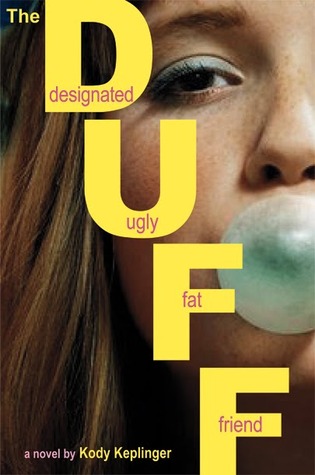
Review: The DUFF: Designated Ugly Fat Friend

6931356

Review for “DUFF: Designated Ugly Fat Friend” by Kody Keplinger (2010)

Rating: none (did not finish)

DNF, dah’lings. Around page 55, I think.

I could practically feel my brain cells shrinking as I read this.

Bianca is senior in high school with a mega-crush on another very-taken classmate named Toby. She hangs very closely with her gorgeous and very beautiful friends, Jess and Casey, and is eventually appointed as the DUFF (Designated Ugly Fat Friend) by a hot guy (more like a man-whore, if you ask me) named Wesley Rush. Bianca hates Wesley because he’s the one who designated her as the DUFF in the first place, but eventually she starts to like him.

I stopped reading here.

I won’t criticize this book. It is YA, written for a teen audience, so obviously their tastes are totally different than my 30-something tastes. But Jesus, even when I was 17, this book would have been trash-worthy. It’s nothing in particular I can bitch about here, it’s just way too ‘trendy’ for my liking. It’s like one of those wildly popular, annoying songs that come on the radio every 10 minutes that defy any rational sense because it has the same IQ as a watercress sandwich. So you sing along to the chorus ad nauseam and hope it passes quick. God, I hope it passes quick…

Book Q&A Monday, Part 1

Every Monday, I’m going to start posting the answers to 5 questions about reading that I’ve gleaned around the net. In the process I hope that you will get to know me more as a reader, as well as the reason behind the choice of books I choose to review here.

Best sellers or no?

As with most readers, I am into popular fiction. If a book is on the best seller list, or people continually rave about it, I am generally obliged to look it up, read a review on it, and see if it’s something I’m interested in. If it doesn’t sound interesting to me, I won’t read it–and I don’t care if God or Oprah herself said it is a great book.

What are my literary interests?

I like literary fiction, I like YA. I love ethnic writers–Asian fiction, African American writers, Caribbean writers, Latin writers, Middle Eastern writers. I feel like reading is all about discovering some kind of mystery or the perspective of another person whose life is not like yours. I am always fascinated by the stories of marginalized people–the poor, the incarcerated, the mentally ill, the people with special needs–people whose voices the mainstream completely disregards. If your book choices always make you feel good, then you’re probably doing it all wrong. If you believe writing has to take risks, and it does, then your reading has to do that too. Or else you ain’t learning much.

What book have you never read and never will?

I have never, ever read a Harry Potter book (which is strange, because my son loves Harry Potter). I’ve never read any of the Hobbit series either. I have nothing bad to say about either, it’s just not my kind of story.

Favorite classical works?

I love Shakespeare. My favorite play is Hamlet, followed by Romeo and Juliet, Julius Caesar, Macbeth, Troilus and Cressida, Othello. I also love love love Edgar Allan Poe.

Book I’ve read the most number of times?

Ntozake Shange’s “for colored girls who have considered suicide/when the rainbow is enuf.” Every time I read that book I make a tally mark and write the date in the front cover. So far there are 8 dates in that book that go back about 10 years.

Review: Sputnik Sweetheart

397165

Review of “Sputnik Sweetheart” by Haruki Murakami (originally published in 1999, translated into English and published again in 2002)

Rating: 2 out of 5 stars

First off, lemme say that this wasn’t a bad book. Like other online reviewers have previously stated, I too think that the reason that I didn’t rate this book higher is because I’ve read too many Murakami books already (this one, Colorless Tsukuru Tazaki and his Years of Pilgrimage, Norwegian Wood, After the Quake).

Murakami’s books are definitely an ‘acquired’ taste. One of the most frequent complaints about his writing is that it is dreadfully boring, but therein, in my opinion, lies the magic. Guys, this man has the power to make a damn phone book sound interesting. His characters are usually lonely men with well-paying jobs living with some kind of unrequited sexual desire, along with highly detailed minutiae of their lives. I am continually mystified by his ability to craft the ordinary written word into the extraordinary, because any other writer that would dares to write a book with subject matter this simple I would have stopped reading in 5 minutes flat.

So the basic outline of “Sputnik Sweetheart” is this: K is a lonely schoolteacher stuck in the friend zone with Sumire, a quirky wannabe novelist who’s currently in a writer’s block. Sumire falls in love with Miu, an older businesswoman, and eventually accompanies her on a trip to Greece. While in Greece, Sumire disappears, and K is left to discover through her writings what happened to her. He eventually concludes that Sumire will not return. The end.

There you have it again: same kind of character (K is a single guy, sexually frustrated up to the wazoo), same unrequited love issues (Sumire never gives him the time of day). I just think I’m tired of the parade of Murakami Manic Pixie Dream Girl characters this time. Sumire never seems to have a life of her own, beyond developing K’s awareness of well, whatever (still not sure of what, but hey). The ending is hopeless, as are most Murakami endings. I haven’t had enough of reading him forever, but for now I’m just…done this trope.