Review: A Lucky Man

36480133

Review for "A Lucky Man" by Jamel Brinkley (2018)

Rating: 5 out of 5 stars

This is one of the most profound short story collections I’ve read over the past few years. I say that with no hesitation, because let’s face it–most short story offerings these days ain’t that good, unevenly written at best. Very rarely are ALL of the stories in a collection readable and relatable pieces of literature. “A Lucky Man” is one of the few exceptions.

In this volume are nine stories, all featuring Black men and boys in the Bronx who are dealing with life and its societal pressures. There is a focus on masculinity here, specifically Black masculinity–how Black men view the women in their lives, their families, and how they justify their behavior toward them. There are definitely depictions of unhealthy relationships here, but it’s not just sexism on display. The nuances of what it means to be a Black man are explored here in a variety of different settings: in some cases, the choice to reject traditional “male” behavior has disastrous consequences, but in others, the character finds peace.

The powerful story “J’ouvert 1996” was my favorite in this collection, which tells the story of a young boy’s coming of age during an all-night street festival. “Everything the Mouth Eats” is the tale of two brothers’ healing of the past during a capoeira festival. “A Family” is about one man’s quest to come to terms with his actions, many years after a terrible act. “A Lucky Man” is an interesting exploration of public spaces and male desire.

Overall, this is a beautiful collection of tales. It is hard to believe that this is Jamel Brinkley’s first book, he writes with a talent that is rare and unique. I look forward to any future writing projects he has. Definitely recommend!
Review: There There

36692478

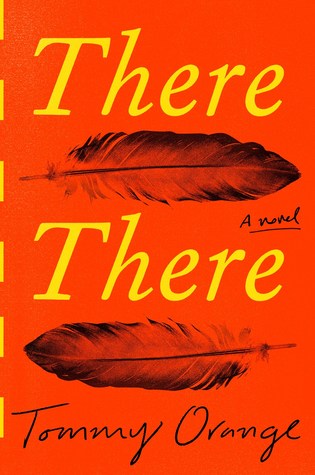
Review for "There There" by Tommy Orange (2018)

Rating: 4 out of 5 stars

Here’s a fact about me: whenever I see a book by a Native American author other than Sherman Alexie winning loads of critical praise, I’m going to read it. Tommy Orange’s There There is one such book–much praise, reviews in major publications. I reserved it months back and finally jumped on it when my copy came up on reserve at the library. I read this in about 4 sittings over a 4 day period.

There There is a unique narrative in that it explores a group that has never really been given a voice–urban Native Americans. In this novel, the characters come from various tribes and live in and around the city of Oakland, California. Orange writes about their search for identity and explores the ‘old’ problems that surround this community (alcoholism, domestic violence), as well as modern ones (cultural appropriation, loss of traditions, etc). The author uses an ensemble approach, telling the interconnected stories of various attendees headed to a local powwow.

Unfortunately though, this is a book loaded with problems. For one, there are about a dozen different perspectives in this book. Even though the same characters are visited over and over again leading up to the powwow, I felt there were far too many perspectives, too many voices here to keep up with. I kept having to look back at other sections to remember who was talking, and at about 50% into the book I gave up trying to connect all of the dots. You never really get to know any of these people before their 8-10 pages is over and it’s on again to another person. I would have much rather the author focused on less people and fully fleshed out his characters more.

Also, I didn’t feel the writing was anything to write home about. The dialogue was bland, the descriptions too stripped back. A lot of telling, as my creative writing teachers would say, and not enough showing. In many places, a person’s entire life was contained within less than 5 paragraphs. It seemed too rushed, like a false start. In other places the writing was mad awkward, like the two times we’re told that a character has his head “on a swivel.” (*eyeroll*)

The ending is anti-climatic and the book simply just…ends. It’s weird. We’re never told what happens to any of the characters. I just turned a page near the end, and that was it.

Strangely, the prologue to this book was quite beautiful. It’s a thoughtful meditation about the attempted genocide of indigenous people, told historically and figuratively through the motif of the infamous Indian-head test tv pattern. I was kinda disappointed when this part was over, ’cause I could have read this for another 50 pages. It’s never OK when the prologue is better than the story, but I’ll digress here.

As much as I didn’t really care for this book, I won’t go lower than 4 stars. There is a story here, somewhere in the rubble of all of this. I respect what Tommy Orange is attempting to do by giving us an alternate perspective of Native American life that’s outside of the images of dusty reservations and old stereotypes. I just don’t think this was executed well. This is his first book, however, so the structural issues are forgivable.

I definitely recommend this book, perhaps you’ll like it more than I did.

Review: Convenience Store Woman

36739755

Review for "Convenience Store Woman" by Sayaka Murata (2018)

Rating: 4.5 out of 5 stars

Wow, I loved this book! Deceptively simple story, yet subversive to the core.

As a child, Keiko Furukura recalls that she was always an odd person, attracting disgust for her behavior. She doesn’t understand these reactions (in her mind, her behavior is logical), but knows that to be a ‘normal’ person, she must change. This change is achieved when, as an 18-year-old student, she is “reborn” as a convenience store worker. Keiko finds that the routine and the monotony of the job is perfectly suited for her. She takes enthusiastic pride in her work: always on time, working extra shifts, keeping her body in perfect shape for store work, just as the store manual instructs her to do. Keiko’s love for her job goes beyond obsession–it is literally her religion, her only desire.

18 years later, Keiko is 36 and still working at her beloved convenient store. She has learned to appear ‘normal’ to friends and family by observing store colleagues and imitating their speech styles and dress. She finds it harder to field the concerns of friends and her sister, who don’t understand why, at her age, she has still not married or gotten a ‘proper’ job. Eventually Keiko does decide to go for ‘normal’ in her love life, and the results are not what she intended.

This is a short novel (about 163 pages), but it packs a helluva punch. There’s a lot being said here about Japanese society and its crushing conformity, social pressures, as well as the peculiarities of what’s considered ‘normal’ behavior. There’s also the self-confessed ‘strangeness’ of Keiko, whose behavior throughout the novel had all of the hallmarks of someone on the autism spectrum (in my opinion), though this is never named. It’s also a love story, not with a person but with the order and routines of retail work. Keiko takes to this lulling sense of sameness like a fish to water. Of course it makes sense that Keiko, who has no other desire but to be ‘normal,’ doesn’t want to do anything else but stock pork dumplings and set store displays five days a week. Of course.

Ya’ll have to read this book. I will go so far as to say that it’s probably one of the best reads I’ve read so far this summer. 4.5 stars.

Top Ten Tuesday: Kick Ass Graphic Novels

Another strange Top Ten Tuesday topic is official today, it’s “Series I’ve Given Up On.” I don’t read serial fiction much anymore, so this topic isn’t for me. There was a time, though, as a young grasshopper when I was obsessed with Sweet Valley High, Nancy Drew, and The Babysitter’s Club, but we won’t talk about that, will we?

I’ve decided to explore some graphic novels today. Whether you call it a graphic novel or a comic book, I find the medium to be highly underrated. There is always a visual element to storytelling, and some authors/illustrators are doing it quite well. The following graphic novels I’ve either read or have been on my radar for a while:

Top Eleven Kick-Ass Graphic Novels

  1. Maus, Art Speigelman. Maus is probably one of the best graphic novels ever produced, nearly 25 years after its first publication. It’s the story of the author’s father’s experiences during the Holocaust, told through very brilliantly drawn cartoons. Even though the Jews are represented as mice (the Nazis are cats), you still cannot help but to be deeply moved by it. When I was a classroom teacher I used to read this with my 7th graders and they loved this book.
  2. Persepolis, Marjane Satrapi. Another classic graphic novel all about a very precocious girl growing up during the Iranian Revolution of the late 1970’s and 1980’s. She’s feisty and definitely not your typical “little” girl narrator.
  3. Waltz with Bashir, Ari Folman and David Polonsky. A story of a soldier’s repressed memories during the 1982 Israeli invasion of Lebanon. The soldier follows up with various people who were in the conflict, trying to fill in the holes in his memory. The story is never completely there, but this is still a fascinating book.
  4. Deogratias, Jean Phillippe Stassen. A graphic novel about the Rwandan genocide. I didn’t like this book so much, there’s a lot of switching back and forth through time and I found the narration too confusing to follow. I do, however, recommend that you read it if you’re into graphic novels and form your own opinion on it.
  5. Diary of a Teenage Girl, Phoebe Gloeckner. I wrote a review for this book and you’ll find it here. Fashioned as a diary, this is a graphic novel about a 15-year-old girl growing up in the 70’s who begins having really creepy sex with her mom’s 30-something-year-old boyfriend. This relationship is not presented as grooming or pedophilia, but one in which the main character actively and happily takes part in. It’s disturbing, but it’s a book that provokes a level of thought that I didn’t think was possible.
  6. Rent Girl, Michelle Tea. Kinda funny but not-so-funny graphic novel about a lesbian’s adventures as a sex worker for mostly male clients. Totally raw and terrifying.
  7. Zahra’s Paradise, Amir. This one I haven’t read yet, though it’s on my radar. It’s about a protester’s death during fraudulent elections in Iran in 2009. The death was captured on social media, and this book is a fictionalization of this story.
  8. Yummy: The Last Days of a Southside Shorty, G.Neri. I also wrote a review for this book and you’ll find it here. Graphic novel that revisits the true story of Robert “Yummy” Sandifer, an 11-year-old child who died in Chicago in 1994. A member of a gang, he racked up 23 felonies and 5 misdemeanors before carrying out a violent hit, which mistakenly ended the life of a 14-year-old girl. Several days later, Robert was murdered by members of his own gang who feared he was an informant. It’s a meditation on inner city gangs and violence without sounding preachy. Gorgeous drawings too.
  9. Nat Turner, Kyle Baker. This one’s on my radar. It’s all about the 1831 Virginia rebellion led by Nat Turner, a slave who, upon hearing a voice from heaven that instructed him to do violence, rose up with a group and killed 55 slave holders before being captured and hanged. Even though don’t like the fact that it takes much of its info from William Styron’s Confessions of Nat Turner (a bogus, historically inaccurate account), this one’s still worth a read.
  10. The Best We Could Do, Thi Bui. This one’s on my radar and currently in my possession. With all the news lately on refugees and immigration, I think it is completely fitting to read this graphic novel about a family’s escape from the war in Vietnam and their subsequent life in America. I’ll have the review when I finish it.
  11. That’s right. I have 11. Anyway, the last book is Black Hole by Charles Burns. I currently have possession of this book and will be reading it over the next few weeks. It’s all about those awkward years you spend as a teenager. It’s good and thick and a really dark read, but I’m liking it so far.

Ok, that’s it. Read more graphic novels, ya’ll. 

xoxo, Kellan

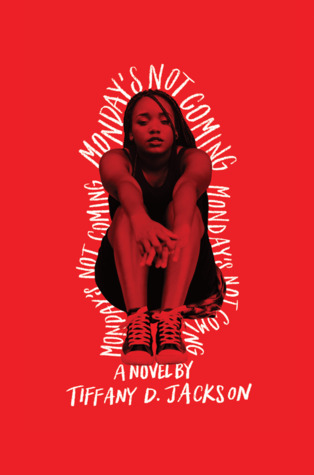
Review: Monday’s Not Coming

35068534
Review for "Monday's Not Coming" by Tiffany D. Jackson (2018)

Rating: 4 out of 5 stars

I’ll admit it: Monday’s Not Coming has been one of my most anticipated reads this year. I read this in a few days and I’m definitely giving this a solid 4 stars.

The story begins when Claudia, the main character, returns from a summer vacation to discover that her best friend Monday Charles has not show up for their first day of eighth grade. No one seems concerned. Claudia’s parents caution her not to worry, but she knows better. After several weeks pass, Claudia begins to ask around about her friend. The school says she hasn’t registered. Monday’s mom says that she’s with her father, Monday’s sister says she’s with an aunt. The police also dismiss her concerns, labeling Monday as a probable runaway. Despite the setbacks, Claudia is more and more determined to find her best friend as the novel progresses.

I loved the setting of this book, as well as Claudia’s character. Claudia resides in Washington, D.C., a city with predominantly Black residents. There are thoughtful explorations here of gentrification, the educational system, the child welfare system, as well as class tensions in Black communities. Go go music, the National Mall, and the Anacostia neighborhood are all very prominent “characters” here as well. I loved it all. Also memorable is Claudia herself, a very complex character. Monday is her only friend, but she represents way more than just a friend–she’s Claudia’s other half. Once Monday’s disappearance takes hold, Claudia’s dyslexia becomes more visible to those around her. She is compelled to take remedial tutoring, which she hates. Claudia also enjoys dance, but lacks the confidence to stand out.

The execution of this novel has some problems, though. This is definitely one of those “down the rabbit hole” kinda books, where nothing’s a given and you’re gonna go through some hoops before you get to the Big Reveal at the end. The hoops here are four timelines that run parallel throughout the book, labeled “Before” (events before Monday’s disappearance), “After” (events after we discover what happens to Monday), “Before the Before,” and “2 Years Before the Before.” It’s confusing. I understand Jackson’s use of ambiguity here, but all of the various timelines and events made this a muddled mess. There is a twist at the end, but by this time I was so lost in the mire of the timeline that I have to admit that the only reason I didn’t skip pages was because I genuinely wanted to find out what happened to Monday.

To tell you more about this book takes it dangerously into spoiler territory. It definitely shines for its fearlessness. It is one of the first YA books that I’ve read in which Black girl friendships are problematized and presented with the realness that they deserve. It is also one of the first YA books that speaks directly to the phenomenon of “Missing White Woman Syndrome,” the term first used by PBS News anchor Gwen Ifill to describe society’s tendency to treat the disappearances of young, affluent White women as media events with constant, around the clock national coverage, despite the fact that men, along with women and children of color, comprise the majority of missing persons cases. For Monday’s disappearance, no one joins a search party. Her picture is not in the newspaper. She’s not even on the nightly news.

4 stars. If you read nothing else in 2018, please read this. You don’t want to miss it.

Top Ten Tuesday: Summer TBR

I have a confession to make, ya’ll. I typically don’t do TBR lists. The reason for this is simple: I have a horrible reading attention span. I simply cannot guarantee that the books I tell you I’m going to read will be read in the allotted time frame I give. I am literally always looking at books–online, in stores, at the library, through emails I get, through requests. I just can’t say I’ll read x, y, and z during this month when the truth is I will probably find something else while randomly browsing the library one afternoon that will catch my interest.

I find that it’s best for me to base my TBR-isms on what’s currently on my shelf and in my Kindle with an expiration date or on reserve from the library. So here goes:

Books I’ll More Than Likely Read this Summer

1. How to Love a Jamaican by Alexia Arthurs (ARC, to be published on 24 July 2018). Short story collection from a debut author that promises to be really yummy.

2. Monday’s Not Coming by Tiffany D. Jackson (currently reading). I am floored by this book so far. Review forthcoming.

3. There There by Tommy Orange (currently on reserve). Debut fiction about urban Native Americans headed to a powwow. It’s gotten some good reviews and I’m curious about it, so I’m going to give this one a peep.

4. The Mars Room by Rachel Kushner (own a copy of this). Fiction book about an incarcerated woman. I’m interested where this one goes.

5. Dread Nation by Justina Ireland (currently in my Kindle). Kick ass Black girls and zombies. Sign me up and take my money…

6. A People’s History of the Vampire Uprising: A Novel by Raymond Villareal (currently on reserve). I told you: I love zombies, so this should be interesting.

7. The Terrible: A Storyteller’s Memoir by Yrsa Daley Ward (currently on my shelf; library copy). I loved her recent poetry volume, Bone, so this should be a great read.

8. Sick: A Memoir by Porochista Khakpour (currently on my shelf; library copy). A nonfiction account of the author’s long and expensive struggle to get a diagnosis for what is discovered to be late-stage Lyme disease. I have a sister-in-law with Lyme disease, and she nearly lost everything just to get a doctor to listen. I need to read this story.

9. Severance by Ling Ma (ARC, to be published on 14 Aug 2018). Interesting dystopian fiction read about a lady who loses her job while the end of the world is happening at the same time. Can’t wait to read this later this summer!

10. Fruit of the Drunken Tree by Ingrid Rojas Contreras (ARC, to be published on 31 July 2018). Fictional story set in Colombia at the time of Escobar’s violent hold on the country. Promises to be a great read by a debut author.

Ok, work in the morning folks.

xoxo, Kellan


Review: Heather, The Totality

34397044
Review for "Heather, the Totality" by Matthew Weiner (2017)

Rating: 4 out of 5 stars
From what I’ve glanced through on Goodreads, this is a book that people either completely loved or absolutely hated. I’m in the first camp, I think this book is fantastic. And no, it’s not because the author was one of the writers on two of my favorite shows, Mad Men and The Sopranos (though being a fangirl sho’ does help). I liked this book because it’s a pretty decent work of fiction.

This is a short book (less than 150 pages), more novella-like than a novel. There is very little dialogue, the story is told through third person narration of one of four characters. I can see where this annoys people because it reads more like a storyboard summary than a fully fleshed out, traditional novel. Either way, the quirks in the style didn’t bother me. I really dug this story.

Mark Breakstone lives the life that people dream about. He works in finance and lives in Manhattan in a spacious, expensive apartment. He marries Karen, a pretty social climber who shares his dreams of the good life. Shortly after their marriage, Karen becomes pregnant and gives birth to Heather, their beautiful and gifted daughter. So beautiful is Heather that both of her parents become obsessed with her, seeking to one-up one other in competition for her affection.

Meanwhile, the reader is introduced to Bobby Klasky. He is not beautiful or gifted or wealthy. He grows up in New Jersey, the son of a heroin addicted mother. He drops out of school and dabbles in petty crimes until he eventually goes to prison for assaulting a woman in his neighborhood. All the while we get a window into Bobby’s thoughts, which become more and more disturbing and violent as the narrative progresses.

It becomes evident early on that the paths of Bobby and the Breakstone family will eventually meet, and that the result will be a violent one. There is a sense of dread that starts in the first quarter of the book that’s played up skillfully until these four characters collide at the end. It’s good that this is a short novel so you don’t have to wait that long to find out.

My only complaint about this book is that the ending was a little too clean and convenient for my tastes. As I said before, there is a tension that’s played up, only to get to the end and it’s like: hmmm, ok. That was easy. None of the scenarios that I envisioned while reading this came even remotely close to what actually happened. A minor complaint. But still, ugh.

Four stars. Read this in one sitting, like you’re supposed to.

Review: We’ll Fly Away

35959354
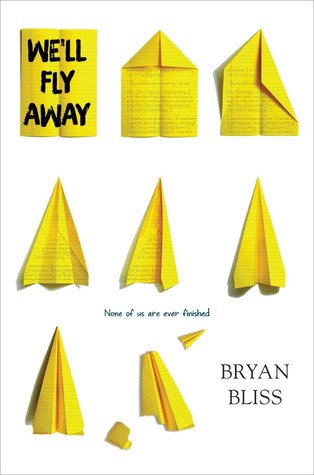
Review for "We'll Fly Away" by Bryan Bliss (2018)
Rating: 4 out of 5 stars

A very well written, hard hitting YA book.

“We’ll Fly Away” is the story of two boys, Luke and Toby, who have been friends for most of their lives. Luke, the stronger of the two, is an athlete who dreams of college success through wrestling, while Toby, aimless and a victim of his father’s physical abuse, relies on Luke to protect him. Both boys long to escape their rural North Carolina town (ironically, the setting of which is only about an hour away from me) and bond over a broken down airplane they discover in the woods as kids. Interestingly, the theme of flight is all throughout this book, even though it is apparent early on that neither of these boys are going anywhere. Escape, it seems, is only possible through death and/or violence.

When the story opens, we discover that Luke is in prison, writing letters of apology to his friend Toby. We are not told why he is on death row, but it is obvious that he is there for a horrible crime. In his letters, Luke struggles with his morality, getting along with inmates, and other adjustments to prison life. The story switches between his letters to a third person narrative of the events leading up to Luke’s imprisonment. In the third person flashbacks, we learn that Luke’s life isn’t free of dysfunction either. When he isn’t wrestling, Luke is taking on way more responsibility than he should, watching over his younger twin brothers while his mother takes up with different men. Toby’s father, a local criminal, physically and emotionally abuses him, leaving him with a lack of social skills that lead him into conflicts at school. Luke, ever Toby’s rescuer, comes to his defense time and time again.

I won’t go into too many of the details of this story to avoid spoiling it. I will say, however, that this is a fairly solid book that examines male friendship, difficult choices, and the criminal justice system in a very meaningful way. Even though there was a bit of a lull in the middle of this, the ending was shocking enough to make up for everything it lacked in between.

Definitely recommended.

Review: Calling My Name

34541786

Review for "Calling My Name" by Liara Tamani (2017)

Rating: 5 out of 5 stars

I loved this YA book. The cover’s cute and the writing is quite gorgeous.

“Calling My Name” is the beautiful story of a young Black girl named Taja, growing up in a middle class, Southern Baptist family in Texas. The story begins with Taja as a young girl and follows her through her senior year of high school through a world of ‘firsts’–social awkwardness, wearing a bra, friendship drama, sibling and family relationships, her first kiss, losing her virginity. Each chapter is named and presented vignette style, with quotes from various Black women authors (Toni Morrison, Zadie Smith, Zora Neale Hurston) interpolated throughout the text as themes for what follows. I also loved the lovely ambiguities here: we’re never told explicitly how old Taja is, though the passage of time as the novel progresses is evident. Also nebulous is the exact time frame in which Taja’s childhood takes place, surrounding references to pop culture and relics such as acid-wash jeans allude to the late 80’s through the mid-90’s. I loved, however, that time really didn’t seem to matter here: Taja’s life could be today, 20 years ago, or even as far back as 40 years ago. I’ve always maintained that the best books do not have to explicitly state everything they’re made of, and this book knows that and much, much more.

Religion, specifically the Black Southern Baptist tradition, plays a prominent role in this book. Taja’s parents are ultra conservative and tightly control her behavior, not wanting her to fall into “sin” or become “used goods” before marriage. Taja’s identity as a Christian influences much of her thoughts and actions, leading to several conflicts as a teenager until she eventually finds her own voice as an individual, shortly before leaving for college.

Reading this book was emotional for me. It is the first book that so closely mirrored my own experiences as a Black girl in the 80’s and 90’s, growing up in very much the same middle class, conservative Southern Baptist family dynamic. The stereotypical ‘problems’ that we typically associate with the narratives of people of color (you know, incidents of racism, poverty, substance abuse, economic struggle) were largely absent here, which I have to admit that I appreciated for a change. This is not a story about any of those kinds of traumas–it’s a story about soul-searching, Black girl style. Throughout the reading of this book I wanted so much to simply applaud because finally, someone got it RIGHT.

It goes without saying that I completely and totally recommend that you read this book.

Top Ten Tuesday: Books I Decided to DNF

Ok, it’s 11:28 pm Eastern Standard Time…and I know where my official Top Ten Tuesday is. A couple of weeks ago I discussed the intricacies of the DNF (book-speak for one that you willfully choose not to finish); this week I’ll list a few books that I’ve DNF’d over the years and the reasons why they ended up that way.

As I’ve explained before, I DNF books quite often for a variety of reasons. If I got over halfway through it and I can put together a somewhat coherent review, I’ll post it here. Often, however, I don’t. I just move on to another book.

So here’s my playlist of skipped books whose reviews I’ve never posted here and I’ve never mentioned to anyone but myself. You always get the latest hits, so here’s:

29chapters.com’s List of Not-So-Famous Misses

  1. Bastard Out of Carolina, Dorothy Allison. This book is actually quite good. I’ve read other books by Dorothy Allison and her work is taught in a lot of Women’s Studies classes, especially at the college level. The reason I DNF’d this book, however, is because of its graphic depictions of the sexual and physical abuse of the main female character by her stepfather. I’ve tried many times to just grit my teeth and read it, but I can’t get past the highly disturbing content here. I just…can’t.
  2. The Lovely Bones, Alice Sebold. Another wildly popular book whose disturbing content I just couldn’t stomach. The horror comes on very early in the book, around page 12 when the main character is raped, killed, and dismembered by a neighbor. After 3-4 times of pulling it off my shelf, reading it, only getting to page 12, and DNF’ing it, this book sat on my shelf for years until I finally got rid of it in a used book exchange last summer. It’s safe to say that I will probably never attempt to read it again. I also refuse to watch the movie version.
  3. Your Heart is a Muscle the Size of a Fist, Sunil Yapa. This is a historical fiction novel that examines several sides of the 1999 Seattle WTO protests from different perspectives–a riot cop, a politician, protesters. Somewhat decent, I just couldn’t get into this.
  4. Her Last Death: A Memoir, Susanna Sonnenberg. One of the few nonfiction books here that I’ve quit. Basically this is a book about a very dysfunctional mother-daughter relationship, which morphs into the author largely blaming her mother for many of her poor choices, including becoming promiscuous at an early age, being a pathological liar, her drug use. I got half way through this book before I just said enough already, I can watch this Dr. Phil episode on any given day of the week…
  5. Paint it Black, Janet Fitch. After her first novel “White Oleander,” I thought author Janet Fitch was untouchable. Au contraire. Her second novel was such a snoozefest that I put it down and never looked back.
  6. The Tsar of Love and Techno, Anthony Marra. This book had glowing reviews, but I kept falling asleep on this one. It’s a set of interconnected short stories, all centered around various characters during the history of modern Russia. Perhaps I also hated this because it brought back bad memories; I fell asleep during the Russian section of World History during high school too. Oh welp.
  7. The Dog Stars, Peter Heller. Post-apocalyptic story. About a man and his dog. And a plane. But the writing style. Was such a fucking distraction. That I put it down. (<— The whole book’s written like this, mates. It is an absolute pill to read.)
  8. Sing, Unburied, Sing, Jesmyn Ward. First off, I love Jesmyn Ward’s writing. I’ve read another nonfiction book of hers, Men We Reaped, and I absolutely loved it. This book, however, not so much. I found the plot kinda tedious and I just couldn’t get into the characters. I’m not surprised that this book won the National Book Award, because there is something special here, but the specialness is simply not for me.
  9. Severance, Robert Olen Butler. This book has an interesting premise: that human consciousness is maintained for 90 seconds immediately after one is decapitated. Therefore, this book is a collection of the “final thoughts” of many people (some famous, some not) who have ‘lost their heads’ throughout history. It’s a really morbid book, and the premise alone should have been enough to carry me through it, but for some reason the writing here was just plain weird. The friend who suggested it to me told me to read it like poetry, but that didn’t help, because I hate bad poetry. Blech.
  10. Blood Meridian, Cormac McCarthy. I’ve read my fair share of Cormac McCarthy over the years: The Road, Outer Dark, Child of God, No Country for Old Men. His writing is typically very dark and violent in nature, but that’s what makes him so special to me: that he can explore darkness and evil in such meaningful, creative ways. Anyway, Blood Meridian was just sloooooow. It’s also a Western (the other four novels I’ve read by him are not), and Westerns are just not my preferred genre.

There’s tons of other books I’ve DNF’d that could discuss here, but these are the ones that stood out most. Stay tuned!

xoxo, Kellan