Review for “Made You Up” by Francesca Zappia (2015)
Rating: 4 out of 5 stars
Very interesting YA novel about a teenage girl living with paranoid schizophrenia. One of the first books I’ve read in a long time that takes the unreliable narrator in an entirely new direction I’ve never seen it venture into before. Alex, the main character, is somewhat unlikeable…but man, this girl is a stick of dynamite. She never wallows in pity, whines, or even asks you to understand her. Her thoughts are honest and laid bare in such a way that I came to trust her, even when I knew that her observations may or may not be real. Three pages into this and I loved her immediately.
I won’t give any spoilers to the actual story here, because that would completely ruin the beauty of this book. If you are interested in books that thoughtfully (and tastefully!) explore mental illness, then read it for yourself.
One of the reasons I love YA so much as an adult is because it’s one of the few genres that seems to be tackling current issues in new and profound ways. I’ve read many books about mental illness in my lifetime, but lemme tell you, nothing like this before.
Before I start this review, lemme celebrate a bit by telling you all that this is my first ARC from Net Galley!!! Yasssss!!!
Ok, now that that’s over, I’ll start my review. This title is scheduled to be published on Sept. 1, 2015. Spoilers abound, so umm…
“Burn Girl” is the story of Arlie, a teenaged girl who is disfigured in a meth lab explosion as a child. After her mother dies as a result of a drug overdose, she goes to live with her uncle in an Airstream trailer. Interspersed throughout the narrative are glimpses into Arlie’s sad childhood–her mother’s drug dependency, her friendship with her close friend Mo, and the devastating explosion caused by her stepfather Lloyd. Through Mo, her uncle, and a love interest at her new school, Arlie gradually learns to accept the love she’s missing in her life.
The premise of this book was good but the slowness of this book made it a three star read for me. The beginning is great–you’re thrust right into the action as Arlie as she discovers her mother deceased. Unfortunately, the story rapidly loses steam from there with slow storytelling and even slower pacing of events. The action does pick up in the last 50 or so pages, but the subplot in the end didn’t seem “right” to me. Why in the world would a man go after his teenage stepdaughter for a ginormous sum of $50,000? Uhh, ok.
Not a bad book, despite its flaws I’d recommend it to teens who are looking for something beyond standard YA subject options.
[I received this ARC via Net Galley in exchange for an honest review.]
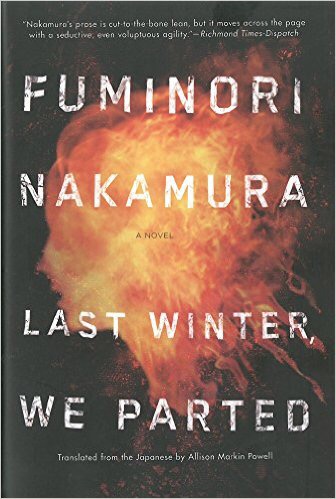
Review for “Last Winter, We Parted” by Fuminori Nakamura (2014)
Rating: 2 out of 5 stars
I love Japanese fiction–it’s dark, mysterious, poetic. It takes risks, it terrifies, it ponders the universe. It pushes you out of your comfort zone of comfortable characters and predictable plots. I try to read a diverse selection of literature, but I do admit I have a soft spot for Japanese writers.
Unfortunately, I didn’t like this book. The plot is alright enough: a writer goes to interview a convicted killer, a renowned photographer named Kiharazaka who is on death row for the murder of two women by setting them ablaze. His investigation leads him to a doll maker who makes life sized dolls (weird), to an underground group of life sized doll lovers (weirder), and eventually into a sexual relationship with the condemned man’s sister (the weirdest). He tries to back out of the project, but he is so obsessed by the photographer’s story that he can’t wrench himself free. There is a twist at the end that I won’t give away–other than to say that it’s kookier than a David Lynch movie, and I’ve watched a lot of those.
Even though the writer was obsessed with Kiharazaka’s story, I wasn’t. There is nothing in this book to engage you, the writing is bland and lacks variety. If I had a stiff drink for every time the author writes that the main character has to “light a cigarette,” “smile,” or “look concerned” I’d be more than three sheets to the wind by page 25. The characters move about the story as lifeless, one dimensional beings. There is an attempt by the author to create a back story, but it’s nothing short of dull and just plain confusing. The structure of this novel also presents a problem, because it mixes the protagonist’s first person narration with Kiharazaka’s narration, as well as related documents and diaries from other characters. It was damn near impossible for me to figure out who was saying what.
The only reason I didn’t give this book one star is because I recognize that this book was translated from Japanese. This is often the problem with foreign novels, some styles and nuances of the story are simply not going to be carried over and understood, no matter how sincere the translator’s intention. I understand the author’s main point behind this book, but the poor execution here can’t be ignored. Would not read again.
Review for A. Manette Ansay’s “Vinegar Hill” (1994)
Rating: 4 out of 5 stars
I am going to start this review by saying that the fact that “Vinegar Hill” was an Oprah’s Book Club pick didn’t deter me from reading it. I think a lot of people are passing up some great books because of the stigma of bad quality that surrounds her book club, even to this day. I’ve read several of her club offerings and found them to be hit or miss–much in the same fashion as any random book you’d find in literary fiction. Do people seriously expect EVERY book that Oprah recommends will be great? Perhaps, due to her larger than life persona, we expect too much of Oprah. Books are still a matter of personal preference, and Oprah’s tastes don’t always have to match mine. Lol, please…
Anyway, I actually really liked this book. A lot of reviewers use the words “bleak” and “depressing” to describe the tone of this book, and these words are very accurate. The story centers on Ellen and James, a married couple with two children, who fall on hard financial times and are forced to move in with James’ parents. Their home is a harsh, loveless place, where secrets are kept and Fritz (James’ father) rules through cruelty and intimidation. The whole time I read this I could feel the tension in the house building and building until Ellen makes a drastic choice and you’re able to find some sense of relief at the end.
I also thought Ms. Ansay did an excellent job with the setting of this book. Religion, specifically the family’s strict, traditional Catholic faith, also played an important role in this story. Back in 1972, people simply did not divorce. Women were responsible for maintaining their household, no matter how miserable they were and that was it. This book explores this dynamic, and it affected me deeply, even though some parts were tough to read. I’m glad the author made this a short book, if it were 50 pages longer I couldn’t see myself continuing to endure the character’s suffering.
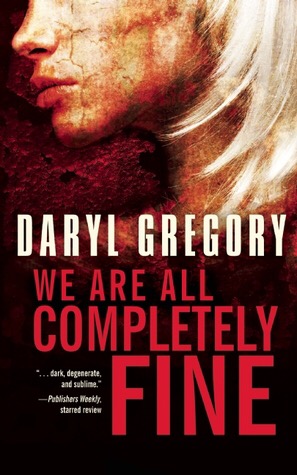
Review for “We Are All Completely Fine” by Daryl Gregory (2014)
Rating: 2 out of 5 stars
Every now and then I need a good horror story. I just want to pick up a book and be whisked away to a dark place that no one likes to talk about. I don’t care if the horror is supernatural or a reality-based psychological freak out. I just, well…every so often, like to be scared. And who doesn’t?
This book somewhat delivers on this. I want to give this a higher rating but I can’t. The idea of this book is a great one: a therapy support for survivors of traumatic events. No one really talks about the people who survive trauma, just the event itself or the inner workings of people who are guilty of doing it. I also like that Daryl Gregory manages to discuss each character’s horrific experience without depressing us too much.
The execution of this, however, is not so great. The point of view of each of the therapy group members shifted entirely too much, almost to where I couldn’t tell from one section to the next which person was talking. One moment it’s Jan, the group director, the next was Harrison, a group member, so on and so forth. I didn’t get the ending either. Way too abrupt and convoluted. Certain questions are never answered, too many plot strings left dangling. But maybe it’s just me.
I understand that this is a novella, but I think this topic would have fit better into a novel format. I still feel like it’s unfinished, like Mr. Gregory only gave us half of a cup when the glass should have been full. You never really get to know the characters, because it’s time to move on to another perspective, another time, another place. It’s quick read for people who enjoy horror books, or people who have survived horrific events.
So I’ve decided to complicate my life here and start taking review requests. If you’re truly interested I’d encourage you to email first to discuss what your book is about, what stage of the publishing process it is in, and what kind of review you are looking for. When I read I take detailed notes and I usually begin writing the review right after I read it. I have no patience for underdeveloped characters and plot holes. Often times I find that when people give me something to critique they will claim that they want an “honest” opinion, but when detailed, constructive criticism is given, they don’t want it. Or the opposite scenario: they’ll listen to what you have to say and later on give you a published copy with the same questionable content still in there, flashing like a neon sign. Almost as if you wasted your time to begin with critiquing it in the first place. Personally I welcome all criticism if I ask for it; I would much rather a reviewer tell me what was wrong with my book before it went to print then have people post ridiculous things on Amazon.com about it, you know?
The details of my review policy are on the appropriate page.
Review for “Single, Carefree, Mellow” by Katherine Heiny (2015)
Rating: 1 out of 5 stars
Jesus, where do I start???
“Single, Carefree, Mellow” to describe this book is a hell of a misnomer, because not one of the characters in this collection of eleven short stories was single. All of Heiny’s characters are upper middle class, educated, young white women working in a writerly kind of job and married to or in a committed relationship to a nice, clueless guy who works in a tech field. Every single story (yes, every. single. one!) included a main character caught up in some form or another of adultery, usually with a slightly older man who also works in a writerly occupation. It was almost as if the author was using a formula here: introduce characters, insert some humorous descriptions, bleep bleep bloop…then onto the coup de grâce of the main character and her running partner going at it like rabbits in the backseat of a car. Yes. Really.
I can understand that a book has a common theme, but this was ridiculous. I’ve never read a short story collection in which the stories were so blandly repetitive, the characters so obnoxiously cliche. The women here were so indistinguishable from one another that it didn’t matter that Heiny used the second person narrative in several selections, or that the same character appeared in three different stories here in three different stages of her life. You don’t remember the characters’ names because they were so predictable and generic—the same voice, same character type. And since they’re all screwing their bosses or the dude they met on the Internet anyway, their affair part of the story becomes mindless, so beside the point. Like background noise, you ignore it. You move on, you don’t care.
Also weird was that no one in this book, not one single person, appeared to have any moral objections to all of this affair-having. Not that every person is a born again Bible thumper, but I found the total lack of empathy in each story strange, to the point where the characters were completely unrealistic. Not one of the significant others/husbands here seemed to be vaguely suspicious of their wife or girlfriend, and no one was ever discovered in their indiscretions. And always, after said affair was over, the protagonist seemed to go on with their daily lives as normal. Really?! Like, I had no idea that getting your rocks off with a guy you met on a plane while your husband’s on a bicycling trip was that simple. Wowzers!
Is infidelity among women this rampant in our society? After reading this book, if I wasn’t careful, I would believe so. However, I honestly believe that women are smarter than what Heiny portrays them as. The strangest part about it was that I actually did enjoy Heiny’s writing, she employs a fair amount of dark humor, which was a plus for me. There was also a very touching scene in one of the stories in which the character loses her dog after an illness, which left me kinda sore because this happened to me about three years ago (RIP Zoe). But that was the only scene that connected with me, it still wasn’t enough to save this crappy mess of a book. Glad I didn’t purchase this, thank God for libraries…
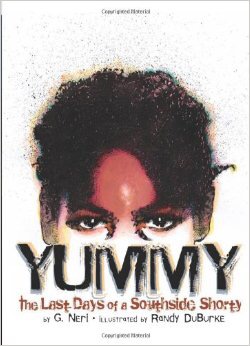
Review for “Yummy: the Last Days of a Southside Shorty” by G. Neri, illustrated by Randy DuBurke (2010)
Rating: 5 out of 5 stars
I was in high school back in 1994, and I remember the case of Robert “Yummy” Sandifer like it was yesterday. My parents used to get weekly subscriptions to TIME magazine back then and I remember staring at the young, barely preteen face in the mug shot on the cover thinking: how could this happen? How can an 11 year old child be both a murderer and a murder victim? Like the 1994 magazine cover, the child’s eyes on the front of this book stare directly at you and you can’t help but to stare back. His gaze is a direct challenge, his eyes are blank, hostile. It’s the coldest stare you’ve ever seen on an 11-year-old kid in your life.
TIME Magazine, September 19, 1994
I read that magazine article over and over again and even though I knew the facts of his brief life (abusive past, both of his parents were incarcerated, ran away from numerous foster homes, and had dozens of brushes with the law), the facts offered no comfort or clarity to my burning question of ‘why?’ In the years since, I have never forgotten the details of Yummy’s short, violent life, or his young face on the cover of a national news magazine.
Twenty years later as a middle school teacher, I had seen about a dozen ‘Yummys’ in my ten year teaching span. Not quite as violent at Robert, but the circumstances were the same–black male children living in hellish home situations, caught up in the ever-present, all consuming lure of gang life. I am also a parent myself, of an 11 year old son–ironically, the same age as the boy at the center of this novel. My interest in this case has never wavered over the years, so when I saw there was a graphic novel about Yummy’s life I jumped at the chance to read it.
This was an excellent book. It is narrated through a fictional bystander, a neighborhood child named Roger. It is illustrated in a clear, thoughtful way that allows you to fully understand through pictures the drama of that unfolded in the Roseland neighborhood of Chicago back in 1994. The tragic facts of Yummy’s life are presented once again but what is unique about this story is that it accurately showed the detrimental effect of abuse and neglect on Yummy’s life. We see that even though he killed a young girl and committed several other crimes, he was still a kid and in many ways, still a victim. Through Roger’s perspective, we witness another side of Yummy. We learn that he was a child who still carried and slept with a teddy bear, loved his Granny, felt fear, and cried often. It was facts like these and several others that were presented that grabbed me emotionally in such a way that I couldn’t help but to want to reach out and hug this child and sympathize with him. The author never pushed an agenda or preached, but left you to make up your own mind about whether or not Yummy was a cold hearted killer.
This book is undoubtedly a morality tale to warn kids away from the perils of gang life. I wish I had discovered this book years earlier as a teacher and presented it to my reluctant readers, who have no choice but to live in a violent, hopeless home environment like the one in which Yummy was raised. The ending is one of hope, though we know deep down that the problem of gangs aren’t going anywhere soon. This book, however, is a great start.
These are the mottoes of the hive in Laline Paul’s “The Bees,” a world in which Flora 717, a sanitation worker and the lowest class in the hierarchy of her hive, is required to follow wholeheartedly or she faces certain death. As we witness Flora’s birth in the first few pages, we immediately know that she is special, different from the hundreds of other low level bees in her hive. Flora discovers early on that she can speak, that she produces Flow (an important nourishing substance to feed larvae) and that she possesses another exceptional secret ability that sets her apart from all of her sisters (all the bees in a hive are female). Throughout the book Flora overcomes great challenges (rain, foraging, wasps, crows) to conceal her gift from the those that threaten her existence.
All in all, I liked this book. And I don’t even like bees. I found myself awestruck by the many things I learned about these fascinating creatures, as I never knew bees’ lives were so complex. This novel was a drastic departure from what I normally read, because I typically don’t go for stories that feature animal characters. Paull’s writing, however, worked beautifully here. Bees became less scary and “human” for me. I felt genuine happiness when Flora and her kin survived to fight another day, and (dare I say it) sadnesswhen one of the little buggers around her died. By the end of this book I remember thinking: Wow, I am officially a bee sympathizer now…
Comparisons to “The Handmaid’s Tale” will be inevitable here. Whether the author intended to or not, you will find all of the earmarks of a dystopian fiction novel here. The constant repetition of the “accept, obey, serve” motto is at the center of the Hive Mind. There’s thought reading, social control, as well as questions and considerations surrounding reproductive freedom to ponder. All in all, this is a thoroughly enjoyable read that I highly recommend.
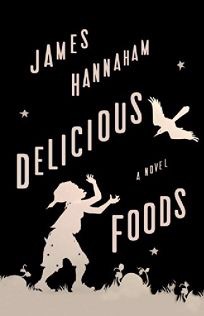
Review for “Delicious Foods” by James Hannaham (2015)
Rating: 5 of 5 stars
[*deep breath*]
After I finished this book I lay awake staring at the ceiling for 30 minutes, thinking: if this book doesn’t win an award this year I don’t know what the hell people think good literature is.
I wasn’t sure what to expect with this book. I knew its main theme was the devastating effects of crack cocaine, but had no idea of what kind of ride this book would take me on. The first chapter completely jars you out of any sense of comfort with its brutality; the rest is deep, slow burn of emotion. This was not a quick read for me. It took a while to get used to the narration of “Scotty,” (a.k.a crack cocaine) but once I did I found myself reading and re-reading those chapters, just to experience the rhythm and hip-ness of the language once more, and to laugh (inappropriately, of course) at its narrative inclusion in this book. I kept waiting for Scotty’s narration to wane or sound ridiculous, but it never did. At times I had to pause and ask myself if it was really crack “talking” and not just another person in the book. Yes, it was THAT good.
I have to admit that the emotion of this book was, at times, too much for me to handle. Young Eddie is eleven years old when he discovers his mother is missing and begins to search, quite literally, through the depths of Hell to find her. My son is also eleven years old, and so many times in the book I found myself so overwhelmed with the image of my own child roaming the streets at night in my absence that I had to metaphorically take a deep breath and gather my bearings before I could continue. My feelings for Darlene and the choices she made throughout the novel alternated between full on rage and absolute pity, I was brought to tears too many times to count here.
This book will break your heart. Very few books have the power to do this to me, I pride myself on having a heart and a stomach for just about anything. There wasn’t a single character that wasn’t real or a single word that’s wasted here. So well written, emotionally gripping. I loved every minute of this book. Highly recommended.






 29chapters.com