Review: Long Way Down

22552026
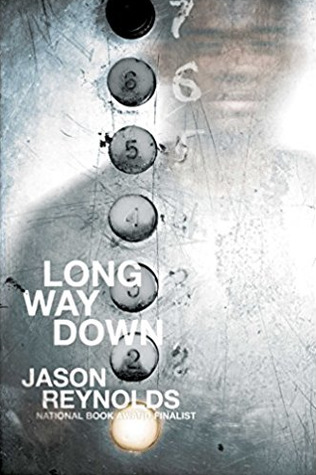
Review for "Long Way Down" by Jason Reynolds (2017)
Rating: 5 out of 5 stars

Not the first novel in verse I’ve read but certainly one of the best.

Will is a teenager who has just lost his older brother in a shocking act of violence. The morning after, he finds his brother’s loaded gun and gets on his building’s elevator, going down, in pursuit of his brother’s murderer to kill him. At each floor, the elevator stops and a different person from Will’s past “gets” on, imploring him to think about his choices before it’s too late. It’s a fascinatingly interesting story, one that I think I actually respected more for the fact that it was written in verse–extraneous details skipped, only the bare bones here. It’s 300 pages or so but only took a couple of hours to read. The ending was a bit confusing, but after several reads I came to appreciate it for what it was–completely and superbly ambiguous to the reader.

As a former teacher I can see this being used in middle or high school classrooms, because there’s so many dialogue and discussion possibilities present with this book. It takes place during anytime and anyplace and anywhere and doesn’t offer any easy answers. Despite inevitable criticism to the contrary, I don’t see why this book should make the problem of violence a simple one, as everyone knows that it’s a complicated cycle that repeats itself over and over again. It’s also great reading for adults like me, I loved this book immensely.

This novel sets a pretty high bar for all other YA poetry books, which is good because I am starting to feel that this form of story-telling is becoming somewhat over saturated. Definitely recommended.
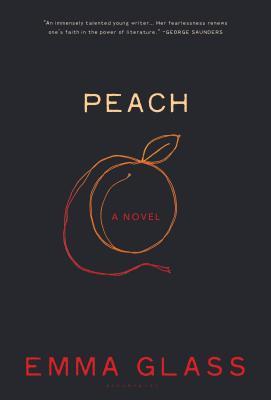
Review: Peach

34957071

Review for "Peach" by Emma Glass (to be published on 23 January 2018)

Rating: 3 out of 5 stars

Thick stick sticky sticking wet ragged wool winding round the wounds, stitching the sliced skin together as I walk, scraping my mittened hand against the wool.

“Peach” is a very short, very violent, and very dark little book. It’s more novella than a novel at less than 150 pages, with a highly artistic, experimental writing style. Some sentences are short, while other sentences run on and on. Some character’s names aren’t capitalized. There’s no punctuation when anyone speaks. And when there’s emphasis (for instance, a character is shouting or thinking aloud), the author uses sTiCkY cApS (uhhh, yeah). Eimear McBride’s “A Girl is a Half-Formed Thing” quickly comes to mind in comparison (the style of which I didn’t care for either) but this book sounded interesting enough to try, so I did.

The beginning of this book is a very visceral one–you’re immediately thrust into the aftermath of a young girl’s brutal sexual assault. Shocked and horrified, Peach manages to compose herself enough to walk home and clean herself up. Her parents, way too occupied with one another and a new baby, do not seem to notice at all that she has come home bloody and bruised. The imagery in this section is physically painful and absolutely heartbreaking.

In response, Peach chooses to keep her ordeal a secret. She attempts to retain a sense of normalcy by going to school and finding comfort in her boyfriend, Green. It’s all too much, though. Her attacker begins to stalk her and the memories and smells of that night become deeply unsettling for Peach, who begins to have violent fantasies.

At about 60% in, the narration became so muddled (stream of consciousness, other goobledegook) that I honestly can’t tell you what happened. The writing style of this book was so confusing that I couldn’t tell between Peach’s thoughts and reality or what was even really happening in the story. And the end (or, let’s say, what I interpreted as the events that occurred at end) was just plain weird. Ewww.

I’m going to give this book 3 stars. In the end, the writing style just wasn’t my cup of tea. I’d recommend this to readers who aren’t afraid of experimental writing, artistic slants, surrealist material.

[A free digital copy of this book was provided to me by the publisher, Bloomsbury USA, and NetGalley in exchange for an honest review.]

Review: The Incest Diary

31574738
Review for "The Incest Diary" by Anonymous (2017)

Rating: none
—– Trigger Warning——

This is a very, very disturbing book.

The New York Times is very accurate when it called reading this book “a dive into the abyss.” This is almost correct. Reading this book was like a jump off of a cliff, hitting every single rock on the way down. There’s no way I enjoyed reading this, so I’m not giving this book a rating.

The writer of “The Incest Diary” is an anonymous woman who describes, in very frank detail, being raped by her father starting at age 3. The sexual abuse continues throughout her childhood until she begins, in a sadistic way, to crave his abuse. He exerts a perverted sense of control over her until she’s in her 20s and finally stops letting him dominate her. By all accounts, her mother was well aware of the fact that the author’s father was raping her and did nothing. There is also physical and emotional abuse inflicted by both her father and her mother, as well as multiple times in the narrative in which she told other people about it, but nobody does anything. It’s infuriating.

But that’s not the worst of it. There’s a jarring sense throughout this book that the author’s frank descriptions are not for the purpose of story-telling, but to titillate and eroticize her experience. While I can understand that prolonged sexual abuse can cause confusion and mixed emotions, words like ‘cock,’ ‘dick,’ and ‘pussy’ to describe the incest just made this book come off as training manual for people who do this sick shit with children. It’s a revolting thought, but it permeates this book.

Given the title, one might ask why I read it in the first place, knowing what it would entail. Honestly, I read this book because it was sitting in the library and I have to admit that it intrigued me. We hear about sexual abuse every day–in memoirs, on the news, in #metoo posts on Twitter–yet we don’t really want to hear their stories, do we? As a reviewer of books I am compelled to explore the human experience, and sometimes parts of that experience are cruel, dark, and scary. I think of myself as an intellectual who transcends fear of dark places.

Needless to say, I don’t recommend this book unless you have nerves of steel.

Review: Ultraluminous

33916025

Review for “Ultraluminous” by Katherine Faw (to be published on 5 December 2017)

Rating: 4 out of 5 stars

I like Katherine Faw. I also liked this book.

No one in this short novel has a real name, including the narrator. Everyone she meets assumes she is Russian, so there are a series of Russian-influenced pseudonyms here (Katya, Karina, Katinka) that substitute for her identity. The narrator works as a prostitute, specializing in high end clients and girlfriend-experience type encounters. On constant rotation are her experiences with such clients such as “the junk bond guy,” “the calf’s brain guy,” “the art guy,” and “the guy who buys me things.” There is also “the ex-Army Ranger,” a man that she never charges, and “the Sheik,” a man she worked for in Dubai.

Not only does the narrator not tell you her name, she never reveals her thoughts either. We only witness her actions, a bizarre series of ‘patterns’ that the narrator adheres to like clockwork. In addition to her clients, she loves trips to Duane Reade for sushi, getting waxed, snorting heroin, trips to Duane Reade for sushi, getting waxed, snorting heroin…and so on. The sex and drug encounters are blunt and matter of fact, she simply moves from one event to the next. The silence between the printed words makes this story interestingly ambiguous until it comes into clear focus at the end.

Four stars. Read if only if you’re looking for an adventure or an experimental type story.

[A free, digital copy of this book was provided by NetGalley and the publisher, MCD, in exchange for an honest review.]

Review: The End We Start From

33858905
Review for "The End We Start From" by Megan Hunter (2017)

Rating: 3 out of 5 stars

Hmm…

I’ve had a few hours to digest this one and honestly I’m not quite sure what to tell you about it. At 160 pages, “The End We Start From” is a very short, almost novella-like dystopian novel told in quiet, sparse paragraphs.

In the beginning (or is it the end?) of this very short novel, an unnamed young mother’s water breaks and she gives birth to a son, Z. The water levels around London are rising and Britain is mostly under water. The narrator and her husband, R, move from their home to stay with his parents in the mountains until food becomes scarce there and then they move again, this time to a makeshift camp with other disaster refugees. Baby Z grows, and the narrator’s husband R eventually leaves the family at the camp to investigate other living prospects. During their separation, the narrator continues to observe life around her, make friends, and bond with her baby, Z.

I think I like the concept of this book more than its actual execution. There’s a lot of interesting things juxtaposed here that I could go on and on about: birth, death, the deterioration of civilized society, the creation of new life. There’s also references to the book of Genesis all throughout which fit quite nicely with those ideas. I just don’t care too much for the writing style, it was too sparse for me. The sense of detachment here was also a problem; the constant use of characters’ initials instead of their names made it hard to remember who was who and vexed me to no end. Too much was left unsaid, I wanted more.

Despite my misgivings, I’m not sorry I read this book. There’s a very unique narration style here that definitely bears notice and may tickle the fancy of others. 3 stars for me, but I invite others to make their own judgment call.

[A free digital copy of this book was provided by NetGalley and Grove Atlantic in exchange for an honest review.]

Review: She Rides Shotgun

23361199

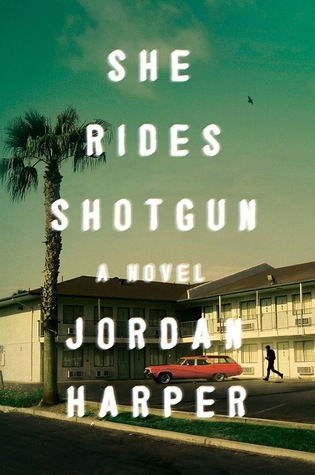
Review for "She Rides Shotgun" by Jordan Harper (2017)

Rating: 4 out of 5 stars

I was about ready to give up on Jordan Harper after I read and loathed his short story collection, “Love and Other Wounds.” Glad I didn’t.

Anyway, “She Rides Shotgun” is a dark story about a father who has just got out of a California prison and run afoul of a vicious prison gang, leading to a ‘green light’ being placed on him, his daughter Polly, and his daughter’s mother. Unable to protect Polly’s mother, he takes his daughter on the run. Fighting for their lives and keeping away from the eyes of the law, eventually his daughter becomes involved in his criminal schemes. I won’t give away the book, but needless to say, I found myself cheering for these two (somehow) until the end. The writing is sparse but beautiful and manages to keep you interested.

Four stars, decent debut novel.

Review: Getting Off: One Woman’s Journey Through Sex and Porn Addiction

33985321
Review for "Getting Off: One Woman's Journey Through Sex and Porn Addiction" by Erica Garza (to be published on 16 January 2018)

Rating: 4 out of 5 stars

Often times when we hear about sex addiction, it is a taboo subject. It is also a narrative that is usually dominated by men. “Getting Off” is one of the few books about this topic that I’ve read that’s written by a woman, and shows the wide range of emotions and dysfunctions that goes along with this affliction.

Garza’s struggle with sex addiction begins when she is twelve and continues long into her adulthood. She has a brilliant writing style–raw, at times funny, and painfully honest in its detail. Once I started reading this book I didn’t put it down and finished it in a manner of hours. As you can guess from the subject matter, it is quite x-rated in certain scenes, so it’s not for the puritanical or faint of heart. If you can move beyond this, however, you will find this an enlightening and enjoyable read.

[A free digital copy of this book was provided by the publisher, Scribner, and NetGalley in exchange for an honest review.]

Review: There’s Someone Inside Your House

15797848

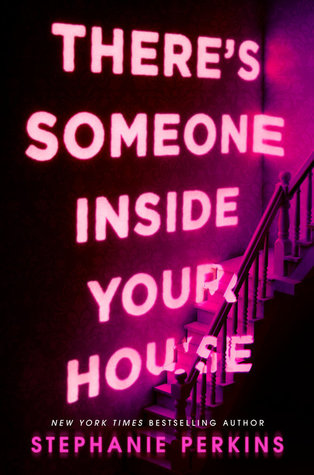
Review for "There's Someone Inside Your House" by Stephanie Perkins (2017)

Rating: 2 out of 5 stars

Whew Lawd this was bad

First off, I love YA thriller/horror. If you spent your high school days reading R.L. Stine and Christopher Pike, then you know what I’m talking about. So when this book came out, I was on it faster than a speeding ticket.

This is my first Stephanie Perkins novel. From my understanding she mostly writes YA romance and this was her first foray into horror. After reading this drivel, it’s my determination that she should probably stick to writing romance.

The run-down: Makani Young, the main character, is sent to live with her grandmother in a small Nebraska town following her parents’ divorce and after a mysterious incident in her Hawaii hometown that’s not revealed until the end of the novel. She has eyes for Ollie, a pink-haired emo kid, and after they meet they make like rabbits for most of the book. While Makani and Ollie are exploring each other’s anatomies, meanwhile, there’s a psycho running around killing members of their high school student body for reasons unknown.

So where do I begin? For the whole “Who will be next?” hook, this book had only about 5 deaths and still turned out to be 99.9% romance. The book pivots between Makani and Ollie’s relationship and the killer’s next victim, which we follow in a brief chapter as it happens. We’re never told why the killer is picking people off, and his identity is fully revealed at about 60% into the book. What happens after this? Nothing. For me, it’s was a hazy blur of wtf moments and skipped pages.

And Makani and Ollie…what a mess. For a romance writer, the author manages to make their relationship strictly about lust and nothing else. Despite all the physical fun these two are having, it’s mindlessly boring. Even an old pervert like me started flipping pages after awhile. On to the next slashing please…

I was expecting more blood and gore here. Two stars.

Review: The Weight of This World

30763901

Review for "The Weight of This World" by David Joy (2017)

Rating: 3.5 out of 5 stars

This is my second David Joy read, the first having been “Where All Light Tends to Go.” I read that one, gave it 3 stars. This one is slightly better, though not by much.

This book literally begins with a bang–with shocking act of violence committed by young Aiden McCall’s father upon his mother. Without parents, he is sent to a group home that he quickly runs away from. Aiden finds a friend in Thad Broom, a brooding, often violent boy with his own problems. The two boys grow up in the same home together, though Thad eventually leaves to join the Army and fight in Afghanistan. Thad returns from combat injured and hopeless, a shell of a man. Aiden, without his friend for six years, doesn’t fare much better: he’s unemployed, bitter, and a part-time drunk. He hopes to escape from their miserable lives and move away, but Thad will not hear of it. In the meantime both Thad and Aiden do drugs (mostly methamphetamine) to get through their days.

In the middle of the drama is April, Thad’s mother. She lives with secrets of her own, and also wants to move on and, in her words, “get off the mountain.” She is swept into the subsequent drama when Aiden and Thad’s drug dealer accidentally kills himself and leaves all three with a large stash of drugs and cash. What follows after this point in the book is a really dark and violent cycle of revenge, suffering, and just plain bad decision-making.

None of the characters in this book are likable, but I think in the end their likability is completely irrelevant to the reason why I gave this book three and a half stars. I can see that the author is perhaps meditating on the power of fate over free will, though as a reader after a while I was just plain tired of the characters and their ensuing Stupidity Olympics. You realize that these people don’t want to better themselves and they simply want to be miserable, end of story. I tried to feel some kind of empathy (nope!) for their choices, maybe even some kind of compassion for these characters but there’s none (absolutely none!) to be found. Three-quarters into this, I just got tired of reading and plodded my way to the end. Needless to say, I was glad when it was over.

Despite my rating, I would recommend this book. Though the violence is not for the faint of heart, but the author’s writing is not that bad and this novel does, in many ways, still manage to hold your attention.

Review: Moxie

33163378
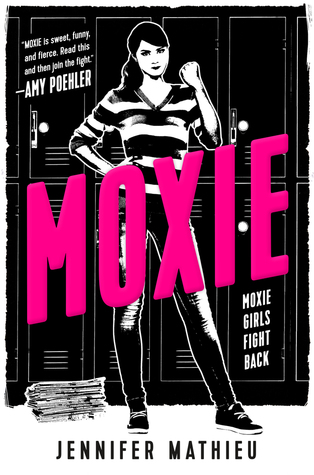
Review for "Moxie" by Jennifer Mathieu (2017)

Rating: 3 out of 5 stars

I know this book has gotten glowing praise from many of its readers, but I was underwhelmed with this one. I know I’m jumping off a cliff by saying this, but this book was just ok for me.

Vivian is an average teen living with her single mother in a small town in Texas. Aided by her mother’s Riot Grrl memorabilia and fed up with sexist administrators, Vivian makes an anonymous zine to protest the unfair treatment of girls at her high school and empowers them to fight back. The zine catches on, and most of the girls at the school eventually join in her fight. In the middle of all of the brouhaha, Vivian manages to snag the hottest artsy guy in school, who, it turns out, is sympathetic to her feminist goals.

My main concern with any feminist text is how it addresses intersectionality. As a woman of color, I’m critical of any text that claims to be feminist, yet focuses exclusively on the voices of White middle class women. Fortunately the author does address the issue, about midway through the novel when Vivian reveals that her mother once said that “Riot Grrls weren’t as welcoming to other girls as they could have been.” Well, no ma’am, they weren’t. There is a Latina and and Black girl at Vivian’s school who join the Moxie movement, yet we’re supposed to believe that their perspectives and concerns (jerky football players and dress code checks) are the exact same as Vivian’s. Sorry, but I simply don’t believe this. Where is race here? How does the author manage to make women of color so one-dimensional in this book? Gimme a break.

Which brings me to the last issue: race. While she does addresses the problem of inclusivity, Mathieu’s fictional small-town Texas world is devoid of any mention of racism. I praise the author for addressing the elephant in the room, but I just don’t think it goes far enough. As far as gender, there is a reference to a lesbian character, albeit a brief one. The problems that arise from race, class, sexuality, and gender will always overlap (hint: why it’s called intersectionality), and I simply wanted more from the Black, Latina, and LGBTQ characters here. What you get instead with this book is a lot of romanticizing on the 90’s Riot Grrl movement, which, let’s face it, was not as inclusive to race and gender as it should have been.

Overall, not a bad book, but not a great one either. Three stars is my best recommendation here, though I look forward to (possibly) reading more of this author in the future.