Review: Team Seven

18209340
Review for "Team Seven" by Marcus Burke (2014)
Rating: 2 out of 5 stars

Oh, this book is just flat out wrong. Where do I begin?

First of all, this book had a lot of potential. It’s the story of Andre Battel, a Jamaican-American boy growing up in the urban center of Boston around the 80s and 90s. We follow him from around age 7 or so until his late teens, though the way the story is written, it’s hard to tell. We also follow his very dysfunctional family during the same period: Eddy, his unemployed, drug-addled, and absent father, Nina, his sister, and Ruby, his saintly, long-suffering mother. There is a host of extended family as well, an aunt and his grandparents, who live upstairs from the ongoing Battel family drama.

Around the age of 9 or 10 (I assume), Andre falls under the influence of a neighborhood drug crew of older boys, eventually becoming their seventh member (hence the title, “Team Seven”). He comes of age in a violent street culture–selling and smoking shitloads of marijuana, doing poorly in school, fighting, treating girls like garbage (along with a misogynistic attitude to boot), and beefs with his dad. The one thing Andre is good at his basketball, which he plays in city leagues with a reasonable amount of talent. He continues this sport until he is a teenager, looking for a way out of his twisted home life.

There are shifts in voice and time here, and that’s where the problems start. In the beginning there’s a young Andre, though as he grows there’s no kind of context of his age or any indication of how much time has passed. It’s just a kind of chapter to chapter ‘snapshot’ of Andre, with no backstory. He speaks and thinks in a heavy street dialect from the 90s and the 2000s, though other period indications in the book don’t seem to match. For example, there’s the mention of a lyric from Outkast’s “ATLiens” album (which came out in 1996), though several pages later there’s the appearance of a paragraph-length, perfectly grammatical cell phone text. Any genius will tell you that there were no such cell phones with such advanced texting capabilities during this period.

The novel also starts with multiple narrators: there’s Andre’s dad Eddy, mom Ruby, and one of the members of Team Seven. They each get a small sections in the beginning and, other than one other narration by Eddy later in the book, are never heard from again. Why have other characters narrate at all if it’s not continuous? Hmm.

And then there’s the members of Team Seven, who, other than two main characters of which are continuously mentioned, we don’t know much about. While we know they’re older that Andre, how old are they? As I said before, the lack of structured detail to the timeline here is terribly confusing.

The author also mixes up Andre’s narration in present and past tenses, depending on what chapter you’re reading. Is Andre currently in the action, or far beyond it, reflecting on the past? This is unclear and inconsistent.

This book had potential, but the rookie-ness of the mistakes here are glaring and detract from the overall cohesiveness of the story. I’d read, but only with caution.
Review: Little Deaths

27845924
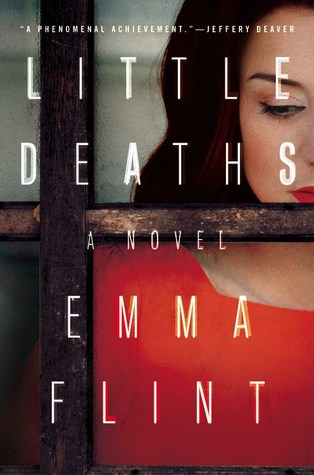
Review for "Little Deaths" by Emma Flint (2017)
Rating: 3 out of 5 stars

It’s the summer of 1965, and Ruth Malone’s two young children, Frankie and Cindy, mysteriously disappear from her apartment in Queens. Cindy’s body is found several hours later, and Frankie’s is found after several weeks, unrecognizable due to decomposition. Ruth, a single mother, is recently separated and in a custody battle with her husband, Frank. The police (all male, of course) find empty liquor bottles and letters to married men in Ruth’s apartment and immediately suspect her of the crime. In their eyes, she is an unfit mother, dressed provocatively, and hardly grieving. Ruth is trailed day and night, all while she continues to frequent night clubs and date various men, though they don’t see her devastating breakdowns in private.

The book is engrossing in the first 75 pages or so, then it shifts a bit. Well, a lot. Enter Pete Wonicke, a young news reporter who, by a lucky break, falls into the Ruth Malone story. Most of what we learn about Ruth’s world after Pete enters the story comes from him as he interviews her various boyfriends, estranged husband, the detectives on the case, and her friends. As the novel continues, it’s more and more of Pete’s POV and less of Ruth’s, which I found super annoying, especially because it’s clear after awhile that he’s obsessed with her.

The problem here is that I never really got over the POV shift from the first half of the book. There is a sense of urgency as you read about Ruth and the anguish she feels after the loss of her children. The rest of the book after this is simply not very engaging, nor was it particularly memorable. While I can understand the author’s purpose of detaching Ruth from the story (to keep the suspense going), it’s unfortunate, because such a move was totally at the expense of character development here. There’s so little of Ruth by midway into the book that it’s almost like she’s a ghost. By this point I was so detached from the story I wanted to put it down completely. I did manage to read it until the end because I did want to know who killed the children, and when that’s revealed in the final pages of the book, I wasn’t impressed.

I can say that I loved Emma Flint’s sense of setting and the period detail of this book. I was surprised to discover on the back flap that she is British, because this story is so uniquely American-style noir. Not bad overall, and certainly would be open to reading more of Emma Flint in the future.

Review: We Are Okay

28243032
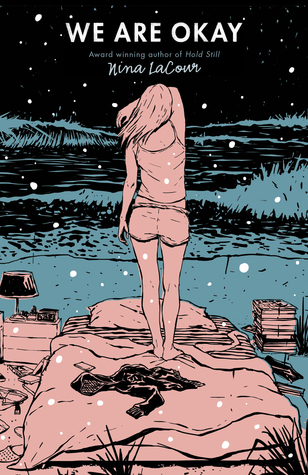
Review for "We Are Okay" by Nina LaCour (2017)

Rating: 2 out of 5 stars

Beautifully written book, but man oh man…this is so, so boring.

‘We Are Okay’ is the story of Marin, a girl from California with no immediate family, so she decides to spends her winter break alone in the dorm after everyone has gone home. Marin is visited over the break by a friend from her hometown, Mabel (all of this occurs before Chapter 3, btw). The rest of the book is flashbacks on her life back in California over the previous summer, uninteresting conversations with Mabel, and getting to the bottom of why she took off abruptly before the semester started and left Mabel hanging with a bunch of unanswered texts (yikes!).

Add to the mix tons of minutiae such as: two girls shopping for clay pots, eating chili, doing the dishes, wiping plates. So many details and not much of a story arc here. I would say screw that, this is a character study, but neither one was really all that interesting.

As I said before, the book is beautifully written. The only reason I didn’t nix it is because something in the writing compelled me to continue. Without giving too much of it away, it is clear that this is a YA book about grief and loss, though there’s not much stated here on the subject that we haven’t already heard before.

If you like ‘quiet’ reads, this is the book for you. I won’t be mad at you for liking it either.

Extra points for the cover, btw. So pretty

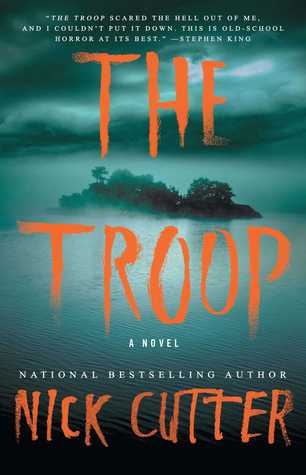
Review: The Troop

28187199
Review for "The Troop" by Nick Cutter (2014)
Rating: 4 out of 5 stars

I liked this book.

Started off a bit slow, with Scoutmaster Tim Riggs taking five boys into the wilderness for their annual camping trip on Falstaff Island, a remote outpost near Prince Edward Island. On their first night, a very hungry stranger enters their camp. He isn’t well. He is unknowingly infested with a horrifying efficient, genetically modified parasite, which eventually takes each character to the brink of their own survival.

Now I will admit that there were some parts of this book that I didn’t want to read so I skipped it (i.e., scenes of self mutilation, a particularly detailed account of the torture of a cat, etc). Otherwise I didn’t find this book as gory as some other online reviewers have. I guess it’s a matter of personal taste. Otherwise it’s a great novel, with echoes of some pretty classic works–Stand by Me, The Lord of the Flies–all throughout.

If you like old school, 1980’s era Stephen King-esque horror, then this book is for you.

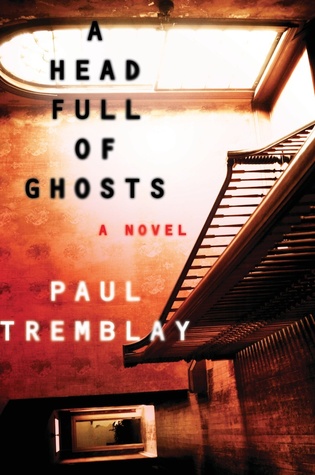
Review: A Head Full of Ghosts

23019294
Review for "A Head Full of Ghosts" by Paul Tremblay (2015)
Rating: 2 out of 5 stars

Didn’t like this. I’m surprised by how many kudos it’s gotten on Goodreads. The plot is interesting enough: a middle class family with two daughters, the youngest bearing witness to her older sister’s supposed demonic possession and the family’s decision to share it on reality television.

The pacing of this book is slow, and trust me…’slow’ is a compliment here. After 150 pages, there’s not much happening beyond the standard cliched “Exorcist” fare, you know…green vomit, talking in different voices, etc. There are also major structural concerns here, one being the fact that much of the book is broken up with written anecdotes by an anonymous person critiquing the reality show of which the main characters are a part of. Other than a few pop culture references, these blog passages in the book are completely useless.

There’s a twist at the end if you care enough to make it there. I wouldn’t hold my breath.

Review: Harmless Like You

30231823
Review for "Harmless Like You" by Rowan Hisayo Buchanan (2017)
Rating: None (DNF)

I DNF’d this book, so there’s no star rating. I didn’t want to, but I just wasn’t feeling it.

This book is a like a cloudy day with no sun, just black clouds everywhere. Every time I picked it up it was the same thing, just leaving me more and more empty on the inside. The writing is good but the characters are stiff and wooden, the action was super slow to develop. I made it to page 200 before just putting it down for good.

‘Harmless Like You’ is the story of Yuki, a Japanese-American girl growing up in NYC in the late 1960s. Her parents move back to Japan around the age of 16 and leave her in the care of her friend, an amoral model by the name of Odile and her mother, Lillian. Lillian is physically abused by her boyfriend, Lou. Yuki begins starving herself, and eventually moves in with Lou, who also ends up abusing her. She quits school and longs to be an artist, yet she doesn’t pursue this dream. Yuki marries a friend, a boring dude who stifles her creativity. They have a son.

Cut to present day: the novel also follows the story of Jay, a douchebag of a guy who hates his wife. He also feels no paternal instinct toward the baby he has with her and eventually cheats on her. We later learn that Jay is Yuki’s son whom she abandoned many years before in pursuit of her artistic dreams.

Yuki’s chapters are in a detached third person, Jay’s in brief, first person narration. It doesn’t do anything for the unrelenting bleak tone of this novel, it’s the same all throughout.

Don’t get me wrong, there’s nothing wrong with somber reads. I just think what killed this book for me is that I have to be in the mood for such reading and now was not such a time. I do recommend it, however, perhaps you will get something out of it and can explain it to me. :/

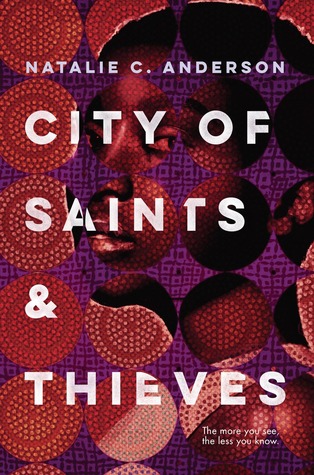
Review: City of Saints and Thieves


33956433
Review of "City of Saints and Thieves" by Natalie C. Anderson (2017)
Rating: 3 out of 5 stars

Tina is a Congolese refugee and a motherless child, as well as one of the few female members of the Goondas, a gang of street thieves in Kenya. She cares for her younger sister, Kiki, while she fantasizes about revenge on Mr. Greyhill, a wealthy business magnate and employer of Tina’s mother, whom she suspects had her murdered after learning of his shady business dealings. With the help of the Goondas, Tina breaks into the Greyhill’s estate and is discovered by their son, Michael. The two form a reluctant alliance and go deeper into the dark side of Kenyan society to discover who murdered Tina’s mother.

With all that said, this was supposed to be a good book. The writing is fine, the setting is well-researched, and the character is kick-ass, there’s no complaints there. I think where this book lost me is somewhere in the middle when it lost the feel of a true revenge thriller. There really is only one suspect, and we find out before the middle of the book is over that it isn’t him. Although we know Tina seeks revenge for her mother’s death, that plot turn is also settled fairly early on in the novel. That left this book kinda hanging by a thread and less about the mystery we were promised and more about a girls’ search for her past. Not bad, just not quite what I expected.

Three stars–no more, no less.

Review: Hold Tight, Don’t Let Go

20702041
Review for "Hold Tight, Don't Let Go" by Laura Rose Wagner (2015)

Rating: 5 out of 5 stars

It’s rare when a book touches you down to your core. You cry (maybe more than once), you read certain passages over and over, you find yourself thinking about the characters in those moments you’re not reading it. This was one such book.

Hold Tight, Don’t Let Go is the story of two 16-year-old cousins, Nadine and Magdalie, raised as sisters by Nadine’s mother in the Haitian capital of Port-au-Prince. The story opens during the first frightening moments of the devastating January 2010 earthquake, with the cousins losing their home, their aunt, and everything they own within several minutes. They eventually move into a makeshift camp with their uncle and scrape by, surviving through the oppressive heat, the lack of food, and the horribly unsanitary conditions there. Eventually Nadine’s father in the U.S. sends for her and she leaves Magdalie behind, promising to send for her later.

From this point, this is really Magdalie’s story. She hopes for Nadine to send for her, but as time passes it becomes obvious to our character that this is not going to happen. We follow Magdalie over the next two years as she makes a living in the Haiti that struggles to rebuild after the quake and the range of emotions she takes in the process–desperation, anger, and eventually hope. I don’t want to give away the ending, but this is a beautiful book. The descriptions, the sights, the smells, the music, I really felt like I was there. It is clear that the author spent time in this place and her understanding of the culture of this land is evident.

5 stars. Do read this.

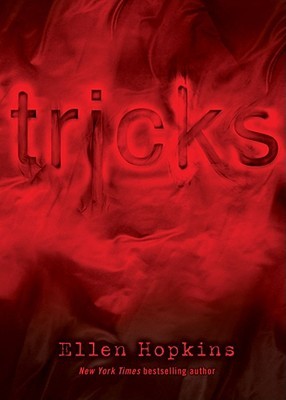
Review: Tricks

5510384
Review for "Tricks" by Ellen Hopkins (2009)
Rating: 3 out of 5 stars

This is my second book by Ellen Hopkins. My first was “Crank,” her novel in verse about a girl hooked on crystal meth, based loosely on the life of her own daughter. Hopkins is quite a prolific YA writer, tackling many of the issues that people tend to avoid when writing for teenagers. She’s written about drug abuse, mental health issues, sexual abuse, eating disorders. I’m not so much a fan of her verse as I am her fearlessness, because I admit that I’m drawn to her books for much of the reason I imagine most people are, to see how certain issues are portrayed for a YA audience.

“Tricks” is no exception; it tells the story of five teenagers who find themselves for various reasons lost in the dangerous world of prostitution. Eden is the daughter of a conservative religious family who is sent away to a Bible camp; Seth is a farm boy who struggles with his sexuality and finds himself a Vegas sugar daddy; Whitney is a goody-goody who stumbles into the arms of a drug-dealing pimp; Ginger is from a broken home and her entrance into the sex trade mirrors her own mother’s, and Cody is a kid who sells himself to men to ease his gambling debts.

I would have preferred to read each character’s story straight through, much like a short story. Instead, Hopkins focuses on one character for while, then abruptly switches to another. The constant starting and stopping of the narrative made it hard to get to know each character and made the book as a whole hard to follow. It never really had a good sense of cohesion and gave it the feel that it was five separate stories instead of one. There was some overlap of the characters, but it was fairly minor (one character mentioning another did occur, but only in passing).

This book is also really explicit in its sexual scenes. I won’t go into detail but if you’re unfamiliar with gay porn or girl-girl-guy threesomes I would leave this book on the shelf. I’m in my 30’s and I felt uncomfortable reading it, not because I’m a prude, but for the sake of the audience it was written for. Personally I wouldn’t allow my teen son to read this unless he was super-mature, which he isn’t. The details were a little too salacious for my taste and the story got lost in the process.

There is a second story in this series that picks up where the action of this story left off. I may read it eventually, but for right now I think I’m good with this.

Review: Saint Death

I just realized that this is my third NetGalley book that I’m about to write a less than flattering review about in the past few weeks. Ya’ll know how I feel about my reviews though. Anyway, on with the show:

31145190
Review for "Saint Death" by Marcus Sedgwick (to be published in the U.S. on 25 April 2017)
Rating: 2 out of 5 stars

This was a really strange book. The tone is dark and so is the subject matter, particularly for a YA book. It explores the world of Mexican immigrants, as well as a dark, spiritual world of guns, gangsters, violence, gods, and money.

Arturo is a young man living in the border of the U.S./Mexico in a shack, working for scraps at a garage and hustling card games for quick cash. Enter Faustino, a childhood friend who Arturo hasn’t seen in years who urgently needs Arturo’s assistance to get his girlfriend and their child across the border to a smuggler, who is to facilitate their illegal entry to the U.S. Together the two pray to Santa Muerte (Saint Death), and make a plan to go after some dangerous men for the money they need. Of course not everything goes according to plan and they run afoul of some gangsters in the process, and of course, there are consequences to pay.

I didn’t really like this story. It’s all over the place with the immigration plot, the supernatural elements of Santa Muerte, the narco stuff, and a couple of other subplots that I could go on and on about. I understand that the author is going for a modern retelling of the Faustian legend (if you missed it, one of the main character’s names is literally Spanish for “Faust”), but Arturo and his friend were never characters that I completely understood or related to. The action was too slow in coming and when it did come, I actually found myself skipping pages. Interspersed throughout the story were also informational factoids about NAFTA and borders and U.S. corporations, all of which could have been edited out for clarity and none of which seemed to match the tone of the story.

Even though I didn’t like this one, I don’t think I would rule out this author’s work in the future.

[Note: A free digital copy of this book was provided by the publisher, Roaring Brook Press, and NetGalley in exchange for an honest review.]