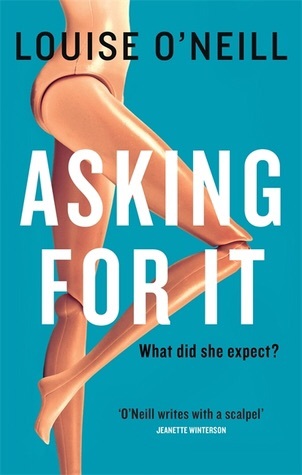
Review: Asking for It

25255576

Review for “Asking for It” by Louise O’Neill (2016)

Rating: 4 out of 5 stars

This book hits you like a sledgehammer. It’s sad, it’s sadistic, it’s cruel. It makes you angry. You want it to be false, pure fiction made up by an ambitious author. But you know from the headlines dealing with this topic that it’s all true, way too realistic.

Emma O’Donovan is an 18 year old high school student in a small Irish town. She’s gorgeous, smart, a promising student, surrounded by beautiful friends and a loving family. In the standard YA novel Emma would be the stock ‘mean girl’ character, the popular bitch, the Queen Bee we love to hate. Because the story is told through her point of view, you are privy to all of her thoughts, many of which are downright obnoxious. In the first pages of the book you learn that she is actually quite insecure–she’s shallow, narcissistic, and jealous of anyone who makes an effort to be part of the same attention that she desperately seeks. When it comes to boys, Emma must be noticed. When they don’t, she wonders why.

One night, Emma and her friends go to a party. She flirts with other boys, including the boyfriend of one of her friends. She drinks heavily, she has consensual sex with one of the guys there. She willingly takes a pill that a partygoer gives her, which causes her to lose consciousness. She awakens on her front porch with no underwear and her dress turned inside out, sunburned and bleeding, with no memory of the night before. Pictures of her gang rape by 4 male classmates are uploaded on social media. People make comments. No one questions the boys. Everyone hates her.

Emma is left to deal with the consequences of that night, and they are awful. Her friends shun her, her parents are ashamed of her. The community blames her. She acted like a slut, she got what she deserved. She took drugs. She drank. She flirted with other boys, and yes, did have consensual sex with one of the accused at the party. She changed her story to the police. She contacted another of the accused boys after the incident. The bullying that she is subjected to by her peers was some of the most sadistic instances of harassment I’ve ever read before. It’s terrible.

Louise O’Neill’s decision to make Emma O’Donovan’s character an unlikeable one was a bold move. No one feels sorry for this victim, and in a lot of ways, YOU don’t either. The author’s choice to portray Emma in all of her flawed humanness forces you to confront your own prejudices about what rape is and what a rape victim is supposed to ‘behave’ like. It’s a spot-on, timely book; specifically in today’s age, where we are still (in 2016, mind you) debating the very definition of rape and consent.

The ending was just that, an ending. It isn’t happy. Nobody apologizes to Emma, nobody gets their day in court. Nothing is wrapped up. The scorn of the community continues, and Emma’s emotional torture (by others and upon herself) does not end. She will deal with this ugliness for the rest of her life, and she knows it.

This is a book that makes you pause and think. It’s not so much plot driven as it is a character study that is meant to challenge our understanding of what a rape victim is. In a perfect world we would extend Emma our support because she was taken advantage of without her consent. We would care. Sadly, we don’t. Louise O’Neill reminds you that it still isn’t a perfect world, and crimes like this continue to go on, whether it’s in Ireland or America or anywhere. It’s an ugly story, and I was all too glad to read and learn from it.

Review: Sweet Lamb of Heaven

26530341

Review for “Sweet Lamb of Heaven” by Lydia Millet (2016)

Rating: none

DNF’d at 60% in my Kindle.

I’ve been on a DNF kick lately, stopping books left and right because, well, f**k it…I have the power of Grayskull and I can. My TBR pile is a beast right now, and I firmly believe that life’s too short for bad books, slow books, stupid books, books with no point. DNF is not always a bad thing: sometimes I’ll stop reading because I just can’t get into it right then (not the right mood, season, or mindset) and I’ll come back to it a year or two later and it’s the best thing I’ve ever read. It’s happened before. I normally don’t review DNF books, because I try to bring you complete and thorough reviews, but it was clear with this one that what I got was all I was going to get.

Anywho, at the beginning of this book we meet Anna, who is pregnant with a child that her dick of a husband, Ned, does not want. She has the child anyway, a daughter she names Lena. She eventually chalks up the loss of the marriage and leaves Ned and moves across the country to Maine. Ever since the birth of her daughter, Anna has been hearing a voice that only occurs when her daughter is around. Throughout this book are blurbs from Wikipedia and other sources on what could possibly be the source of the voice–psychosis, possession by demons, etc. It’s boring to read. Ned eventually catches up with Anna, and about here was where I stopped reading.

As far as the writing, it’s actually good. It rambles at times, a stream-of-consciousness kinda style that never really grew on me. Because the main character hears voices only when her daughter is around, there’s a heavy case here for an unreliable narrator. There is a sense of foreboding and dread, which was very skillfully played all throughout this book, but that was about it for me. This novel is being marketed as a psychological thriller–and in a way, it is that–but there was never a ‘thrill’ here for me, just circles of weirdness and Wikipedia entries and me wondering if I should even continue to bother with Anna because I don’t know if she is crazy or not.

Another reason I am reviewing this book (even though I didn’t finish it) is because I do recommend that people out there read it. If possible, please report to me what you got out of it, if anything at all. Pretty pretty please…

[Note: I received a digital copy of this book from NetGalley and W.W. Norton Publishers in exchange for an honest review of this book.]


Review: Girls on Fire

26074200

Review for “Girls on Fire” by Robin Wasserman (2016)

Rating: 5 out of 5 stars

Whoa, buddy…

When I finished this book, I shut off my Kindle and stared at the ceiling for about 10 minutes, thinking: whoa, buddy.

“Girls on Fire” is the story of a destructive friendship between two teenage girls in a small Pennsylvania town. Lacey is the dark, brooding, Nirvana-crazed rocker, Hannah is the mousy, quiet girl from a straight-laced family. Set in the early 90s, the story opens with the shocking discovery of the body of a popular athlete in local woods, ruled a suicide. Lacey and Hannah (called “Dex” by Lacey and throughout the book) bond over their hatred of the athlete’s girlfriend, Nikki Drummond, the beautiful ‘queen bee’ of their high school.

What follows after Lacey and Dex collide is nothing short of intense, with detailed descriptions of their adventures with sex, drugs, and satanic experiences. The novel is told in a dual perspective, with alternating chapters by both Dex and Lacey. There’s lots of Nirvana (particularly Kurt Cobain) mentions through this book, as well as other 90’s pop culture references to give you an excellent sense of time and place. People not hip to this decade’s charm may find the nostalgia annoying, but as a teenage myself during this time in history, I did not.

I can’t tell you guys how lovely the writing is in this book. I think I malfunctioned my Kindle with the constant underlining of passages. Some chapters were so freakin’ beautiful that I had to read them aloud, write them out for myself. Once this book really got going for me I could not put it down. Dex and Lacey are equal parts unlikeable and complex. One moment the mother in me wanted to hold them close, the next moment the practical side of me wanted to lecture them, to try to plant some common sense into their brains. It’s a captivating tale, and I was all along for the ride.

Be forewarned, however, that this is a very dark novel. Think: Gillian Flynn. Think: Stephen King’s “Carrie.” It’s not YA, and I don’t think it has a prayer to ever be considered such. If you don’t mind dark stories (non-humorous, just dark) then this is the book for you (note: personally I love gloom and doom every now and then, it helps me to balance out the scarily bright and cheery). Do read this book though, if you get a chance. I can’t recommend it enough.

Review: One

23524610

Review for “One” by Sarah Crossan (2015)

Rating: 4 out of 5 stars

Loved this book. It’s written in verse so it’s a quick read, a couple of hours of uninterrupted time will take you straight to the end. Anyway, “One” focuses on a unique topic I’ve never seen in fiction before: the lives of conjoined (or, “Siamese”) twins. Due to this fact, Tippi and Grace (I love their Hitchcock-themed names, btw) are typical teenage girls that share vital organs and have never attended school–until now. This book follows them on their first day at school and beyond, on their quest for a sense of normalcy in their lives.

However, Tippi and Grace’s home lives are no picnic. Their dad is a drunk, their sister has body issues of her own, and their family has little money, which leaves the family with the difficult choice of deciding whether or not to allow a film crew in their home to document Tippi and Grace’s lives. Eventually a dire medical situation arises with the twins’ health and they must decide whether to stay “one” or be separated.

I won’t reveal the end, but I will say that this book was a definite tearjerker. For me, it says a lot about a novel written in verse, because I typically like my fiction to read like fiction, with neat little paragraphs. However, this book was special. There were passages I found myself reading aloud because they seemed to leap right off of the page. Beautiful writing.

I rated this four stars because this book isn’t without its flaws. For one, it is narrated completely from Grace’s point of view, which is somewhat of a end spoiler. A dual narration probably would have kept the suspense going at least until the middle of the book. Second, it just kinda…ends. You never find out what happens with many different aspects of the story that seemed to be quite critical.

I definitely recommend this book. And bring a box of tissues.

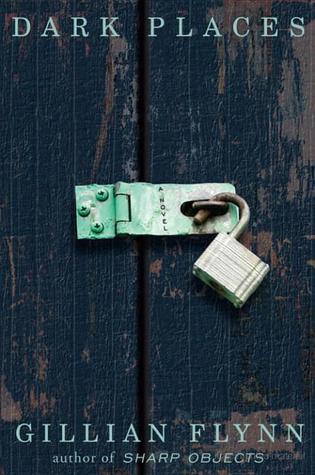
Review: Dark Places

5886881

Review for “Dark Places” by Gillian Flynn (2009)

Rating: 2 out of 5 stars

I didn’t care for this book.

Ok, ok…let me explain myself. Perhaps I went into this one somewhat biased. My only other Gillian Flynn experience was Sharp Objects and didn’t like that one either. Flynn is a great writer, but her characters–diabolical, twisted females–seriously make me wonder if she has some deeply seated psychological issues with women. Fast forward to 3 years later and I decide to give Flynn another try. But lo, I didn’t like this one either.

The plot: Twenty four years ago, Libby Day’s mother and two sisters were brutally killed in the infamous ‘Satan Sacrifice’ murders of Kinnakee, Kansas. She testified that her brother Ben was the killer, and he was found guilty and locked away in prison. Today she is out of work, living off of sympathy donations from strangers. When a crime enthusiast group called the Kill Club reaches out to her about the murders, Libby agrees, for a price, to talk with them. From there, Libby begins to question Ben’s guilt and what really happened on that night.

The first quarter of this book actually starts off promising. Its dark with sinister undertones, with just the fair amount of suspense to keep you turning the page. But then it just gets…well, boring. It flashes between Libby in the present and Ben and their mother Patty in the past, leading up to the night of the murders. Ben’s narrative is far more interesting than Libby’s, but both scenes are drawn out in such painstaking detail that the suspense wore off and there wasn’t much to compel me to care anymore about any of the characters. The parts of the novel where I was supposed to be sitting on the edge of my seat I wasn’t, and when the murderer was revealed at the very very end it was such a WTF moment that I stopped reading it right then and there. I won’t reveal it, but it’s the most contrived, ridiculous, deus ex machina bullshit I’ve ever read.

So there you go: two stars. Slightly better than Sharp Objects, but not by much. I may read Gone Girl eventually, though I seriously doubt it. I like Flynn’s writing, but I think her stories and subject matter are just not my cup of tea. I’ll pass.

Review: Dime

23271669

Review for “Dime” by E.R. Frank (2015)

Rating: 5 out of 5 stars

This book is horrifying and heartbreaking. I was holding out on four stars, but this book is incredible. Five stars.

When the novel opens, Dime (we are never told her real name) is a 13-year-old girl living in a foster home in New Jersey with a guardian who drinks and physically abuses her. Her only true love is reading, which she quietly does whenever she has a moment in between caring for her foster siblings and fighting off the sexual advances of her foster brother. She walks the streets cold, sick, and hungry in the evenings until she meets another young girl who takes her home to meet her ‘boyfriend,’ a charismatic, smooth talking man named Daddy. Dime becomes enamored with Daddy, whom she soon discovers is a pimp. Dime resists the reality of her situation until she is told that in order to ‘earn’ Daddy’s love, she must bring him money and work the streets.

This book is gritty and raw. It spares no details of all of the ugly realities of human trafficking you’ve probably already seen on tv. Dime describes in vivid detail the particulars of being regularly beaten and raped, along with life on the street as a pimp’s ‘property,’ sex work in dirty hotels, degrading sexual acts requested by johns. It’s adult stuff, yet this book is completely appropriate for a YA audience. Although I cringed through most of the story because even though she only hints at times of what’s going on, I knew what was happening to this 13-year-old child. Dime manages to detach herself from the ugliness around her and never quits school (even though she’s encouraged to), never stops reading, and towards the end of the story, begins to see her way out of a life of prostitution.

I’m determined not to spoil this book for this review. However, I was definitely impressed with this novel. Dime is such a likeable girl that you can’t help but to root for her in the face of such insurmountable odds. It took me about 4 days to read this book and all through that time I could not help but to think about her and the thousands of girls just like her being held against their will.

This book is definitely a must-read. Get this book right away!

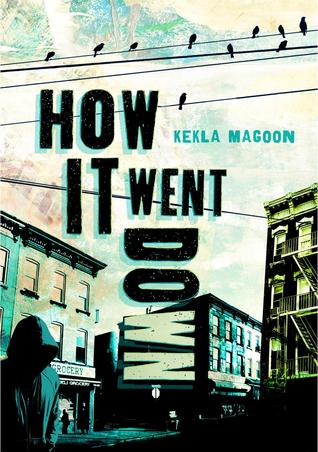
Review: How it Went Down

20517379

Review for “How it Went Down” by Kekla Magoon (2014)

Rating: 2 out of 5 stars

One of the struggles I remember having as a middle school teacher was finding books about current issues that are timely and relevant to urban youth. In 2012, I was teaching 8th grade when Trayvon Martin was shot and killed by a neighborhood watch guy in a supposed act of ‘self defense’ near Orlando, Florida. None of my students were there, but I remember the deep sense of anger that they felt about it. Perhaps they understood for the first time in their young lives that because of the color of their skin, their lives were expendable. Perhaps they saw their own mortality in the picture of a young man dressed like them in a hoodie in a country that doesn’t give a damn about their success or failure. Whatever their reasons were, I remember them coming to school in the days after the shooting went down wearing hoodies, carrying Skittles (reportedly young Treyvon had a bag of Skittles when he was murdered), practically daring the teachers and admins to say something to them about it. I remember giving a lesson in response on the complexities of the Stand Your Ground law and how most of them perked up, excited that I took the time to even care about an issue that interested them.

Fast forward to 2014. How it Went Down is published. It’s a fictional story but has all the earmarks of the Trayvon Martin case. It’s a moderately paced urban tale about the events surrounding the shooting of a unarmed young black man by a white man who mistakes a Snickers bar in his pocket as a gun. It’s a powerful and relevant story, and the two stars I’m giving it have nothing to do with its message or its sense of importance in today’s society.

I just didn’t like the way this story was written. For me, there were too many perspectives (the victim’s mother, the shooter, the shooter’s friend, bystanders, the victim’s sister, the victim’s friends, a minister, etc) —everybody has a ‘say’ in this story and it was far too confusing for me to keep track of who is saying or doing what. There are labels at the top of each section before each character speaks, but with over a dozen people ‘speaking,’ it was just too much. About a third of the way in I tossed my hands in the air and didn’t finish. While I’m not knocking the inclusion of the differing perspectives, I didn’t like the manner in which it was included here. I have no doubt that multiple perspectives are absolutely necessary–especially in the hazy aftermath of sudden movements and adrenaline responses. We will probably never know what truly went down in Florida, in New York, or in Ferguson, only that a young man is dead and another gets to walk away scott-free, the outcome already decided due to the color of their skin.

I would not recommend this for personal reading satisfaction. I would, however, recommend this to people who were in the situation I was in in 2012, desperately searching for reading materials to penetrate the zeitgeist of today’s youth.

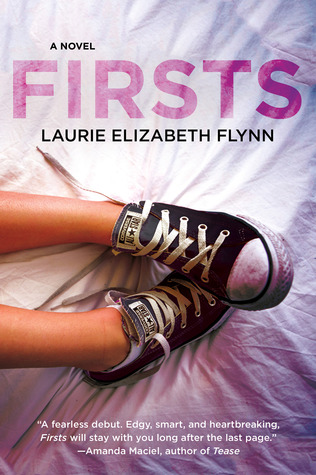
Review: Firsts

23480844

Review for “Firsts” by Laurie Elizabeth Flynn (2016)

Rating: 1.5 out of 5 stars

Man, this book sucks…

Possible spoilers abound. #sorrynotsorry

Mercedes (or, Mercy) Ayers is a 17 year old girl who provides a unique ‘service’ to the boys at her high school. Boys looking to get their first time awkwardness over with and ‘learn the ropes’ come to her for their first sexual experience. All she asks for in return is their secrecy and that they give their girlfriends the perfect first time, something that she herself never had. All goes well until she hits a snag with Zach, a boy who wants to be more than just an occasional a sex partner, and her best friend Angela, a ‘prayer group nerd’ whose boyfriend Charlie throws a monkey wrench into Mercedes’ life.

Lemme say this: I knew this book would be about sex. Sex scenes, sex positions, sex, sex, sex. I don’t have a problem with it, but the way it was executed was way over the top–particularly for a high school context. Like who would think there would be so many male virgins at ONE school, scared of how they would perform sexually? Mercedes also spends extensive amounts of time with other things sex related, like her lingerie collection (satin, leather, lace, negligees, etc). Dude, she’s seventeen. How does she know so much about this topic? Yeah, she’s no virgin, but the author portrays Mercedes as practically a porn star with specific knowledge on how to please each boy she takes on, based on his perceived attributes. Bitch, please.

As far as the character herself…make no mistake, girlfriend is a train wreck. Mercedes’ mom (not called Mom, but by her first name, Kim) is a liquored-up, Botoxed divorcee who’s never at home, her father abandoned the family long ago, and “her first time” was far less than ideal. The author spends a lot of time in this novel discussing Mercedes’ home life, trying to get you feel for her and to empathize with why she does the things she does. And I understand, I really do. But come on…I’m not saying Mercedes is a bad person for having sex (she does use condoms, btw) but did she really think she could have sex with a double-digit number of guys at one high school and for it not get out? And not just any guys, but OTHER PEOPLE’S BOYFRIENDS? Come on, now. I’m not one for slut-shaming, but you can’t blame an entire school for incurring their wrath upon her once they heard the truth about her side chick exploits…

I just can’t believe this book is anywhere near a realistic portrayal of the sex lives of high schoolers. I know it’s been a long time since I’ve been in high school, but still. No way.

Review: The Vegetarian

25489025

Review for “The Vegetarian” by Han Kang (2016)

Rating: 4 out of 5 stars

This book is bananas…

To tell you too much about it is to spoil it, which I’ve decided not to do for the purposes of this review. However, this was a very well-written, eloquent story. I enjoyed reading Han’s words even if I didn’t really completely get the plot just because they invoked that kind of beauty.

The story centers on a typical Korean housewife, Yeong-hye, who, after having a series of violent dreams, decides that she is not going to eat meat anymore. Her husband, Mr. Cheong, is shocked at this revelation and does not know what he is going to do with her. From this point, there is a brewing conflict in their home which ultimately reaches into Yeong-hye’s immediate family and she goes into a downward spiral of madness and starvation (and a few more things I won’t reveal here) as a result.

This book is interesting in that it is split into three novella-length parts, and Yeong-hye is not the primary narrator of any of them. The first part is told by her husband, Mr. Cheong, the second by her brother in law, J, and the third by her sister (and J’s wife) In-hye. Only during the first section does Yeong-hye occasionally interject, but only to tell of the disturbing content of her dreams that lead her to give up meat. Each narrator has their own agenda, and the reader only knows of Yeong-hye though their lens.

This book is extremely short (less than 200 pages), but there was a LOT here. This is a book that ultimately I will probably end up reading again to fully understand, just because the plot was THAT heavy in symbolism and meaning. In here there’s brutal violence juxtaposed with beauty, complacency alongside action, and an reprehensible act involving a dog that truly gave me nightmares. I think this book grasps at a much larger message: how trauma in one person’s life ultimately creates ripples in a metaphorical pond that affects other people.

I must say though that now Han Kang is a writer that is on my radar. She has another book she’s written that is not available in the States that I am desperately trying to get a hold of now, and I eagerly anticipate more of her work to be translated into English.

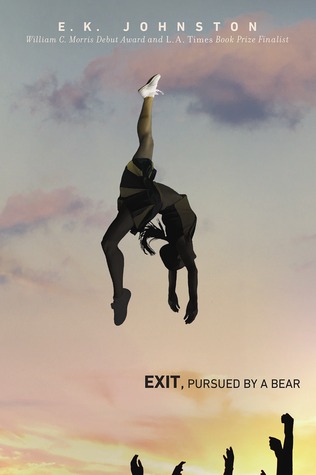
Review: Exit, Pursued by a Bear

25528801

Review for “Exit, Pursued by a Bear” by E.K. Johnston (2016)

Rating: 2 out of 5 stars

As soon as this book came up on NetGalley I immediately wanted to read it. I didn’t request it there because I’ve got so many books in my NG queue (I’ll probably be reading until Christmas), so I downloaded this from Amazon. At only 250 pages it’s a quick read, but one that completely perplexed and frustrated me. Let me explain.

NOTE: Spoilers abound here. #sorrynotsorry

Hermoine Winters is a talented cheerleader in a small Canadian town, surrounded by friends and high expectations for her senior year. On a summer evening during the last night of cheerleading camp, she is slipped a drug in a drink by an unknown assailant and raped. When she awakens, she remembers nothing of the attack.

In theory, I should have loved this book. Hermoine defies everything about a rape ‘victim’ that we have ever been previously told or read about. She is bold, undeterred by people’s whispers and stares, and determined to move on with her life. Her friends, family, cheerleading coach, and her therapist rally to her side and support her. But that’s where the ‘good’ part of this book ends. I had incredible difficulty with Hermione as narrator. She is so emotionally detached here that she may as well have been on another plane of existence. Her whole ‘I don’t remember it, I’ll be ok’ attitude perplexed me. I understand that this is more than likely due to the trauma of not remembering her attack, but it distanced me from the story and did not make for a compelling narrative here. There were also deeper, more introspective events in the story that warranted discussion that were glossed over by the author with little to no fanfare at all. Her best friend comes out as a lesbian. Hermione has an abortion as a result of the rape. Although she senses who her perpetrator was, he is never caught or prosecuted. Throughout the book I kept waiting for that YES! moment in the story for Hermione to break out of her shell and claim her right to get fucking angry, but it never happened. The story managed to take all of its issues and wrap up neatly and then…exeunt.

A blurb in the back of the book by the author discusses how she wanted to stress the importance and value of support networks for rape victims. I certainly understand this, but perhaps this trope is overstressed here, to the detriment of the believability of the book. I mean, shit…we live in a society that still does not know how to discuss or even begin to address rape as an actual crime. The fact that there continues to be a raging debate over whether or not Bill Cosby’s admitted drugging of women was wrong in the year 2016 shows that many people still do not even consider this deplorable action to be a crime. Hermione drifts through this book facing the scorn of no one, and, other than an unnamed reporter who tries to slut-shame her, she faced little, if any, actual on-screen harassment. Her reality just did not feel real, it felt rushed and unrealistic.

Overall, the writing here is nothing to brag about. It wasn’t the point though, as I would have went higher in my rating had the main character connected with me. I’ve praised many books where the writing wasn’t that spectacular, but I formed a bond with the character. Despite my harsh criticism, I do recommend this book. Just because the main character did not connect with me does not mean she will not with you, or that you won’t get anything out of this book. If anything, I came away from this novel appreciating the fact that the author chose to write about the topic of rape/sexual assault, as it takes courage to do so.