Review: This is Where it Ends

24529123

Review for “This is Where it Ends” by Marieke Nijkamp (2016)

Rating: none

DNF’d at 250 pages. Yep, I was actually almost finished. But the horror of this…oh no, not today, Satan…

What this is: a narrow, ridiculously unclever book told from the perspectives of four students in an Alabama high school surrounding the events of a 50-minute shooting spree/hostage situation. Several students, teachers, and the principal are gunned down after the student shooter traps the unsuspecting student body in the auditorium during an assembly and kills some and terrorizes others for nearly an hour. The characters are bland and indistinguishable from the other, and the shooter is so cartoonish in his evilness it’s laughable. It’s literally just bang bang bang…then one of the characters presents us with a flashback. You get to the end and find out that he shoots and kills his classmates not because he was bullied or had a mental problem or he was angry but because well…he wanted to.

Maybe it was the violence at the LGBTQ club in Orlando the night before that caused this book to strike such a sour note for me. I am not saying that mass shooters aren’t evil, but the acts they commit cannot afford to be reduced to such simplicities. I don’t shun violence in literature, but it pays to give those who perpetrate it depth, specifically if you would like to understand why it occurred in that particular context in the first place.

I recommend Jennifer Brown’s “Hate List,” Jim Shepard’s “Project X,” and Shaun David Hutchinson’s “Violent Ends” if you’d like more fleshed out, realistic, and thoughtful discussions of school violence in YA literature.

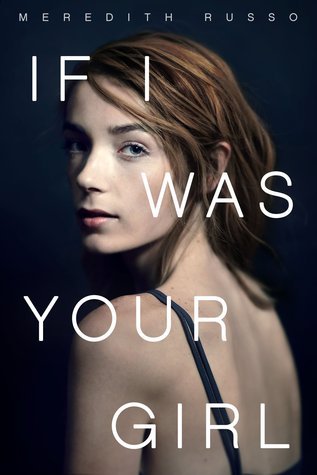
Review: If I Was Your Girl

26156987

Review for “If I Was Your Girl” by Meredith Russo (2016)

Rating: 5 out of 5 stars

This is truly a book after my own heart. It’s really really good, and I mean that. I had heard a lot of buzz about this book before it was published, so after a few weeks of watching my reserve status at the library, I finally got a notice to pick this up. Needless to say, I read this book in three days. I only paused to work on my lit review for my summer class, eat, and sleep.

Yes, it was that serious. This book had my soul.

“If I Was Your Girl” is the story of Amanda, a male to female transgendered teenager. When we first meet her, she has just moved from her mom’s house in Atlanta where she has recently been physically attacked to her dad’s apartment in a small town several hours away. At her new school, she quickly attracts the attention of a popular athlete and they begin a romance. Amanda is also surprised by how fast she makes friends and gains their trust, yet never revealing her own secret because she knows that her life could be in danger.

I can’t tell you how this story compares to other stories of transgendered individuals, because I have to admit that this is the first of its kind that I’ve ever read before. There is no discussion of genitals or body parts, because from the first page you are simply seeing the character as you are intended to see her–as a girl named Amanda. There are several flashbacks throughout the book that give you a bit of info on Amanda’s past (instances of bullying, a suicide attempt, her parents’ divorce) but from this I came away with even more of an appreciation of Amanda and her bravery to live her life in the way that makes her happy.

There is a note by the author at the end that clears up some of the criticisms I could have made about this book. For one, Amanda is able at a young age to have the surgery and access to the hormones that so many cannot afford. She’s also able to seemlessly transition into life as a female (she’s told that she’s beautiful, other people cannot tell that she was born male). The author writes that she did this so that readers could fully accept Amanda as a teenage girl. There is so little fiction right now that focuses on the trans community, so I think the author gives a decent argument for why she chose to portray Amanda this way.

“If I Was Your Girl” is one of those stories that, in my opinion, has to be out there right now. The fact that the author gives numbers for suicide hotlines in the conclusion shows that as a society, we have not progressed as far as we think we have when it comes to accepting people as they are. As a resident of North Carolina and home of the HB2 legislation (the infamous ‘bathroom bill’ that bans transgendered people from using the restroom that coincides with their chosen gender) makes it all the more important that we hear stories like Amanda’s and remind ourselves that she and people like her are real people who deserve legal protection, consideration, and respect–just like anyone else.

Needless to say, I loved this book. If you read nothing this year, save room on your TBR list for it. You will NOT be disappointed!

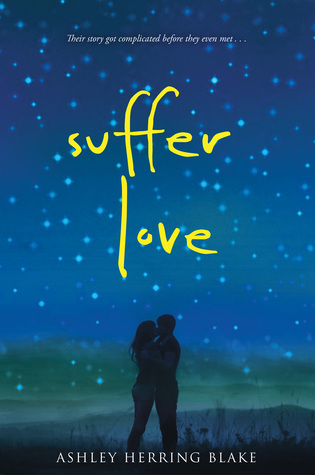
Review: Suffer Love

25897851

Review for “Suffer Love” by Ashley Herring Blake (2016)

Rating: 3.5

First impression: mehhh….

Hadley St. Clair and Sam Bennett are two teenagers that have gone through an emotional wringer in the past year, and just so happen to be paired together by chance for a school project. Hadley’s dad, a college professor, had an affair with Sam’s mom, a graduate student, which leaves everyone involved (including the children on both sides) angry and emotionally despondent. Very early on, Sam learns who Hadley is and despite his misgivings, starts to fall in love with her. He chooses not to tell her what he already knows about her. Meanwhile, Hadley likewise begins to fall for Sam, completely unaware of his connection to her family. This novel follows their courtship, the revelation of the secret that binds them, and their eventual ending.

The writing of this book is quite nice. I managed to get sucked in early on and found myself not wanting to put it down. Sam and Hadley narrate in alternating chapters, which I liked, as their voices are very distinct and allow the story to unfold quite nicely.

So why 3 stars?

Despite the ‘niceness’ of this book, it never seems to rise out of generality, its own bland pedestrian-ness. Think: a taco with no sauce, sweet tea with no sugar. Sam likes Hadley, Hadley likes Sam. It stays this way for about 100 pages. Ho hum. We know their parents are cheaters, but why? We’re never given a reason why their seemingly perfect parents screwed around or why their kids know so much about their sex lives. There is a hint toward the end of forgiveness and normalcy, which I guess makes this a cool book overall, but there were so many Dr. Phil moments that I wondered why the author bothered to go there. This book is pretty on the surface, but ultimately lacks depth, which makes it just ok for me.

Review: Golden Boy

16099325

Review for “Golden Boy” by Tara Sullivan (2013)

Rating: 4.5 out of 5 stars

Ay, I loved this story.

Before I read this book, I was only slightly aware of the killings of albinos in Africa, specifically in the country of Tanzania. Tanzania, an eastern African nation, is home to an above-average number of albinos, who are targeted for murder by witch doctors and folk healers because it is believed that their skin, hair, and body parts will bring good luck as ingredients for potions and other rituals. In addition to this, they are ostracized in their own families and communities–discriminated against, abandoned, cast out, sometimes even killed as infants.

13-year-old Dhahabo (called ‘Habo’ for short) lives in a small Tanzanian village with his mother and siblings. His father, we learn, left when he was an infant, convinced that his albino son was a portend of bad luck. His mother shows little emotion towards Habo and has reduced herself to tolerating him. His brothers ridicule him, he has no friends. Everyday life fares no better–because of the lack of pigmentation in his eyes, Habo cannot see very well. His skin easily burns in the sun and he is forced to stay indoors, which makes him useless in the eyes of his family. The only one who shows him any hint of kindness is his older sister, Asu, who makes a point to look after him. When dire straits strike the family, Habo and his family leave their village and go to another, where he is shunned once more by his aunt and forced to hide there, due to the fact that her village is known for the murder of albinos. Eventually Habo leaves this situation as well and goes to the larger city of Dar es Salaam, where he finds himself face to face with a man who is determined to murder him for his body parts.

I won’t give away the whole story, but I will say that it is definitely a good one. Habo is a person who you can’t help but to feel empathy for. You want to give him a hug and invite him home for tea. Despite his lot in life, there isn’t a bad bone in his body. When he describes the stares and the pain he feels when people call him a zeruzeru (a word that literally means “zero”, “nothing”) you feel the same pain he feels. It touches your heart.

This novel was a classic adventure story. The author did some great research, and it definitely shows in the writing. Habo’s journey is incredible and worth reading about. Its completely appropriate for middle schoolers, not too weird and definitely not boring

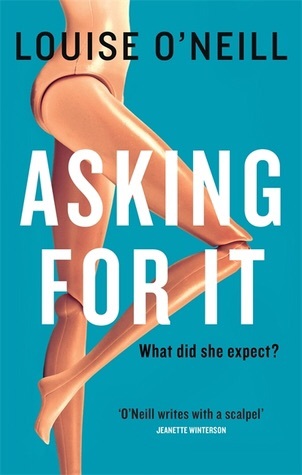
Review: Asking for It

25255576

Review for “Asking for It” by Louise O’Neill (2016)

Rating: 4 out of 5 stars

This book hits you like a sledgehammer. It’s sad, it’s sadistic, it’s cruel. It makes you angry. You want it to be false, pure fiction made up by an ambitious author. But you know from the headlines dealing with this topic that it’s all true, way too realistic.

Emma O’Donovan is an 18 year old high school student in a small Irish town. She’s gorgeous, smart, a promising student, surrounded by beautiful friends and a loving family. In the standard YA novel Emma would be the stock ‘mean girl’ character, the popular bitch, the Queen Bee we love to hate. Because the story is told through her point of view, you are privy to all of her thoughts, many of which are downright obnoxious. In the first pages of the book you learn that she is actually quite insecure–she’s shallow, narcissistic, and jealous of anyone who makes an effort to be part of the same attention that she desperately seeks. When it comes to boys, Emma must be noticed. When they don’t, she wonders why.

One night, Emma and her friends go to a party. She flirts with other boys, including the boyfriend of one of her friends. She drinks heavily, she has consensual sex with one of the guys there. She willingly takes a pill that a partygoer gives her, which causes her to lose consciousness. She awakens on her front porch with no underwear and her dress turned inside out, sunburned and bleeding, with no memory of the night before. Pictures of her gang rape by 4 male classmates are uploaded on social media. People make comments. No one questions the boys. Everyone hates her.

Emma is left to deal with the consequences of that night, and they are awful. Her friends shun her, her parents are ashamed of her. The community blames her. She acted like a slut, she got what she deserved. She took drugs. She drank. She flirted with other boys, and yes, did have consensual sex with one of the accused at the party. She changed her story to the police. She contacted another of the accused boys after the incident. The bullying that she is subjected to by her peers was some of the most sadistic instances of harassment I’ve ever read before. It’s terrible.

Louise O’Neill’s decision to make Emma O’Donovan’s character an unlikeable one was a bold move. No one feels sorry for this victim, and in a lot of ways, YOU don’t either. The author’s choice to portray Emma in all of her flawed humanness forces you to confront your own prejudices about what rape is and what a rape victim is supposed to ‘behave’ like. It’s a spot-on, timely book; specifically in today’s age, where we are still (in 2016, mind you) debating the very definition of rape and consent.

The ending was just that, an ending. It isn’t happy. Nobody apologizes to Emma, nobody gets their day in court. Nothing is wrapped up. The scorn of the community continues, and Emma’s emotional torture (by others and upon herself) does not end. She will deal with this ugliness for the rest of her life, and she knows it.

This is a book that makes you pause and think. It’s not so much plot driven as it is a character study that is meant to challenge our understanding of what a rape victim is. In a perfect world we would extend Emma our support because she was taken advantage of without her consent. We would care. Sadly, we don’t. Louise O’Neill reminds you that it still isn’t a perfect world, and crimes like this continue to go on, whether it’s in Ireland or America or anywhere. It’s an ugly story, and I was all too glad to read and learn from it.

Review: Sweet Lamb of Heaven

26530341

Review for “Sweet Lamb of Heaven” by Lydia Millet (2016)

Rating: none

DNF’d at 60% in my Kindle.

I’ve been on a DNF kick lately, stopping books left and right because, well, f**k it…I have the power of Grayskull and I can. My TBR pile is a beast right now, and I firmly believe that life’s too short for bad books, slow books, stupid books, books with no point. DNF is not always a bad thing: sometimes I’ll stop reading because I just can’t get into it right then (not the right mood, season, or mindset) and I’ll come back to it a year or two later and it’s the best thing I’ve ever read. It’s happened before. I normally don’t review DNF books, because I try to bring you complete and thorough reviews, but it was clear with this one that what I got was all I was going to get.

Anywho, at the beginning of this book we meet Anna, who is pregnant with a child that her dick of a husband, Ned, does not want. She has the child anyway, a daughter she names Lena. She eventually chalks up the loss of the marriage and leaves Ned and moves across the country to Maine. Ever since the birth of her daughter, Anna has been hearing a voice that only occurs when her daughter is around. Throughout this book are blurbs from Wikipedia and other sources on what could possibly be the source of the voice–psychosis, possession by demons, etc. It’s boring to read. Ned eventually catches up with Anna, and about here was where I stopped reading.

As far as the writing, it’s actually good. It rambles at times, a stream-of-consciousness kinda style that never really grew on me. Because the main character hears voices only when her daughter is around, there’s a heavy case here for an unreliable narrator. There is a sense of foreboding and dread, which was very skillfully played all throughout this book, but that was about it for me. This novel is being marketed as a psychological thriller–and in a way, it is that–but there was never a ‘thrill’ here for me, just circles of weirdness and Wikipedia entries and me wondering if I should even continue to bother with Anna because I don’t know if she is crazy or not.

Another reason I am reviewing this book (even though I didn’t finish it) is because I do recommend that people out there read it. If possible, please report to me what you got out of it, if anything at all. Pretty pretty please…

[Note: I received a digital copy of this book from NetGalley and W.W. Norton Publishers in exchange for an honest review of this book.]


Review: Girls on Fire

26074200

Review for “Girls on Fire” by Robin Wasserman (2016)

Rating: 5 out of 5 stars

Whoa, buddy…

When I finished this book, I shut off my Kindle and stared at the ceiling for about 10 minutes, thinking: whoa, buddy.

“Girls on Fire” is the story of a destructive friendship between two teenage girls in a small Pennsylvania town. Lacey is the dark, brooding, Nirvana-crazed rocker, Hannah is the mousy, quiet girl from a straight-laced family. Set in the early 90s, the story opens with the shocking discovery of the body of a popular athlete in local woods, ruled a suicide. Lacey and Hannah (called “Dex” by Lacey and throughout the book) bond over their hatred of the athlete’s girlfriend, Nikki Drummond, the beautiful ‘queen bee’ of their high school.

What follows after Lacey and Dex collide is nothing short of intense, with detailed descriptions of their adventures with sex, drugs, and satanic experiences. The novel is told in a dual perspective, with alternating chapters by both Dex and Lacey. There’s lots of Nirvana (particularly Kurt Cobain) mentions through this book, as well as other 90’s pop culture references to give you an excellent sense of time and place. People not hip to this decade’s charm may find the nostalgia annoying, but as a teenage myself during this time in history, I did not.

I can’t tell you guys how lovely the writing is in this book. I think I malfunctioned my Kindle with the constant underlining of passages. Some chapters were so freakin’ beautiful that I had to read them aloud, write them out for myself. Once this book really got going for me I could not put it down. Dex and Lacey are equal parts unlikeable and complex. One moment the mother in me wanted to hold them close, the next moment the practical side of me wanted to lecture them, to try to plant some common sense into their brains. It’s a captivating tale, and I was all along for the ride.

Be forewarned, however, that this is a very dark novel. Think: Gillian Flynn. Think: Stephen King’s “Carrie.” It’s not YA, and I don’t think it has a prayer to ever be considered such. If you don’t mind dark stories (non-humorous, just dark) then this is the book for you (note: personally I love gloom and doom every now and then, it helps me to balance out the scarily bright and cheery). Do read this book though, if you get a chance. I can’t recommend it enough.

Review: One

23524610

Review for “One” by Sarah Crossan (2015)

Rating: 4 out of 5 stars

Loved this book. It’s written in verse so it’s a quick read, a couple of hours of uninterrupted time will take you straight to the end. Anyway, “One” focuses on a unique topic I’ve never seen in fiction before: the lives of conjoined (or, “Siamese”) twins. Due to this fact, Tippi and Grace (I love their Hitchcock-themed names, btw) are typical teenage girls that share vital organs and have never attended school–until now. This book follows them on their first day at school and beyond, on their quest for a sense of normalcy in their lives.

However, Tippi and Grace’s home lives are no picnic. Their dad is a drunk, their sister has body issues of her own, and their family has little money, which leaves the family with the difficult choice of deciding whether or not to allow a film crew in their home to document Tippi and Grace’s lives. Eventually a dire medical situation arises with the twins’ health and they must decide whether to stay “one” or be separated.

I won’t reveal the end, but I will say that this book was a definite tearjerker. For me, it says a lot about a novel written in verse, because I typically like my fiction to read like fiction, with neat little paragraphs. However, this book was special. There were passages I found myself reading aloud because they seemed to leap right off of the page. Beautiful writing.

I rated this four stars because this book isn’t without its flaws. For one, it is narrated completely from Grace’s point of view, which is somewhat of a end spoiler. A dual narration probably would have kept the suspense going at least until the middle of the book. Second, it just kinda…ends. You never find out what happens with many different aspects of the story that seemed to be quite critical.

I definitely recommend this book. And bring a box of tissues.

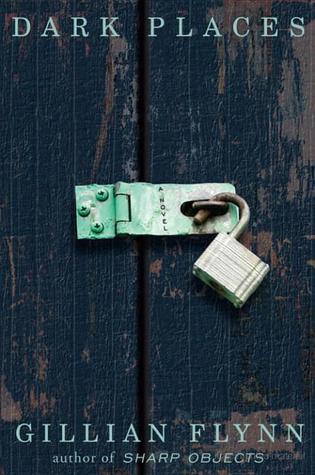
Review: Dark Places

5886881

Review for “Dark Places” by Gillian Flynn (2009)

Rating: 2 out of 5 stars

I didn’t care for this book.

Ok, ok…let me explain myself. Perhaps I went into this one somewhat biased. My only other Gillian Flynn experience was Sharp Objects and didn’t like that one either. Flynn is a great writer, but her characters–diabolical, twisted females–seriously make me wonder if she has some deeply seated psychological issues with women. Fast forward to 3 years later and I decide to give Flynn another try. But lo, I didn’t like this one either.

The plot: Twenty four years ago, Libby Day’s mother and two sisters were brutally killed in the infamous ‘Satan Sacrifice’ murders of Kinnakee, Kansas. She testified that her brother Ben was the killer, and he was found guilty and locked away in prison. Today she is out of work, living off of sympathy donations from strangers. When a crime enthusiast group called the Kill Club reaches out to her about the murders, Libby agrees, for a price, to talk with them. From there, Libby begins to question Ben’s guilt and what really happened on that night.

The first quarter of this book actually starts off promising. Its dark with sinister undertones, with just the fair amount of suspense to keep you turning the page. But then it just gets…well, boring. It flashes between Libby in the present and Ben and their mother Patty in the past, leading up to the night of the murders. Ben’s narrative is far more interesting than Libby’s, but both scenes are drawn out in such painstaking detail that the suspense wore off and there wasn’t much to compel me to care anymore about any of the characters. The parts of the novel where I was supposed to be sitting on the edge of my seat I wasn’t, and when the murderer was revealed at the very very end it was such a WTF moment that I stopped reading it right then and there. I won’t reveal it, but it’s the most contrived, ridiculous, deus ex machina bullshit I’ve ever read.

So there you go: two stars. Slightly better than Sharp Objects, but not by much. I may read Gone Girl eventually, though I seriously doubt it. I like Flynn’s writing, but I think her stories and subject matter are just not my cup of tea. I’ll pass.

Review: Inside the Criminal Mind

Remember when I said that I’ll never review nonfiction? Well, I kinda lied. Not in a bad way, though. I read NF all the time, I just prefer not to write about it here.

This book is different. I had to read it for a class I’m taking on social deviance, so therefore the ‘review’ was already there. I had to type it last night, so I’m sharing it here.
587876

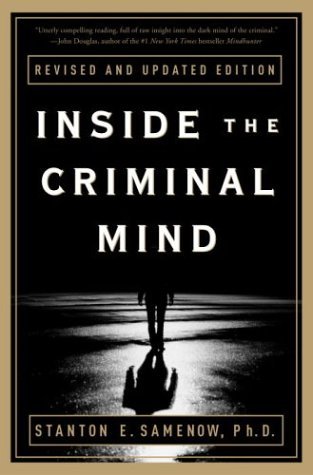
Review for ‘Inside the Criminal Mind’ by Dr. Stanton Samenow (2004)

Rating: 1 out of 5 stars

I read this for a doctoral level class I’m taking in Social Deviance. I wish I hadn’t though. In this book, Dr. Samenow sets out to answer the age-old question of why criminals commit crimes and spends 50,000 words (or how ever long this book is) answering, simply, “well, because they choose to.”

Don’t get me wrong. I am not the one to coddle or play hug-a-thug either with the big bad wolves of society. I did agree with some of the points he makes here. Samenow says that criminals are usually narcissistic, selfish people who feel entitled to the finer things in life (agreed) and feel that they shouldn’t have to work for them (agreed). Their need for power and validation feeds into their desire to victimize others in whatever way they can–fraud, sexual assault, robbery, etc (agreed). Work places, schools, family units, and other social institutions are where they hone their con game, and if and when they’re caught and locked up, they’ll hopefully change their thinking (agree). Samenow is adamant that prisons, rehabs, reading programs, and career counseling will not change the criminal because of how he thinks. He scoffs at sociologists who point to indicators such as poor schooling, drug abuse, lack of job opportunities, mental illness, poverty, and other factors as the reasons why people turn to crime.

And I understand this, I really do. But how can Dr. Samenow completely dismiss these sociological viewpoints? Most of the case studies of criminals he gives in this book are of middle class men he has interviewed–men who came from the so-called ‘normal’ two-parent homes, whose folks more than likely had the resources for therapy, and, who despite all of their efforts, still went on to choose a life of crime regardless. One cannot help but to notice the lack of socioeconomic diversity in this book, which, I’m sad to report, makes this book terribly biased. While I am not saying that all poor people are criminals (nor are all criminals poor), one cannot deny the effects of poverty and class stratification on a large number of the people in our criminal justice system. Poverty itself does not cause crime, but it definitely leads to the illusion that illegal means are necessary to achieve prosperity.

Another jarring problem with this book is how Dr. Samenow talks about criminals as one homogeneous group. We know that a woman who is addicted to crack cocaine and sells her body for profit and a Jeffrey Dahmer-like sex predator/murderer are both criminals according to the law, but are they really in the same category of deviance? According to Dr. Samenow, there isn’t much of a difference between a weekend ecstasy user and John Wayne Gacy. He also disregards ‘addiction as a disease’ pathology and with it, pretty much everything that’s been written in the field of human psychology for the past 25 years. As a psychologist, you would think he wants to understand what really drives people to do what they do beyond the most obvious, the motivator of choice.

I got almost zero information from this book. I imagine that this book is hot with prosecutors and other right-wingers who want to ‘get tough’ on crime by locking up people doing everything from robbing a bank to stealing a chicken. It doesn’t make it correct though. Not in the least.