Review: The Fishermen

22875103

Review for “The Fishermen” by Chigozie Obioma (2015)

Rating: 5 out of 5 stars

This is one of those books that you pick up and time stands still, because you’re so engrossed in what’s going on that nothing else seems to matter. I picked this up at the library on a Friday afternoon and sat right down on the couch there and dove right in, not realizing that an hour had passed and librarian dude was standing next to me, about to tap me on the shoulder to warn me they were about to close.

“The Fishermen” is the story of four brothers–Ikenna, 15, Boja, 14, Obembe, 11, and Benjamin–who is 9 years old when the story begins. The novel is told from the point of view of the youngest child, Benjamin, who looks up to his brothers and decides to join them when they begin skipping school to fish at the local river. At the river they encounter an outcast, a local madman who makes a terrifying prophecy: that Ikenna will be murdered by one of his brothers.

From this point onward, nothing is ever the same. Each of the brother’s fates change for the worst and the entire family as a stable unit gradually becomes undone. But this is more than just a retelling of the Biblical story of Cain and Abel, this book has all of the complexities of a Shakespearean tragedy. There is a lot of violent imagery in this novel, coupled with beautiful words that I found myself going back and reading over and over again. There are also thoughtful references to the work of Chinua Achebe, and one can’t help but to read this book as an allegory of the African continent–ravaged from the outside and left to corrode through corruption, greed, and other inside forces.

When I checked the Internet for some info on this book I saw that it had been long-listed for the 2015 Man Booker Prize. I do hope it wins a major prize, it’s really that good. Loved this, A+

Review: Cutter Boy

27788155

Review for “Cutter Boy” by Cristy Watson (to be published in September 2016)

Rating: 2 out of 5 stars

As I’ve said earlier, the 10 years I spent as a 7th and 8th grade Language Arts teacher guides my reading choices. In addition to simply liking the genre, I often I select YA books to see how they deal with particular issues in our society. This was one such book. Right now I’m undecided about this. Three stars is out of the question, two is being generous here.

The rundown: Travis is bullied in school and ignored by his parents at home. Cutting himself with a razor blade is the one way he finds relief from his anguish and a way to control his pain. He becomes friends with a girl at school, Chyvonne, and eventually reveals his secret to her. Inspired by an unconventional teacher and his new friend, he eventually takes up the art of paper cutting as a way to avoid harming himself.

While I appreciate the author’s attempt to write a book about boys who self harm (an important subject that doesn’t get written about much) the ending seemed forced and terribly unfinished. The suggestion that art is a better form of therapy than cutting is suggested as a resolution here, but further details beyond this are left out. For such a large problem that cutting can be for a person, the resolution here just seemed too convenient, too simple. I am not a person who self harms, but I do know people who do. Pushing a piece of paper in front of them to cut instead of their bodies is an interesting prospect, but hardly a ‘solution’ to resolving the anger, pain, and depression that drives them to cut in the first place. I also did not like the way that the act of cutting was romanticized either. We don’t need to read about “beauty” swirling down the drain, or the smooth surface of a razor being “like ice, like glass” to understand what you’re referring to. These are tired, boring metaphors that don’t really portray cutting as the harmful action that it truly is. Like just...stop already.

Character development is also lacking here, big time. Travis, Mom, Dad, Chyvonne, and “the twins” (Travis’ sisters) all seem to move about this story with no real solid sense of purpose. I still don’t feel like I know anyone any better than I did when I first started. For a book that aims to engage reluctant readers, this book succeeds, but that’s about it.

[Note: I received a free publisher’s copy of this book courtesy of NetGalley in exchange for an honest review.]

Review: Give Me Everything You Have: On Being Stalked

Hey there, folks!!

The semester is kicking my arse. I’ve been reading though. I’ll be back with my feature on Monday. Till then…

15793858

Review for “Give Me Everything You Have: On Being Stalked” by James Lasdun (2013)

Rating: 1 out of 5 stars

This book is so bad it’s laughable.

Being the curious person I am, the title drew me in. Stalking has always been a subject that’s received considerable attention, so I read it.

Man, I am SORRY I read this.

It’s supposed to be a true story. Sadly, I don’t believe much of it.

Mr. Lasdun is a creative writing professor at some college in NYC when he meets Nasreen, an Iranian student in his class who he believes shows talent in her writing. She asks him to look over her manuscript, and after several refusals, he eventually agrees to, as well as introduce her to his agent. Around this time they begin (in his words, of course) a “friendly” correspondence through email. At some point, Mr. Lasdun feels their conversation has gone too far and he reminds her he is happily married. This is the point where, according to him, all hell breaks loose. Nasreen begins a complicated campaign of online harassment, spreading accusations of plagiarism and rape among his colleagues, threatening him and his family, making anti-Semitic statements, etc.

But all that’s not my beef with this book. Although I do not feel like Lasdun is being completely honest (I do believe a little more happened between him and this student that he is not telling us), that’s not why this book got 1 star from me. You see, I don’t care about the drama. On page 30 I wondered aloud why this so-called ‘intelligent’ man didn’t just change his email and move the hell on with his life. It’s the execution of the story that fails miserably here. Mr. Lasdun tells you the stalking story, along with pages upon pages on extraneous information: musings on architecture, the writings of D.H. Lawrence, a 37 page train ride that had ZERO to do with the story. Oh God, and the last 55 pages of this had almost nothing to do with anything at all, the content is so far afield it’s almost like another book entirely.

I almost DNF’d this sucker had it not been for my extraordinary power of skimming to get to the end.

Don’t read this book. If you do decide to take the plunge, for God’s sake, don’t buy it. Get it from the library. Stand in Barnes and Noble and sip a latte and skim it. Read parts 1 and 3, skip 2 and 4. You’ll have the whole story right there. Guaranteed.

Review: Far From You

20517739

Review for “Far From You” by Tess Sharpe (2014)

Rating: 3 out of 5 stars

I didn’t like this as much as I probably should have. On the surface, it is quite perfect: a contemporary YA novel in which the main character is a bisexual teenage girl fighting an addiction to prescription pain meds, the suspicion of her parents, and solving the murder of her best friend. I should have been impressed. But I was only half-thrilled.

This is the story of Sophie, a teenaged girl living with her parents who is sent involuntarily to rehab after the murder of her best friend, Mina. She is clean at the time of the event, but because she is a recovering addict and cops found pills in her jacket at the scene of the murder, her parents and the rest of the community assume that the two girls got themselves in trouble, caught in a drug deal gone bad. Once she gets out of rehab, Sophie goes about solving the murder of her best friend and clearing her and her best friend’s name.

The book switches a lot between Sophie’s past, where we learn she was seriously injured in a car crash (her injuries are the reason for her subsequent painkiller abuse) and her present, where she tries to live with the trauma of losing her best friend. While I understand the author’s intention, every time the ‘time’ switched I almost felt like I was reading another, separate book. The novel moved from past, to present, to further past, to furthest past, back to present, back to further past, etc. Although there was a label whenever this happened (i.e., “two years back,” “now/June”), it was not a very cohesive narrative here at all. I am not arguing that this book need be presented chronologically, but the back and forth here was more of an annoyance than anything else. Add in the current murder mystery plot and it seemed as if there was way too much here being juggled at once.

Despite my problem with the logistics of the story, I did actually like the main character here. Sophie is strong, outspoken, and a survivor. This is also the first YA novel I have read with a bisexual female main character. I thought that Miss Sharpe did an excellent job with this–the character’s sexuality never overshadowed the narrative, and the narrative never overshadowed character’s sexuality–somehow these two components synced up and worked together perfectly. After reading the novel, I could totally understand how Sophie loved Mina and also had relationships with boys. In today’s society where a lot of teens are discovering their sexual identities, I thought the author’s choice to present a character in this way was a bold move, and a good one.

I must say, though, that the ending was kind of anti-climactic. You get to the end and you’re just like: really? As several other reviewers have pointed out, the larger point here did not even seem to be the answer to the whodunit, but the way Sophie handles life after trauma. All of which is cool, but why call this a mystery if the mystery wasn’t the point to begin with? Hmmm.

Solid 3 stars here. Read with caution.

Review: The DUFF: Designated Ugly Fat Friend

6931356

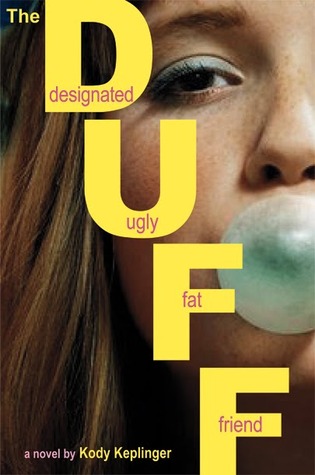
Review for “DUFF: Designated Ugly Fat Friend” by Kody Keplinger (2010)

Rating: none (did not finish)

DNF, dah’lings. Around page 55, I think.

I could practically feel my brain cells shrinking as I read this.

Bianca is senior in high school with a mega-crush on another very-taken classmate named Toby. She hangs very closely with her gorgeous and very beautiful friends, Jess and Casey, and is eventually appointed as the DUFF (Designated Ugly Fat Friend) by a hot guy (more like a man-whore, if you ask me) named Wesley Rush. Bianca hates Wesley because he’s the one who designated her as the DUFF in the first place, but eventually she starts to like him.

I stopped reading here.

I won’t criticize this book. It is YA, written for a teen audience, so obviously their tastes are totally different than my 30-something tastes. But Jesus, even when I was 17, this book would have been trash-worthy. It’s nothing in particular I can bitch about here, it’s just way too ‘trendy’ for my liking. It’s like one of those wildly popular, annoying songs that come on the radio every 10 minutes that defy any rational sense because it has the same IQ as a watercress sandwich. So you sing along to the chorus ad nauseam and hope it passes quick. God, I hope it passes quick…

Review: Sputnik Sweetheart

397165

Review of “Sputnik Sweetheart” by Haruki Murakami (originally published in 1999, translated into English and published again in 2002)

Rating: 2 out of 5 stars

First off, lemme say that this wasn’t a bad book. Like other online reviewers have previously stated, I too think that the reason that I didn’t rate this book higher is because I’ve read too many Murakami books already (this one, Colorless Tsukuru Tazaki and his Years of Pilgrimage, Norwegian Wood, After the Quake).

Murakami’s books are definitely an ‘acquired’ taste. One of the most frequent complaints about his writing is that it is dreadfully boring, but therein, in my opinion, lies the magic. Guys, this man has the power to make a damn phone book sound interesting. His characters are usually lonely men with well-paying jobs living with some kind of unrequited sexual desire, along with highly detailed minutiae of their lives. I am continually mystified by his ability to craft the ordinary written word into the extraordinary, because any other writer that would dares to write a book with subject matter this simple I would have stopped reading in 5 minutes flat.

So the basic outline of “Sputnik Sweetheart” is this: K is a lonely schoolteacher stuck in the friend zone with Sumire, a quirky wannabe novelist who’s currently in a writer’s block. Sumire falls in love with Miu, an older businesswoman, and eventually accompanies her on a trip to Greece. While in Greece, Sumire disappears, and K is left to discover through her writings what happened to her. He eventually concludes that Sumire will not return. The end.

There you have it again: same kind of character (K is a single guy, sexually frustrated up to the wazoo), same unrequited love issues (Sumire never gives him the time of day). I just think I’m tired of the parade of Murakami Manic Pixie Dream Girl characters this time. Sumire never seems to have a life of her own, beyond developing K’s awareness of well, whatever (still not sure of what, but hey). The ending is hopeless, as are most Murakami endings. I haven’t had enough of reading him forever, but for now I’m just…done this trope.

Review: Girls Like Us

18404410

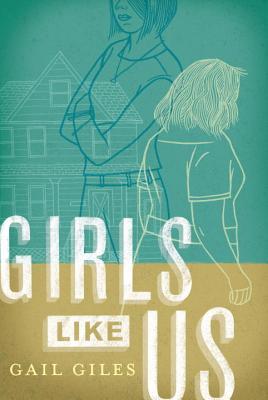
Review for “Girls Like Us” by Gail Giles (2014)

Rating: 5 out of 5 stars

Sooo…I cried while reading this book. That’s twice in one week now, and the week’s not even over with yet. Darn.

“Girls Like Us” is the story of Quincy and Biddy, two “Speddies” (their term for special education students) who graduate from high school at the same time and are placed in a living assignment together by a school caseworker. The girls live together in a small apartment above Miss Lizzy, a wealthy elderly woman, in exchange for cooking and cleaning and helping around the house with physical tasks. At the beginning of the story, Quincy and Biddy are not friends and are polar opposites. Biddy is white and, we learn, was born with her mental disability. Quincy, a mixed race girl, was ‘normal’ until around the age of 6 when she was physically assaulted by her mother’s boyfriend and brain damaged as a result. Biddy is shy and timid, and Quincy is outwardly aggressive and opinionated. Quincy is slightly higher functioning than Biddy and holds a job at a local grocery store, Biddy helps Miss Lizzy around the house. Eventually they settle into their lives together and uncover the pain of their pasts and work through the physical, emotional, and sexual abuse that they have endured.

This book is presented in alternating chapters between the perspectives of Quincy and Biddy. One of the problems with this technique in other novels is that multiple voices sometimes have a tendency to get muddled and begin sounding the same–but fortunately, this problem never once happened in this book. Ms. Giles does an excellent job of maintaining a clear, distinctive voice for both characters. There were colorful spellings and pronunciations that were spot-on, it was evident that Ms. Giles knows this population (a blurb in the back of the book says that she taught special education students for 20 years) and is familiar with the inner thoughts of special needs people.

Although this was a short book with simple narration, it is not an easy one to read. There were definite adult themes of physical and sexual violence. The characters’ stories were so heartbreaking that there were a couple of times that I had to close it and I almost didn’t finish. The author did a fantastic job of demonstrating the struggles of young people with disabilities. Powerful stuff.

Before I end this review, I wanted to say that I think the reason why this book was so powerful for me was because my mother was a special education teacher for over 25 years. She’s no longer in the classroom, but when she was, she taught students with severe mental and physical disabilities. I could see the stories of so many of her students reflected here. Her choice to work with the disabled is the reason why I will always have a heart for special needs people, because they deserve our compassion and respect. ❤

Review: The Storied Life of A.J. Fikry

20312470

Review for “The Storied Life of A.J. Fikry” by Gabrielle Zevin (2014)

Rating: 4 out of 5 stars

“We read to know we are not alone.”

I can’t stand books that intentionally seem to break out the violins and Kleenex just for the sake of inducing tears. I can’t love a so-so story simply because it is sad, its got to hold its weight in terms of an actual plot line and characters that actually DO something for me. This was one such exception.

This novel is the story of A.J. Fikry, a widowed curmudgeonly middle-aged man who owns an independent bookstore on a fictional small New England island. Sales are down, and A.J. spends most of his time chasing away his customers and drowning his sorrows in alcohol. He is content to live this life in this manner until one day when a mysterious customer abandons a small child in his bookstore. He eventually adopts the little girl, and his entire life turns around for the better.

This would be well and good if this book weren’t so, I don’t know…cheesy? There are several plot twists and turns that just seem to be there because they’re well…there. The dialogue all throughout was somewhat contrived, and the characters never rose above behaving exactly as they were ‘expected’ to. However, when I got to the end of this book, I was actually crying big ol’ crocodile tears.

This is ultimately a book lover’s book. Once you take this into context, the pieces of the story I didn’t like really did not matter in the grander scheme of novel. I chose the quote above to begin this review because aloneness and the desire to be a part of something is the reason I found hours of pleasure reading as a little girl, and thirty years later, it is the reason why I still love reading today. There are thoughtful literary references all throughout the book from stories that I’ve read before and I completely related to. This book takes the love affair that we book nerds have with indie book stores and ups the romance factor 100x, and for that reason (given that I now have to drive 30 minutes from home to find a bookstore that’s not connected to some corporate chain), this gets four stars from me.

This book is not perfect, but it’s a book that makes you feel wonderful, exciting things in wonderful, exciting ways. Yassss….

Review: The Longest Night

25361917

Review for “The Longest Night” by Andria Williams (scheduled to be published on January 5, 2016)

Rating: 3 out of 5 stars

Hmm. I can’t go any higher than 3 stars here.

This novel is a historical fiction, based on a true event, the only fatal nuclear reactor incident in the U.S, which occurred in Idaho Falls, Idaho on the night of January 3, 1961. “The Longest Night” is set during this period at the military outpost there, where Paul Collier, the main character, works at the nuclear reactor site. Nat, his wife, is a young stay at home mom with two little girls who has trouble fitting into the socially acceptable role of a military wife.

Most of the story focuses on the nuances of Nat and Paul’s marriage–its history, its breakdown, and his eventual deployment to a remote nuclear station in Greenland for 6 months. In the background is the impending failure of Paul’s assigned nuclear reactor, mostly due to the incompetence of Paul’s narcissistic boss. Also in the background is Nat’s brewing attraction to a local man, which turns their community against them and threatens to rip their family apart.

The writing here is fairly decent. Andria Williams does an excellent job of setting the time and place of the early 1960’s. I could literally feel myself sitting in Paul and Nat’s house, seeing things the exact way in which she described them. Both Paul and Nat are constrained by the stifling roles that society and the military have forced upon them, and the claustrophobic nature of their marriage is completely apparent here. But this claustrophobia and frustration is drawn out in such painstaking detail that I almost didn’t finish this. For a long period in the middle of the book nothing really happens, you’re just stuck with the mundane thoughts of Paul and the ordinary, everyday observations of Nat. The beautiful writing ultimately keep me pushing forward, even though I knew what would happen to this reactor (duh) and I kinda knew what would happen to this couple in the end. For a book so finely crafted, the subject matter was unengaging and the plot was woefully predictable.

I would be interested in reading more of Andria Williams writing, especially with purely fictional subject matter. I would not be surprised if this book ends up on “Best Of” lists or gets selected for multiple book clubs in 2016. To be a first time writer, she definitely has talent.

[NOTE: This e-book was provided to me by the publisher, Random House, and NetGalley in exchange for an honest review.]

Review: This Raging Light

23208417

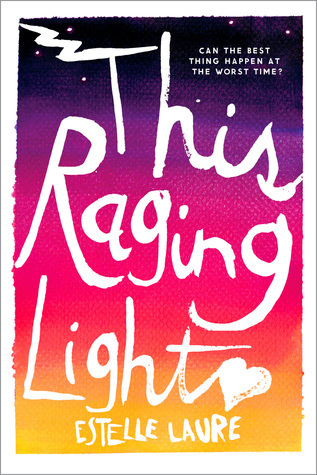
Review for “This Raging Light” by Estelle Laure (scheduled to be published in January 2016)

Rating 2 out of 5 stars

Special Note: This book is currently available on Amazon, although the publishers’ copy I have in my possession says “January 2016” as the scheduled publication date. For purposes of this review, I will go with the publication date of the copy that I was furnished with.

I struggled to finish this one. Well, ok…I kinda liked it. When I say that, I really mean that I think I liked the idea of it more than its actual execution on paper. So many things in this book just didn’t work for me.

Beware, spoilers abound (#sorrynotsorry)…

Lucille is 17, and her life is turned completely upside down when her mother decides she’s had enough and abandons her and her 9 year old little sister Wren to go “on a vacation.” Her father is in a mental hospital and the supposed cause of their mom’s breakdown. The book begins 14 days after their mother’s departure, with Lucille taking on the role of caring for herself and her sister without alerting anyone to the predicament they are in. She eventually finds a job and leans on her friends to care for Wren while she’s working in the evenings after school.

Which leads me into what I didn’t like about this book. Lucille gets herself into a complicated romance with Digby, her best friend’s twin brother who is very taken by someone else. Her best friend turns on her for some weird reason that’s never really explained. There’s drama at her job. There’s issues with her father, whom she visits several times in the story. There’s also some mysterious benefactor who seems to be aware of Lucille and her sister’s plight and keeps slipping in and doing nice shit around their house (leaving baked muffins, mowing the lawn). It’s far too many plot points and in the end NOTHING is truly resolved. Well, take that back–you DO find out who’s dropping off the damn muffins, but that’s about the only subplot that finds an ending here. Lucille’s mother’s abandonment is the lynchpin of this book, but the reader gets nothing as far as any kind of resolution to this.

The writing style of this book is a bit strange too. A lot of short, short sentences that left me struggling to understand what the author was trying to present the main character as. There is growth in the character of Lucille from the beginning to the end of the book, but I don’t know…I think I just wanted more here. Like perhaps why she is so ga-ga for Digby in the first place. Their relationship is really awkward, and Lucille seems to get no more in return than his general concern about her and her sister’s welfare. Weird, because when this book begins, the main character is quite love struck with this dude. Perhaps if this relationship had more of a backstory, then we’d get why he’s going through the trouble of cheating on his girlfriend with her. Otherwise, it just seems flat.

Ultimately I’m on the fence with this book. It should have been a good story, but it felt unfinished and I never really connected with any of the writing, the events, or any characters here.

[NOTE: I received a free copy of this book from Houghton Mifflin Harcourt as a giveaway through GoodReads. This was my honest review.]