Review: Another Day in the Death of America

29502379
Review for "Another Day in the Death of America: A Chronicle of Ten Short Lives" by Gary Younge (2016)
Rating: 4 out of 5 stars

“Another Day in the Death of America” is a look at the effects of gun violence on children in the United States. Younge, a British reporter, picks a random day (November 23, 2013), and identifies 10 children who died of gunshot wounds around the country within that 24 hour period. He follows up with their families and acquaintances, interviewing them and seeking insight into the victim’s short lives.

All of Younge’s subjects are male. The youngest victim was 9 years old, the oldest, 18. They hailed from large cities and small towns, inner cities and suburbs. Seven of the victims were Black, one was White, and two were Hispanic. Some of their deaths were accidental and some were intentional. In at least four of the cases, the killer (or killers) is still unknown. What matters the most, however, is that all of them were loved by their family, the majority of which agreed to be interviewed for this book.

The author puts a very human face on the tragedy of gun violence. He also probes, quite extensively and justifiably, issues of race and social class, which play a part in the prevalence of violence in some communities more than others. While he says that this book is not a plea for gun control, I’m not sure how this book can be read by anyone as anything but. It is clear that the point the author is making is that Americans are not inherently more violent than the citizens of any other country, yet the availability of guns make deaths more likely and more prevalent.

This book was written in 2016, and yet, two years later, it is still a timely one. The author admits that he began the research and writing on this book shortly after the Sandy Hook shooting. I read this in 2018, and we’re only several months removed from yet another school shooting, this time in Parkland, Florida. The questions raised in this book two years ago are the same questions we face today over gun control, and we’ve done absolutely nothing since.

I try to refrain from getting overtly political on my site, because, well, it’s all about the books, right? However, I realize more and more that the books I choose are political, and that every time I post my thoughts about them it is clear where I stand on certain issues. I’m OK with that. I am not a Democrat or a Republican, but I am a mother who sends my 14-year-old son off to school every morning with a hug and a kiss, just like everyone else.

I pray every single day that he comes home without a bullet in his body.

Review: Barracoon

2590136

Review for "Barracoon: The Story of the Last "Black Cargo" by Zora Neale Hurston (2018)

Rating: 4 out of 5 stars

Barracoon is the field work of legendary writer and anthropologist Zora Neale Hurston. It is the story of the last known survivor of the African slave trade, Cudjo Lewis, in his very own words. In 1927, Hurston traveled to visit Cudjo to his home in Alabama, and over several weeks interviewed him directly, transcribing his account of how he was taken captive at the age of 19 in an area now known as the country of Benin and transported illegally to America in 1860. She completed a book containing Cudjo’s story in 1931. However, her book never found a publisher and remained locked away in her archives at Howard University for over 80 years.

The reasons why Barracoon was never published are quite obvious. For one, Hurston insisted that Cudjo’s voice be heard and he be allowed to speak in his own dialect. Second, it implicates Africans as profiteers within the nexus of the slave trade, a fact that many historians have long denied. Originally named Oluale Kossola, Cudjo was captured by a rival tribe and was sold into slavery, a common practice on the continent for hundreds of years. He spent three weeks in a stockade (called a barracoon) and was subsequently shipped to America on a ship named Clotilda. Once in America, Kossola is renamed Cudjo and lives as a slave for five years until he is freed by Union soldiers in 1865. He eventually marries and has six children, all of whom die before his own death in 1935.

If you are unfamiliar with rural Black Southern dialect, you will have a helluva time with this book. Hurston was right to insist on not changing Cudjo’s words, and as you read this book you will understand why. I am fairly familiar with the cadence and the speech patterns of Black dialect, yet I still found it helpful throughout this book to read Cudjo’s words aloud, his speech ‘as is’ is critical to the understanding of his story, along with Hurston’s prose. Also telling were the many times in the book where Cudjo refused to speak, preferring instead to sit on his porch and eat a peach or share a watermelon with Hurston in silence instead of talk about the horrific experiences he’d gone through.

I loved this book. I feel it is definitely a story that demands to be told, especially when there’s an open bigot in the White House and one ignorant public figure in particular who is dumb enough to actually open his mouth to suggest that “slavery was a choice.” This book seems timely and well-intentioned, in the climate of so much rhetoric that seeks to undermine the horrors of slavery and its present-day implications.

Highly recommended–don’t miss this one.

Top Ten Tuesday: Book Loves and Hates

Once again, this week’s designated Top Ten Tuesday doesn’t agree with me…so I’m making my own topic. I’ll pretend I’m in a speed dating situation and I’ve got about 15 minutes to tell you about what I like and don’t like as far as what I read.

(This is silly, but play along here, OK?)

Top Ten Book Loves/Book Hates

Loves

  1. YA, YA YA. I pity people that don’t read YA. Seriously. Like, what do you do in your boring ass life? Young adult books are the shit because it’s where all the action is. Want to know what’s hot in the streets? Read YA. YA is a cool litmus test for finding out what’s hip, what’s controversial, what will be talked about next. As an educator I dive into YA often, because I want to know what young people think about, what types of messages about life they receive from older people. I also like YA because it’s a safe place for nostalgia, make believe, and uncomplicated, raw emotion. Where else can you be angsty as fuck and get away with it? YA, of course.
  2. Diverse characters. Ever since I took a Multicultural Literature class as an undergrad student in 2001, I’ve strove to make my reading as representative of society as a whole as possible. Here on 29chapters.com, you will find that I review books about people of all races, ages, gender identities, sexual orientations, ethnicities, religions, ability levels, social classes, as well as inside and outside of the U.S. This is done purposefully, not only keep me in the loop of the human experience, but to shine a light on people with experiences unlike your own whose stories deserve your attention.
  3. Nonfiction about social issues. I love reading nonfiction, but I strive to make the reading of mine worthwhile by reading to educate myself on social issues that interest me–particularly issues of crime and the criminal justice system, race, feminism, immigration, and poverty. Oppression of one is essentially the oppression of all, and learning how all of these issues are connected in our every day lives is critical.
  4. Dystopian lit. Books on how jacked up the future will be are always a treat for me. Perhaps it is because I am deeply pessimistic on the future as well, and believe that the changes we don’t make now will revisit us in the future, only three times worse. Either way, it’s fun to read about how the world’s going to hell, and there’s very little we can do about it but wait. Weee…
  5. “Thinking” while reading. If I’m thinking while I’m reading it, that’s always a good thing. Books that engage me intellectually and challenge me are always books that I will finish, whether I like them or not. It just drives home (for me, at least) that reading will always be a thinking process, not just some passive activity where I’m sitting and absorbing info like a plant. It also means that we can still be friends and disagree.

Hates

  1. “Chick” lit. Ewww, I hate anything that resembles this genre of literature. Books where the main objective is finding love, catfights, figuring out silly friendship drama, or a good pair of heels is not for me. I turn down offers to review on these kinds of books all the time and will continue to do so unapologetically. No chick lit here ever, I’m convinced it causes brain shrinkage.
  2. Romance novels. Another genre I don’t touch with a ten foot pole. As a matter of fact, if I go to a book review site and it’s full of reviews on romance novels (even if they are YA) and chick lit, I immediately back up and make a note not to visit that site again. Brain shrinkage occurs with this one as well, only at a more rapid rate.
  3. Books from Western canons. I’m not saying there aren’t classics because there are, but surely one has noticed that 99% of the books in the humanities considered “classics” are written by White men. I love All Quiet on the Western Front, Grapes of Wrath, Aristotle’s Poetics, and Huckleberry Finn as much as the next gal, but if these kinds of books is all one reads, I question why your reading perspective is limited to that of straight White dudes only. As if Western perspectives and being cisgendered is the center of the moral universe. Not so, I say. I’ll stay on the left.
  4. Mainstream bestsellers. I could care less what’s on the Amazon or New York Times bestseller list. I also don’t care about who won what award, or what book “everybody” is reading right now. As a matter of fact, if I see a book on “the list” I will usually avoid it for that very reason because yes, millions of people can be wrong. Occasionally I do read pop fiction, but it is only because I am curious about that particular book. But nah, I’ve never gone to “the list” and scanned it for something to read. To this day I maintain that I’ve never read a Harry Potter book and don’t plan to. My son has read them all though. Bless his heart.
  5. “Major Motion Picture” covers. So Everything, Everything is a movie now. That doesn’t mean you have to change the paperback cover. I know you want to sell movie tickets, but urrrrgghh…this burns me up. Keep it the same, don’t change it.

Rock on, guys…

xoxo, Kellan

Review: We’ll Fly Away

35959354
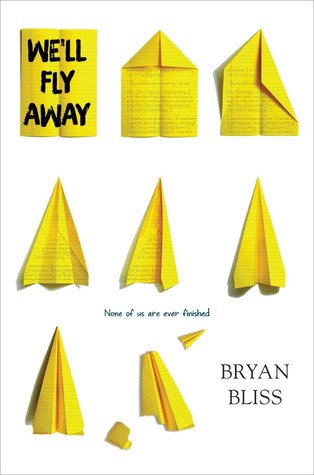
Review for "We'll Fly Away" by Bryan Bliss (2018)
Rating: 4 out of 5 stars

A very well written, hard hitting YA book.

“We’ll Fly Away” is the story of two boys, Luke and Toby, who have been friends for most of their lives. Luke, the stronger of the two, is an athlete who dreams of college success through wrestling, while Toby, aimless and a victim of his father’s physical abuse, relies on Luke to protect him. Both boys long to escape their rural North Carolina town (ironically, the setting of which is only about an hour away from me) and bond over a broken down airplane they discover in the woods as kids. Interestingly, the theme of flight is all throughout this book, even though it is apparent early on that neither of these boys are going anywhere. Escape, it seems, is only possible through death and/or violence.

When the story opens, we discover that Luke is in prison, writing letters of apology to his friend Toby. We are not told why he is on death row, but it is obvious that he is there for a horrible crime. In his letters, Luke struggles with his morality, getting along with inmates, and other adjustments to prison life. The story switches between his letters to a third person narrative of the events leading up to Luke’s imprisonment. In the third person flashbacks, we learn that Luke’s life isn’t free of dysfunction either. When he isn’t wrestling, Luke is taking on way more responsibility than he should, watching over his younger twin brothers while his mother takes up with different men. Toby’s father, a local criminal, physically and emotionally abuses him, leaving him with a lack of social skills that lead him into conflicts at school. Luke, ever Toby’s rescuer, comes to his defense time and time again.

I won’t go into too many of the details of this story to avoid spoiling it. I will say, however, that this is a fairly solid book that examines male friendship, difficult choices, and the criminal justice system in a very meaningful way. Even though there was a bit of a lull in the middle of this, the ending was shocking enough to make up for everything it lacked in between.

Definitely recommended.

Review: Calling My Name

34541786

Review for "Calling My Name" by Liara Tamani (2017)

Rating: 5 out of 5 stars

I loved this YA book. The cover’s cute and the writing is quite gorgeous.

“Calling My Name” is the beautiful story of a young Black girl named Taja, growing up in a middle class, Southern Baptist family in Texas. The story begins with Taja as a young girl and follows her through her senior year of high school through a world of ‘firsts’–social awkwardness, wearing a bra, friendship drama, sibling and family relationships, her first kiss, losing her virginity. Each chapter is named and presented vignette style, with quotes from various Black women authors (Toni Morrison, Zadie Smith, Zora Neale Hurston) interpolated throughout the text as themes for what follows. I also loved the lovely ambiguities here: we’re never told explicitly how old Taja is, though the passage of time as the novel progresses is evident. Also nebulous is the exact time frame in which Taja’s childhood takes place, surrounding references to pop culture and relics such as acid-wash jeans allude to the late 80’s through the mid-90’s. I loved, however, that time really didn’t seem to matter here: Taja’s life could be today, 20 years ago, or even as far back as 40 years ago. I’ve always maintained that the best books do not have to explicitly state everything they’re made of, and this book knows that and much, much more.

Religion, specifically the Black Southern Baptist tradition, plays a prominent role in this book. Taja’s parents are ultra conservative and tightly control her behavior, not wanting her to fall into “sin” or become “used goods” before marriage. Taja’s identity as a Christian influences much of her thoughts and actions, leading to several conflicts as a teenager until she eventually finds her own voice as an individual, shortly before leaving for college.

Reading this book was emotional for me. It is the first book that so closely mirrored my own experiences as a Black girl in the 80’s and 90’s, growing up in very much the same middle class, conservative Southern Baptist family dynamic. The stereotypical ‘problems’ that we typically associate with the narratives of people of color (you know, incidents of racism, poverty, substance abuse, economic struggle) were largely absent here, which I have to admit that I appreciated for a change. This is not a story about any of those kinds of traumas–it’s a story about soul-searching, Black girl style. Throughout the reading of this book I wanted so much to simply applaud because finally, someone got it RIGHT.

It goes without saying that I completely and totally recommend that you read this book.

Top Ten Tuesday: Books I Decided to DNF

Ok, it’s 11:28 pm Eastern Standard Time…and I know where my official Top Ten Tuesday is. A couple of weeks ago I discussed the intricacies of the DNF (book-speak for one that you willfully choose not to finish); this week I’ll list a few books that I’ve DNF’d over the years and the reasons why they ended up that way.

As I’ve explained before, I DNF books quite often for a variety of reasons. If I got over halfway through it and I can put together a somewhat coherent review, I’ll post it here. Often, however, I don’t. I just move on to another book.

So here’s my playlist of skipped books whose reviews I’ve never posted here and I’ve never mentioned to anyone but myself. You always get the latest hits, so here’s:

29chapters.com’s List of Not-So-Famous Misses

  1. Bastard Out of Carolina, Dorothy Allison. This book is actually quite good. I’ve read other books by Dorothy Allison and her work is taught in a lot of Women’s Studies classes, especially at the college level. The reason I DNF’d this book, however, is because of its graphic depictions of the sexual and physical abuse of the main female character by her stepfather. I’ve tried many times to just grit my teeth and read it, but I can’t get past the highly disturbing content here. I just…can’t.
  2. The Lovely Bones, Alice Sebold. Another wildly popular book whose disturbing content I just couldn’t stomach. The horror comes on very early in the book, around page 12 when the main character is raped, killed, and dismembered by a neighbor. After 3-4 times of pulling it off my shelf, reading it, only getting to page 12, and DNF’ing it, this book sat on my shelf for years until I finally got rid of it in a used book exchange last summer. It’s safe to say that I will probably never attempt to read it again. I also refuse to watch the movie version.
  3. Your Heart is a Muscle the Size of a Fist, Sunil Yapa. This is a historical fiction novel that examines several sides of the 1999 Seattle WTO protests from different perspectives–a riot cop, a politician, protesters. Somewhat decent, I just couldn’t get into this.
  4. Her Last Death: A Memoir, Susanna Sonnenberg. One of the few nonfiction books here that I’ve quit. Basically this is a book about a very dysfunctional mother-daughter relationship, which morphs into the author largely blaming her mother for many of her poor choices, including becoming promiscuous at an early age, being a pathological liar, her drug use. I got half way through this book before I just said enough already, I can watch this Dr. Phil episode on any given day of the week…
  5. Paint it Black, Janet Fitch. After her first novel “White Oleander,” I thought author Janet Fitch was untouchable. Au contraire. Her second novel was such a snoozefest that I put it down and never looked back.
  6. The Tsar of Love and Techno, Anthony Marra. This book had glowing reviews, but I kept falling asleep on this one. It’s a set of interconnected short stories, all centered around various characters during the history of modern Russia. Perhaps I also hated this because it brought back bad memories; I fell asleep during the Russian section of World History during high school too. Oh welp.
  7. The Dog Stars, Peter Heller. Post-apocalyptic story. About a man and his dog. And a plane. But the writing style. Was such a fucking distraction. That I put it down. (<— The whole book’s written like this, mates. It is an absolute pill to read.)
  8. Sing, Unburied, Sing, Jesmyn Ward. First off, I love Jesmyn Ward’s writing. I’ve read another nonfiction book of hers, Men We Reaped, and I absolutely loved it. This book, however, not so much. I found the plot kinda tedious and I just couldn’t get into the characters. I’m not surprised that this book won the National Book Award, because there is something special here, but the specialness is simply not for me.
  9. Severance, Robert Olen Butler. This book has an interesting premise: that human consciousness is maintained for 90 seconds immediately after one is decapitated. Therefore, this book is a collection of the “final thoughts” of many people (some famous, some not) who have ‘lost their heads’ throughout history. It’s a really morbid book, and the premise alone should have been enough to carry me through it, but for some reason the writing here was just plain weird. The friend who suggested it to me told me to read it like poetry, but that didn’t help, because I hate bad poetry. Blech.
  10. Blood Meridian, Cormac McCarthy. I’ve read my fair share of Cormac McCarthy over the years: The Road, Outer Dark, Child of God, No Country for Old Men. His writing is typically very dark and violent in nature, but that’s what makes him so special to me: that he can explore darkness and evil in such meaningful, creative ways. Anyway, Blood Meridian was just sloooooow. It’s also a Western (the other four novels I’ve read by him are not), and Westerns are just not my preferred genre.

There’s tons of other books I’ve DNF’d that could discuss here, but these are the ones that stood out most. Stay tuned!

xoxo, Kellan

Review: After the Shot Drops

31179039
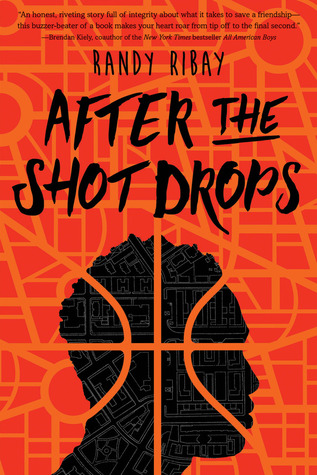
Review for "After the Shot Drops" by Randy Ribay (2018)
Rating: 3.5 out of 5 stars

“After the Shot Drops” is the story of two friends, Bunny (affectionately named so because he’s got ‘hops’) and Nasir. When the novel begins, Nasir and Bunny are not on speaking terms, mostly because Bunny has recently transferred to an upper crust private school to play basketball without talking to him about it first. While Bunny realizes he’s out of place among his wealthy, mostly White peers, Nasir remains at his inner-city school and finds kinship with his cousin, Wallace, a troubled young man facing eviction. To earn quick cash, Wallace bets against Bunny in a final championship game–leading to very serious, life-altering consequences for all three young men.

I gave this three and a half stars because there are some issues here. For one, the pacing was entirely too slow. It took me nearly a month to finish this book, and that was because it failed to really maintain my interest for more than 50 pages at a time. We don’t find out until nearly page 150 that Wallace is up to something sinister that will ultimately change the rest of the book. Second, this book is written in dual narration, switching back and forth between Bunny and Nasir. While I’m not criticizing this method of storytelling, I was a little weary of the characterization here. The voices of Bunny and Nasir seemed indistinguishable, I couldn’t tell one from another. If the author hadn’t labeled who was speaking before each chapter, I wouldn’t have known who was saying what.

Third, during certain scenes of this book, there’s a lot of very technical, play-by-play basketball talk. While personally I like bball, there may be other readers that get kinda lost here. While I don’t think you have to love basketball to read this, liking it sure does help you get through those pages.

Overall, I think this is a fairly decent book. I love how it focuses on Black male friendship, a subject that I don’t think gets a lot of play in YA literature. As a matter of fact, I can’t think of a book that I’ve read in the past 5 years where a friendship between two young Black men was front and center, to the exclusion of other subjects. There are short, quick chapters here too, which tends to engage those students who are reluctant to read.

Definitely recommend this book!

Review: Sex Money Murder

36236094
Review for "Sex Money Murder: A Story of Crack, Blood, and Betrayal" by Jonathan Green  (2018)
Rating: 4 out of 5 stars

Like a good pair of heels, every gal needs a good ol’ fashioned true crime book. The ones I prefer tend to be concentrated in urban environments and focus on fantastical tales of violence, drug dealing, and hip hop martyrdom. It’s great stuff, and this is a great book.

Before beginning this book I knew only vaguely about Sex Money Murder, a notorious gang that controlled the drug trade in the Bronx in the late 1980s and 90’s. Aside from a lone episode of the weekly documentary Gangland from The History Channel several years ago and a couple mentions in hip hop songs, the history of this group has been mostly unknown to those outside of the urban realm. The story of SMM revolves around three childhood friends–Peter “Pistol Pete” Rollock, Emilio “Pipe” Romero, and Shawn a.k.a. “Suge.” They come of age in a particularly violent NYC housing project, the Soundview Homes. Eventually Pete turns to the drug trade and he and his two lieutenants’ operation take over the area, mostly through intimidation of residents, extortion of other dealers, and brutal violence. They also traffick crack to other markets, mostly in cities on the East Coast. Like a Shakespearean tragedy, all three live out their wildest fantasies of success until pride, greed, and disloyalty eventually take them all down and cause them to turn on one another. While one of the original three members of SMM is a free man, Pipe is currently serving time and “Pistol” Pete has been in jail since 2000, serving a 100+ year sentence in isolation for several murders and racketeering in one of the most secure federal prisons in the nation, ADX Florence.

Author Jonathan Green brings new life to the tale of Sex Money Murder with fair and balanced research of his subjects. It is evident that he spent extensive time with the people whose stories that he tells. Also profiled are the cops who brought SMM down, as well as an examination of the urban de-industrialization and the racist housing practices that created SMM in the first place.

Be forewarned, however, that this is not an easy book to read. There is all manner of violence, tales of drug dealings, shootings, and a lack of remorse by all involved that permeates this book. However, it is a story that begs to be told, and the author does a great job here. I definitely recommend this book.

Review: The Weirdness

18050224
Review for "The Weirdness" by Jeremy Bushnell (2014)

Rating: 4 out of 5 stars

I hate that it took me two months to finish this book. Not because it was bad, but because I have severe book ADD and I own this copy, so the task of finishing it kept getting pushed farther and farther to the back of my reading pile. Anyway, this is a great book. I read Jeremy Bushnell’s other novel “The Insides” and loved it so much that I decided to go for this one too. I’m glad I did.

“The Weirdness” is about a 30-year-old schnook named Billy Ridgeway. He’s a wannabe writer looking for his big break and working part time in a sandwich shop. Him and his girlfriend have drama, he has no money for rent, his roommate’s gone AWOL. Billy doesn’t think his life could get any worse until he encounters the devil in his apartment one day, with freshly brewed coffee and ready to make a deal with him. Retrieve the devil’s lucky cat, the Neko of Infinite Equilibrium, from a dangerous warlock and he’ll make sure that Billy’s book is published to rave reviews.

I don’t want to get too far into the plot with this one because there are hella twists and turns. There’s also a lot of fantastical elements (time portals, God machines, hell-wolves), so you have to step outside of realm of the rational and relax just for a little while. There’s also a healthy dose of black humor, which I appreciated.

This is definitely a fun read. Four stars.

Review: All God’s Children

2624807
Review for "All God's Children: The Bosket Family and the American Tradition of Violence" by Fox Butterfield (2008 reissue, originally published in 1995)
Rating: 4 out of 5 stars

This book is fascinating. It’s a shame that the original hardcover edition is out of print and quite hard to find at any library in my city. In the end, I had to order it through interlibrary loan.

Anyway, “All God’s Children” traces five generations of the Bosket family, from their days as slaves in rural South Carolina all the way to Willie Bosket’s incarceration in 1978 as one of the youngest murderers in New York City’s history. At 15 years old, Willie, recently free from a reform school, killed two subway riders in cold blood and shot another. Under the laws of the time, the maximum he could get was 5 years. The public outcry was so great against this that the Juvenile Offender Act was passed later that year, making it possible that children as young as 13 could be tried as adults.

Fox Butterfield uses Bosket’s family history as a way to discuss the history of violence in America. Willie’s great grandfather was a violent man, his grandfather, as well as his father. Details of all of their lives and crimes are given here. He avoids the typical fluff arguments about the causes of violence (poverty, television, etc) and instead characterizes it as something deeply embedded into the fabric of American life, a product of the White slave-holding class, the pre-Civil War South. He also discusses the violence of reform schools and prison institutions whose function is to “correct” violent individuals. Willie believes he is merely the product of these institutions in its grossest form. I can’t disagree.

The amount of research in this book is exhaustive. I commend the author for writing this book. I just wish that it was more available in 2018.