Review: My Life as a Rat

40942642

Review for "My Life as a Rat" by Joyce Carol Oates (2019)

Rating: 3 out of 5 stars

I’ve read numerous Joyce Carol Oates books over the years (The Sacrifice, Evil Eye, Lovely, Dark, Deep, Black Water, you get the picture). She’s ridiculously prolific, there’s about 60 novels to her credit and that’s not even counting her short fiction and other writings. Like any other writer, she definitely has her hits and misses, so every now and then I’ll take a Joyce Carol Oates book off the shelf and see what she’s writing about now. My Life as a Rat is her latest fiction novel.

This novel is the story of Violet, a 12-year-old girl living in upstate New York in the mid-90’s in a working class Irish American family with four brothers and two sisters. Although the children are physically cared for, expressions of emotion and love are minimal and her father rules over everyone with an iron fist. The boys in the family are clearly valued over the girls, with the oldest two sons Jerome and Lionel getting themselves into occasional trouble around town (one occasion being the rape of a mentally handicapped local girl). As always, Violet’s parents always get their boys out of trouble by hiring lawyers and protecting them from consequences or any severe punishment.

Eventually, Violet’s brothers graduate from rape to an actual murder. A popular Black student is riding his bicycle home one night and, because he appears ‘suspicious’ (there’s echoes of the Trayvon Martin case here) Jerome and Lionel run him off the road and beat him to death with a baseball bat. Violet sees the bloody bat and puts the two together, and, after an agonizing choice, tells administrators at her school what happened. She is instantly banished by her family for being a ‘rat’–placed into the custody of an aunt and told that she is not welcome to come home. Her brothers are jailed for their role in the crime.

Overall, this is a very difficult book to read. The novel goes into detail with how family violence and banishment shapes Violet over the course of her life, eventually leading to her being raped and sexually abused by a series of men during her teenage years. The book changes points of view and narrators and shifts from 1st, 2nd, and 3rd POVs. Violet’s thoughts wander often, as if she has had a split in her state of being. You really get the full impact of the tragedy and more.

This book is not badly written, but I think it was a little over the top. There is a such thing as TOO MUCH happening to a character, and this is one of those examples. There’s a lot of descriptions of sexual abuse that I think could have been left out–I got the point over 150 pages ago. The end hints at some kind of hope for the future, but not really. I kept reading because I did care about the main character, but by the end of the book I felt tired and demoralized, much like Violet.

I give this book three stars. Trigger warnings abound for rape, sexual abuse, and violence.

Review: Rabbits for Food

42977510. sy475

Review for "Rabbits for Food" by Binnie Kirshenbaum (2019)

Rating: 4.5 out of 5 stars

Man oh man I loved this book!

“Rabbits for Food” is all about a 40-ish married woman named Bunny (her real name), a NYC writer who ends up in a mental hospital after a breakdown on New Years Eve 2008 when she stabs herself with a fork in full view of onlookers. Flashbacks throughout the book reveal Bunny’s past: her emotionally absent parents, her upbringing as an unlovable middle child, meds for depression, the death of her best friend, her bland marriage to a college professor. Once in the mental hospital, Bunny makes friends with a quirky set of patients. Although Bunny is quite unlikeable, her observations of life and the people around her are quite hilarious, all throughout the book Bunny’s biting sarcasm keeps you turning the pages.

Even though this book deals with mental health issues which are always quite serious, I’d describe this novel as a black comedy. There are definite echoes of Sylvia Plath’s “The Bell Jar” and Kaysen’s “Girl, Interrupted.” Either way, I recommend this book with my entire heart.

Review: The Affairs of the Falcons

Pardon my absence, I’ve been ill for a few weeks. Part of this is neglecting my diet and habits toward self care, the other part of that is a genetic component to my life that I need to be more cognizant of. If you’ve never had large kidney stones I hope that you never get them (or have to have surgery to remove them), and that you take loving care of your kidneys and your health in general.

The good news? I did a lot of reading while I was at home recovering.

Ok. On to my review…

41479536. sy475

Review for "The Affairs of the Falcons" by Melissa Rivero (2019)

Rating: 3 out of 5 stars

This book was so-so. I liked the premise of it, the execution, however, not so much.

“The Affairs of the Falcons” is the story of Anita Falcon, an undocumented immigrant from Peru. She lives with her husband’s cousin’s family in Queens in a cramped apartment. Anita is married to Lucho, has two young children, and works as a seamstress in a factory. Her husband drives a cab, but when the story begins, we learn that he has lost this job due to his undocumented status.

As you can imagine, money is very tight in this family. Most of this book revolves around the subject of money–getting it, losing it, and borrowing it from others to pay back the loan sharks who smuggled the family into America. Due to her status as undocumented there is no access to banks, and Falcons are always limited in terms of what kinds of jobs they can get. Housing is also an issue, internal conflicts in the home push the Falcons’ welcome with Lucho’s family to the limit. Also depicted here are the ways in which class and race play into the lives of a Latinx family (Anita is rural and indigenous, Lucho is lighter skinned, well educated, and from Lima). Lucho’s family remind Anita often of her despised, lower status among them.

Despite the external pressures, Anita is not a weak character, though she does makes questionable choices throughout the book. I don’t necessarily have a problem with this, my reason for the 3 stars is because I found the book to be less than compelling. There are tons of books out there on the immigrant experience, and I don’t really feel this book will stand out much within that group. There is not much that happens here that we haven’t read before, especially if you are familiar with this sub-genre of books.

I definitely recommend reading this book though. I’d also be open to reading more from this author in the future.

Review: The Usual Suspects

35535480

Review for "The Usual Suspects" by Maurice Broaddus (2019)

Rating: 4 out of 5 stars

Thelonius Caldwell is very much like many of the boys I taught in my ten years as a middle school teacher: bright, mischievous, and labeled as “special ed.” Despite his label he is very keen in his perceptions of people and aware of the reality that he is being ‘warehoused’ (i.e., placed in a self contained classroom with similar students and given sleep-inducing lessons until he either drops out or is removed via expulsion). Because the school and his teachers have low expectations of him, Thelonius and his friend Nehemiah pass the time by playing pranks on the staff, causing chaos between students, and just plain acting silly.

One day, a gun is found in a park near their school. Because Thelonius and Nehemiah have a reputation for bad behavior, the principal rounds them up and blames them for the incident. Knowing that he did nothing wrong, Thelonius begins to search for the culprit, careful not to break the code of the streets by being a ‘snitch.’ This story traces the route along his journey for answers, playing homage to the 1995 film “The Usual Suspects.” There’s even a Keyser Soze kinda figure, which is pretty brilliant for a kid’s book.

I definitely recommend this novel. Sure, it’s readable children’s book fare but there’s a sad subtext here: the reality that far too many poor children of color are placed in “special ed” classes and, once there, nobody supports or listens to them. Research shows that these are the kids who are most likely to drop out of school entirely and end up in the criminal justice system, or just to have poor outcomes in life in general. It’s a very real depiction of their lives.

4 stars.

Review: With the Fire on High

38739562
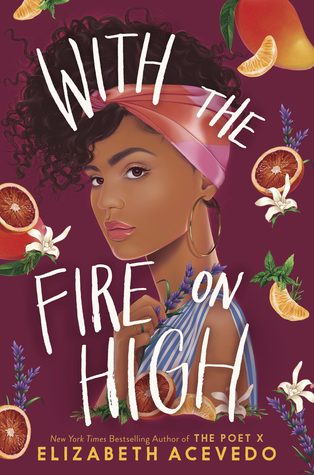
Review for "With the Fire on High" by Elizabeth Acevedo (2019)
Rating: 4 out of 5 stars

After reading and immensely liking “The Poet X” by Elizabeth Acevedo, I knew I had to read this. Although I liked this one as well, I wouldn’t say it’s as good as her first.

Emoni Santiago is a high school senior and mother to Emma, her 2 year old daughter. She is also an aspiring chef, integrating her own unique twists on traditional home cooked Puerto Rican recipes. In addition to her parental and school responsibilities, Emoni works hard at a burger restaurant, has a supportive best friend, and a kind grandmother who helps to raise her daughter. This novel is mostly the story of Emoni’s senior year of high school, in which she begins to nurture her love of cooking by taking a culinary arts elective at school. The class requires a trip to Spain, and Emoni, a single mom of modest means, is faced with the burden of raising money to go. In addition to this, there is some minor drama with Emma’s father, as well as unresolved issues in her relationship with her father.

Although I liked this book and its short chapters make it intensely readable, the main problem here is that I felt it lacked a conflict. Yes, Emoni does struggle, but she eventually gets what she wants. I am not saying that this is a bad thing, she’s a great character who I empathized with and desperately wanted to win. Buuuuttt…it just made for a kinda blah narrator. The romance is reluctant and felt forced, there was never a point in the book where I didn’t know that things would improve. It’s perfectly put together and predictable.

Still, I won’t go less than 4 stars here. I love Elizabeth Acevedo, and I think her writing about Afro-Latina character is super-important, particularly with all of the discussion in lit circles these days about diverse books. I also think that her choice to feature a urban teenage mother of color that is not a caricature or a stereotype was a very brave one that should be commended. The cover art is cool too (is that Alicia Keys??) Woooooww…

Review: Heroine

40536342

Review for "Heroine" by Mindy McGiniss (2019)

Rating: 4 out of 5 stars

This book will crush your soul. I definitely recommend a trigger warning if you’re not in a good place emotionally or mentally. This book does contain scenes of drug use, particularly opioids.

Mickey Catalan is a star catcher on her high school softball team. After a devastating car accident leaves her with a hip injury, she is prescribed the painkiller Oxycontin. Not only do the pills take away the pain, they make her feel good. She begins to take them more and more often, until her supply dries up. She then finds an illegal source who sells her Oxy, and along with a group of friends who also use and offer her friendship and acceptance. As pressure for Mickey to stay in top athletic form continues, her dependence on Oxy spirals out of control. Her supply dries up and she eventually turns to shooting heroin.

Before I started this book, I was afraid it would fall into the all-too-common trap of romanticizing drug use. While the highs of opioids are described here, it’s equally balanced with scenes of the gut-wrenching lows of withdrawal. Mickey’s POV is first person, so we follow her as she spirals more and more into addiction. It’s really well written, there’s a devastating energy here that hits really hard and doesn’t stop until the end.

I only give this book 4 stars because it’s so raw I would never read it again.

Review: Soon the Light Will Be Perfect

Back from a week-long vacay to my family’s rental property in Panama City, Florida. I got a wicked tan. Oh, and I did get some beach reading done…

40165907
Review for "Soon the Light Will Be Perfect" by Dave Patterson (2019)
Rating: 4.5 stars

“Soon the Light Will Be Perfect” is the coming of age story of an unnamed 12-year-old boy and his family living in a small working class Catholic community in Vermont in the early 90’s. The family includes the narrator, his 15-year-old brother, and his parents, who have recently moved out of a trailer park and into a modest home that they are proud of. The father, who works at a weapon manufacturing plant, has a good job with ramped up production due to the U.S.’s involvement in the Gulf War. The mother, a homemaker, involves herself with charity work and delivering food to the poor. The family is staunchly Catholic; both of the children serve as altar boys and they attend mass regularly, even participating in events such as local anti-abortion protests.

Then comes the summer, when this novel begins. The mother’s stomach problems bloom into a devastating cancer diagnosis. The father loses his job when his conscience prevents him from turning a blind eye to shady goings-on at work. His brother begins experimenting with pot, alcohol, and talking to girls. The narrator begins to have affections for a troubled local girl and experiences a crisis of faith where he questions everything, everyone. All of the events in this novel are told by an older and wiser narrator, looking back on this particular period in time.

I really liked this book. Each chapter could stand alone as a separate story, with its own plot, characters, and conflict. From the first page onward I was engaged in this, and when I wasn’t reading it, I was thinking about the characters in it.

I will definitely read more of this author in the future. 4.5 stars.

Review: Internment

38167114

Review for "Internment" by Samira Ahmed (2019)

Rating: None (DNF)

Not going to rate this because I DNF’d this one, right at about 30%.

“Fifteen minutes into the future,” Muslim-American teenager Layla finds herself in an internment camp in the desert of California, placed with her family there after an Islamophobic president (sound familiar?) enacts an Exclusion Law, prompting the government to round up Muslims and relocate them. It’s pretty horrifying but feels achingly real in today’s climate: neighbors turning on other neighbors, the government pursuing those who resist. Layla and her family are taken to a dusty outpost in the California desert and treated not much better than animals. Despite the harsh reality of the camps and the danger of escape, Layla begins to plot how to take down the system for good.

The idea behind this book is excellent, exactly why it immediately found its way on my TBR list. But the execution, MY LORD…

For one, let’s talk about the universe of this novel. We’re told this story occurs “15 minutes” in a not so distant future, but there is no build up or explanation of how we got here. The author assumes we get it, but I’m sorry–all of us don’t. The premise is heavily based on the Japanese internment of WW2, but the author makes the assumption that her readers have a detailed understanding of these events. Even if the topic is contemporary, worlds still must be built up, a reader needs to feel as if they’re a part of it. I didn’t get this at all here. There’s no effort to familiarize or explore the background, just a small info dump and then bam….we’re in the camp with Layla.

Two: the characters. There’s not much to Layla’s voice. She hates the camp, she disagrees with her docile parents, she thinks about her boyfriend a lot. Granted I didn’t finish it, but with this basic info–why would I want to? The guards and the director of the camp yell and pound their fists and drag people away like your typical stock bad guys. There’s a lot of telling here and very little showing, I wasn’t compelled and I wasn’t convinced.

Overall, great idea but not executed with a whole lot of care and consideration.

Review: A Woman is No Man

41016483

Review for "A Woman is No Man" by Etaf Rum (2019)

Rating: 4.1 out of 5 stars

I just finished this book last night. I went back and forth between a 3 and a 4 for a while before finally deciding on a low 4, with reservations.

“A Woman is No Man” is the story of three generations of Palestinian Muslim women and the lives they lead, which are completely constrained by the demands of men, child-rearing, family, their community, and faith. The story begins in the early 90’s with Isra, a young girl growing up in Palestine whose marriage is arranged to Adam, a Palestinian-American man. They marry and go back to New York City, where over the next several years, Isra bears four daughters. With each pregnancy Isra becomes more and more depressed, sad, and eager to please Adam, who drinks and beats her. Her mother in law, Fareeda, is cruel as well, constantly demanding that she give Adam a son.

The story continues with Deya, Isra’s oldest daughter, in the late-00’s. She is a young girl going to a Muslim school and living in NYC with her grandmother, Fareeda, who is attempting to marry her off to a Palestinian man. We are told that both of her parents died in a car accident when she was 7 years old. She has very few memories of her mother. Deya does not wish to marry, but to go to college. She never questions the story behind her parents’ demise until she receives a letter from a stranger, who begins to counsel her and eventually, tell her the truth about her parents. As she learns about the tragic past, Deya’s memories of her mother come back to her gradually and she grows stronger in her desire for independence.

The narration of the novel shifts between Isra’s account and Deya’s, and later on in Part II, Fareeda’s voice is thrown in, whom we learn also has secrets in her past. I didn’t have a problem with this, but the pacing of the novel is a problem. At about 75%, we find out the truth of what really happened to Isra and Adam. The book drags on for another 25%, repetitively repeating each narrator’s details of an event that we already know about.

Another problem is the lack of nuance of this book. In traditional Palestinian society, women are married off young, expected to raise children, cook, clean, sit at home, and wait for their husbands to tell them what to do. They are discouraged from reading, going to college, or venturing anywhere outside their homes without a man. Every page or two, a character’s words or actions remind you of this until you’re practically screaming: “WE GET IT!” I understand that the author really wanted to drive home her point about the suffering of women, but there’s such an excessive amount of detail given here that if I weren’t careful, I could begin to assume that all Palestinian households are like this one. I know better, though. The lack of nuance is so strong here that the story tilts toward being unrealistic, the characters one-dimensional.

So, there it is–a 4. I do recommend you read this book, however. Perhaps you’ll like it better than I did.

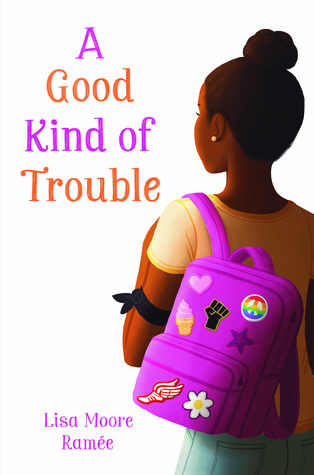
Review: A Good Kind of Trouble

38251243

“A Good Kind of Trouble” is about a young Black girl named Shayla navigating through typical middle school struggles: boys, school dances, friendships, teachers. Her older sister is an activist and involved with a local chapter of Black Lives Matter but Shayla steers clear, not wanting to risk getting in what she perceives as ‘trouble.’ However, when the police shoot an unarmed Black man near her neighborhood, Shayla decides to take a stand for what she believes and takes on more ‘trouble’ than she bargained for.

I liked this book. I would call it the younger sister of “The Hate U Give” with a similar theme and main characters, but aimed at younger readers. The major difference in the two is that this book expressly mentions Black Lives Matter by name, while THUG doesn’t (THUG’s connection to BLM is assumed, however). Therefore, the explicit naming of Black Lives Matter here is notable. The police violence stayed mostly in the background of the novel as an ongoing trial, and while it’s not the primary plot it’s pretty clear that this is the reason why Shayla speaks out. I would have liked a more direct connection to this plot point, but perhaps indirectly is the best way to expose this topic to younger readers without making this book TOO heavy.

I also appreciated how this book respected struggles that are distinct to youth of color, i.e., the pressure to conform to racialized norms. Shayla’s best friends in the book are Asian and Latinx, however, it’s only in the 7th grade that she begins to receive pushback from Black peers about “acting White.” I enjoy the way the book grapples with the idea of being Black beyond stereotypes and encourages kids of color to be themselves.

Great book about a complex and nuanced topic without being preachy or sad.