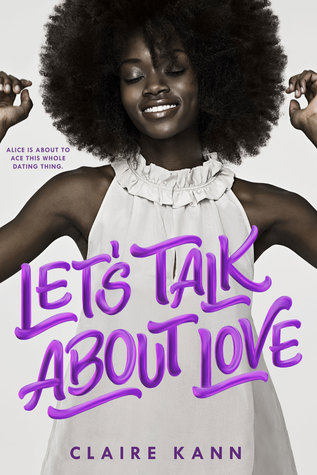
Review: Let’s Talk about Love

Hey folks!

I’m writing this from a hotel in Manhattan. I’ve been here for 5 days now for an education conference and so far I’m totally in love with the city. Anyone who would like to see my NYC adventures can follow me on my IG: kellythegreat.

Anywho, on to the review:
31625039
Review for "Let's Talk About Love" by Claire Kann (2018)

Rating: 2 out of 5 stars

I’m sad to say that I didn’t really like this book.

It’s disappointing because I wanted to love it, to grab it and go out and buy my own instead of a library copy. I did finish it, but honestly, after 25 pages, I knew this wasn’t the book for me.

Alice is a bi-romantic, asexual Black girl college student. As the story opens, she is being dumped by her girlfriend Margot because her gf believes that she doesn’t want to have sex with her. Heartbroken, Alice moves out of their shared space and into an apartment with another friend, Feenie, and her boyfriend. Meanwhile, she develops an intense romantic attraction for one of her co-workers, Takumi. The remainder of the book details Alice’s romance with Takumi and her struggles with her asexuality, as well how she deals with a whole host of family problems to boot.

I liked this novel because it is the first book I’ve read in which asexuality (or “ace,” as some asexual individuals call themselves) is discussed like the very real thing that it is. It is not ‘weird’ or a mental illness. Although there are a wide variety of perspectives on sexual activity within this community (some do have it, some don’t), it is widely accepted by people who identify in this manner that it is an orientation, not a “choice.” Even though they may lack interest in sex, they do indeed have romantic inclinations. Alice, the main character of this book, is featured in this way. I appreciate the fact that this book’s purpose was to allow people to understand asexuality without the long-winded explanations of an academic paper or a textbook. It’s timely and informative.

My dislike of this book, however, was in the characterization of Alice. While she’s not the worst character I’ve ever encountered, I loathed the way the author portrayed her–less like a real college student and more like a 12 year old. For example, Alice has mental categories called “Cutie Codes” to describe her attractions to people. She constantly refers to this all throughout the novel: Cutie Code Orange, Cutie Code Red, Cutie Code Yellow, all the way to Cutie Code Black (Takumi, according to Alice, is the ‘perfect’ black). She also has the nerve to refer to a tv character on pg. 48 as a ‘cutie patootie badass.’

((*eyeroll*))

Are you serious? What adult (or, as I said earlier, anyone over the age of 12) in 2018 talks this way? While I can understand making character relatable and giving the protagonist some quirks, the author was trying entirely too hard for this angle. Alice’s wide-eyed, child-like nature was problematic for me, because I don’t think real ace people go around acting like a bubbly 12 year old. It’s completely ok for an ace character to say someone’s hot or that someone they like is sexy without resorting to infantile language associations.

And the writing…while it’s not bad, it’s nothing to write home about. This book is plagued by an overuse of parentheses, usually employed between paragraphs to represent Alice’s thoughts. This is weird, because this book is written in 3rd person. If there is so much emphasis on the thoughts of the main character (which there is) why not use the 1st person and make it official? Reading this book in a 3rd person POV seemed unnecessarily awkward, because I always had the sense that it was a 1st person narrative.

Once again, I appreciate the diversity of racial representation in this book (a Black ace female, an Asian male), as well as what it attempts to do when it comes to portraying a sexual orientation that few people understand. I just wish it could have been executed better.

2 stars.

P.S. – The cover is Cutie Code Black.

Review: When My Heart Joins the Thousand

35098416

Review for "When My Heart Joins the Thousand" by A.J. Steiger (2018)
Rating: 4 out of 5 stars

I really really liked this book.

Alvie Fitz is a 17-year-old girl with Asperger’s syndrome. When the book begins we learn that her mother has died several years before, and after a series of unsuccessful stays in residential care centers and foster family placements, Alvie now lives alone in her own apartment and works a stable job at a local zoo. She is checked on weekly by a psychologist, Dr. Bernstein, in preparation for her request to be legally emancipated. Typical of people with Asperger’s, Alvie has above-average intelligence but difficulty with the most basic of social interactions. She has an obsessive interest in animals, scientific facts, and the book Watership Down (where the title of the novel is from). She also suffers from anxiety and depression, which she copes with by turning to animals and avoiding people altogether.

At its core, this is a love story. Despite Alvie’s difficulties bonding with other people, she falls for Stanley, a very shy college student also with a disability. Life has not been kind to either of them, yet what they find together is extraordinary.

I have to admit that I struggled with Alvie through a lot of this book. During certain scenes where she attempts to interact with people I found myself shaking my head in frustration, sighing. Her difficulties interacting with people are extreme, and even though I was aware of how large her hurdles would be, I don’t think I was prepared for just how much of her motivations, reactions, and thoughts are due to Asperger’s. Stanley has an incredible amount of patience with Alvie, even though her efforts to be “normal” at times seemed like acts of self sabotage.

I think this book really challenged me to move past my ableism and develop empathy, as well as understand what life is like for people with autism. The author has incredible insight into this disability, and although I’ve read many books about people with them, this one really moved me.

Do read this book.

Review: Tyler Johnson Was Here

35604682
Review for "Tyler Johnson Was Here" by Jay Coles (2018)
Rating: 3 out of 5 stars

From the moment I saw this book I knew I had to have it. I’m always down for YA books by and about people of color that are overtly political in nature, as well as books that challenge young people to think critically social issues. And yes, THAT cover. Gor-juss…

“Tyler Johnson Was Here” is just such a book that is destined to provoke conversation, particularly on police killings and the role of Black Lives Matter movement. The novel centers on the lives of twins, Tyler and Marvin, growing up in the fictional town of Sterling Point. The twins are raised by their single mother while their father, who is incarcerated, makes frequent appearances throughout the book in the form of letters written to Marvin.

Even though this is the story of twins, the story is told through Marvin, the more grounded of the two. Marvin hangs out with his friends Guillermo and Ivy, makes decent grades, watches reruns of “A Different World” and hopes to get into MIT. Tyler is the more restless twin, directing his energies toward social pursuits and hanging with a tough crowd. Much to Marvin’s dismay, he notices a rift between him and his brother and cannot convince Tyler to stay away from trouble. One night, after a party thrown by a local drug dealer, Tyler does not return home. Several days later, he is found deceased. A leaked video reveals that Tyler was unarmed when he was shot by police. As Marvin deals with his grief and anger over his brother’s death, he turns his efforts to protest and making sure that his brother’s memory isn’t forgotten.

What’s wrong with this book? A lot. Hell, I’m just going to bullet point here:

— The pacing of this novel was a problem for me. We’re told on the front flap of the book that Tyler is going to disappear and later be discovered dead. However, the characters do not discover Tyler’s death until well over halfway into the book. I felt as if the author could have skipped the ‘missing’ part, because it slowed the pace of the novel significantly. You’re literally just sitting around waiting for the inevitable for the first 150 pages. That’s not fun.

— Characterization fell a bit flat in this book as well. Even though I felt I understood Tyler, when I finished this I realized that I really didn’t. The limitations of a single perspective (Marvin’s) is apparent here. We know he was a good kid who got mixed up in a troubled crowd, but we’re never told the exact nature of his last days, his dealings with his friends. The author spends a great deal of time making the point that although Tyler may have been troubled, this was no reason for the manner of his death. While this is true, I think this point would not have required so much emphasis with more character-building as far as Tyler was concerned.

— There’s also a side character that goes absolutely nowhere: an aunt who’s a police officer, mentioned several times in the novel, who’s “always on the phone” with Marvin and Tyler’s mom. Considering that the police are the bad guys here who murdered Tyler and all of law enforcement in this book is portrayed as the epitome of evil, a relative of Marvin’s who happens to be a cop may have added to the complexity of this book. But that’s never explored. Weird.

— Marvin meets a girl, Faith, through his attempts to discover his brother’s whereabouts after the fateful night at the party. They eventually become involved with one another, but I never got a sense of their chemistry, her relevance to the story beyond the standard YA romance requirement, or really why she is in the book at all.

— The multitude of references to the tv show “A Different World”: Marvin is obsessed with this show, viewing it as a way to “understand” diverse Black characters. I’m not sure why this is, especially when there are more modern (and diverse!) shows with Black characters that could have been referenced here. I’m an 80’s baby, so I watched “A Different World” as a teenager (it went off the air in 1993, right as I went into high school). A teenager in 2018 still fixated on characters from a show from well over 25 years ago seemed strange, kinda like a kid who watches a dated show like “Hogan’s Heroes” expecting to find enlightenment. Yikes.

Comparisons to “The Hate U Give” are inevitable (both have Black main characters, both are about the subject of police violence), and if I had to pick between the two I’d say in a heartbeat that “The Hate U Give” is the much better book. Despite my criticisms, however, I won’t go lower than 3 stars for “Tyler Johnson Was Here.” I also wholeheartedly recommend this to other people to read. Even though TJWH has problems in its execution, I respect what it does accomplish successfully, and that’s place the narrative surrounding police violence in the hands of Black youth, within the context of their own language and culture. The value of those things in and of itself is immeasurable, respectable, and deserves notice.

And yes, the cover. It’s quite beautiful.

*sigh*

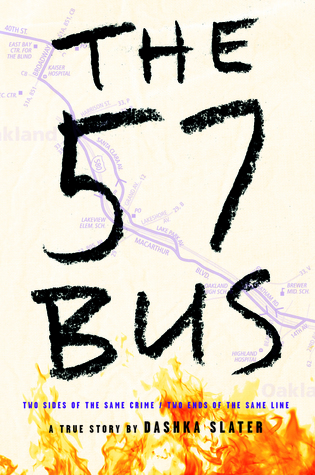
Review: The 57 Bus

33155325
Review for "The 57 Bus" by Dashka Slater (2017)
Rating: 4 out of 5 stars

After reading this book I came to the realization that I rarely read YA nonfiction. I need to change that. This was a decent book.

“The 57 Bus” probes the real life case of a Black male teenager who sets a White agender teen’s skirt on fire as they rode on a commercial bus on the way home from their respective schools in Oakland, California in 2013. It was a chance encounter–neither teen knew the other–but lives were changed forever. I think Slater does a great job of setting the scene, introducing us first to Sasha, the agender, Aspberger’s teen who wears skirts to express himself, and then to Richard, a Black male who grows up with a mother who works two jobs, the constant threat of arrest and incarceration. I also think the author does an exceptional job with the point of view of the perpetrator, being careful not to pathologize his behavior, but at the same time not excusing it either. This is hard to do, as most authors who write about people of color committing crimes generally tend to take one role or another.

Anyway, this is a great book. Definitely a quality read.

Review: A Land of Permanent Goodbyes

35082445
Review for "A Land of Permanent Goodbyes" by Atia Abawi (2018)

Rating: 3 out of 5 stars

This is a heartbreaking, modern day story about a young man named Tareq from Syria who loses his mother, several of his siblings, and his grandmother in the tragic bombing of his home during the Syrian war. He flees with his father and sister to his uncle’s home in Raqqa, though he soon discovers that it is not safe in this location either. Tareq eventually leaves Raqqa with his cousin and escapes to Turkey. However, due to the large amount of Syrian refugees like himself, there are few job opportunities available. Deciding to continue his journey into Europe to gain asylum, Tareq travels to Greece, hoping to gain some kind of sense of normalcy.

I liked the premise of this book but its execution was a firm ‘no’ for me. Though the story itself is extremely compelling, the author’s choice to go with an omniscient narrator, “Destiny,” was a strange one. “Destiny” interrupts the story often, giving us its thoughts on war, the human condition, people’s sufferings, insights on various unconnected character’s lives, etc. I didn’t like this. As a matter of fact, every single time “Destiny” began to narrate I found myself skimming pages and disengaging from the story. I feel there was no need for this kind of storytelling, Tareq’s story was certainly strong enough to maintain its own narration.

Also included in this story is a young Greek woman’s account of her interactions with Syrian refugees. Although she is connected to the events of the novel, the author’s choice to include her narration (in addition to “Destiny”) was odd as well. Other than a shallow representation, her account of the events were pointless and really seemed to serve no purpose other than to propagate a kind of ‘kind White savior’ trope.

When I got to the end of this, I noticed this was a YA book. This book is pretty graphic in its descriptions of war–there are descriptions of beheadings, executions, and other pretty harsh realities that a child is in for should they decide to read this. But as an educator, I don’t believe in censorship, so this is a very eye-opening and timely book.

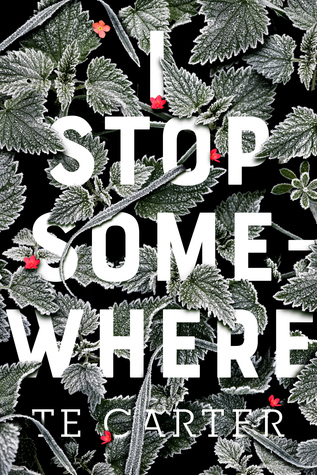
Review: I Stop Somewhere

29751533

Review for "I Stop Somewhere" by T.E. Carter (to be published on 28 February 2018)
Rating: 2 out of 5 stars

I didn’t like this book. It’s kind of a mashup between “The Lovely Bones” and “13 Reasons Why,” neither of which I liked either. I read this fairly quickly, not because I was engaged with it, but out of desperation to get it over and done with.

Ellie is a quiet, shy teenage girl in a small New York town being raised by a single father. She comes from a working class background and quickly becomes enamored with a wealthy local businessman’s son, Caleb. From frequent flashbacks, we know that Caleb is not what he seems. He is cruel and sadistic, as well as the main perpetrator in a string of brutal assaults and rapes of local girls, one of which ends Ellie’s life.

The first 100 pages of this book are unbearable. Ellie is a spirit, trapped in the location of the last moments of her life, watching from the afterlife as girl after girl is taken to the same abandoned house and brutally assaulted and raped. She drifts back and forth between each act of violence she witnesses to narrate events in her former life, which quite frankly, doesn’t have much plot depth or character development.

Let’s pause and talk about this for a moment. This is one of my greatest pet peeves in fiction–authors who overemphasize rape and acts of violence through excessive narrative detail, with very little to no character development (the film equivalent to this is known as “torture porn”). It’s gratuitous, it’s voyeuristic, and worse, it does absolutely nothing to challenge the rape or the rapist, nor does it shift power in favor of the victim. You cannot conquer rape culture or violence through “torture porn”- style writing. It only serves its own end, which is to capitulate on the sexist notion that to keep people interested, women must die or be somewhere in the act of dying. It’s wrong.

Thankfully, the tone of the book does shift in the second part, which turns to the voices of the victims. There is a kind of reckoning in the end that’s somewhat hopeful, along with a thoughtful commentary on victim-blaming and why Ellie’s disappearance was ignored for so long (i.e., she’s from a lower social class and not from the “better” side of the tracks). I still don’t like this book though. Even though the sun does comes out in the end, there was too much bleakness, too much of a lingering dark cloud here. If I hadn’t have read the first part I think I would have felt better about it, or maybe even given this a higher rating.

This book is categorized as YA, btw. If I was troubled greatly by reading this, I cannot imagine what it does to the psyche of a younger person, who may or may not possess the insights to deal with this level of realism. Proceed with caution.

[Note: I received an advance digital copy of this book from the publisher and NetGalley, in exchange for an honest review.]

Review: I Am Not Your Perfect Mexican Daughter

29010395
Review for "I Am Not Your Perfect Mexican Daughter" by Erika L. Sanchez (2017)

Rating: 2 out of 5 stars
Before I begin, lemme say that I hope that everyone is having a wonderful winter holiday, whether it’s Christmas, Hanukkah, Kwanzaa, or just a few days of physical rest from work.
Now, onto my review. Kinda spoiler-y, so beware…

Julia is a Mexican American teenager living in inner-city Chicago. In the first 25 pages we learn that her life really sucks: her older, “perfect” sister Olga has just been run over by a bus, her dad stays drunk and emotionally unavailable, and her overly domineering mother projects all of the expectations that she had for her older daughter onto Julia. As a result, Julia stays depressed and angry, transferring her rage back onto her family and the people around her.

While it’s an understandable anger that this character has, man…I’ve never read a YA book with a character this unbelievably gross. Julia is truly a monster that is equal parts cruel and arrogant, with a haughty demeanor to match. I can understand sarcasm, dark humor, or even a whip-smart kinda protagonist, but this character is just a plain jerk. All throughout the novel she internally mocks and belittles the people around her, even her own sister in her casket. When she speaks she is not nice either, cursing at folks, whining, and talking down to people unless it involves something she enjoys. It seems that the author wants us to empathize with Julia’s plight, but this was not possible for me. There was really nothing redeeming about her character here at all. Nothing.

There are plot problems too. Very early on in the novel Julia discovers a possible secret that her deceased sister kept from everyone, but then this story line is abruptly dropped. It’s picked up again and we learn a little more about it, but then it’s dropped again, picked up a little later on, then dropped again. This goes on for 250 pages or so. By the time the “secret” is revealed, it’s not really a secret anymore and you already know what happens, nor do you care. Also a problem was the multitude of issues in this book being juggled around in a maddening circle–abortion, teen sex, rape, mental illness, suicide, class issues, racism, being an undocumented immigrant, LGBTQ issues–with such minimal focus devoted to each that you’d rather the author had just chosen two or three issues and written accordingly. For this reason ending seemed terribly rushed to me.

Lastly, at about 60% in, there is a romance in this novel. Julia meets a wealthy young white man in a book store and within 10 pages, they’re kissing. In another 15 pages, they’re meeting up over at his place and having sex. The too-instant nature of their supposed attraction makes no sense to me, given just how plain evil Julia is toward everyone else in the book. I realize it’s YA and romance is practically a requirement in this genre, but I dunno…I just didn’t like it.

While I didn’t like this book, I do recommend you read it. It appears to be quite popular on Goodreads and with online reviewers, so everyone’s bound to have an opinion on it some way or another. My advice to the author: not terrible for a first time writer, but if you’re going to go the unlikable main character route, there has to be something else, that oompf factor to compel the reader to want to like reading forward. This wasn’t it.

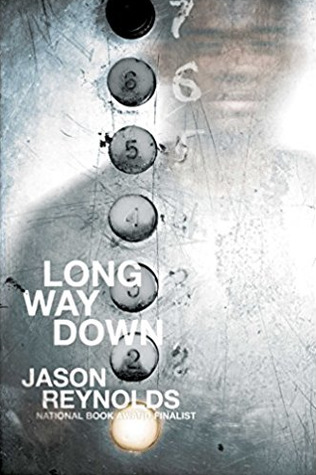
Review: Long Way Down

22552026
Review for "Long Way Down" by Jason Reynolds (2017)
Rating: 5 out of 5 stars

Not the first novel in verse I’ve read but certainly one of the best.

Will is a teenager who has just lost his older brother in a shocking act of violence. The morning after, he finds his brother’s loaded gun and gets on his building’s elevator, going down, in pursuit of his brother’s murderer to kill him. At each floor, the elevator stops and a different person from Will’s past “gets” on, imploring him to think about his choices before it’s too late. It’s a fascinatingly interesting story, one that I think I actually respected more for the fact that it was written in verse–extraneous details skipped, only the bare bones here. It’s 300 pages or so but only took a couple of hours to read. The ending was a bit confusing, but after several reads I came to appreciate it for what it was–completely and superbly ambiguous to the reader.

As a former teacher I can see this being used in middle or high school classrooms, because there’s so many dialogue and discussion possibilities present with this book. It takes place during anytime and anyplace and anywhere and doesn’t offer any easy answers. Despite inevitable criticism to the contrary, I don’t see why this book should make the problem of violence a simple one, as everyone knows that it’s a complicated cycle that repeats itself over and over again. It’s also great reading for adults like me, I loved this book immensely.

This novel sets a pretty high bar for all other YA poetry books, which is good because I am starting to feel that this form of story-telling is becoming somewhat over saturated. Definitely recommended.

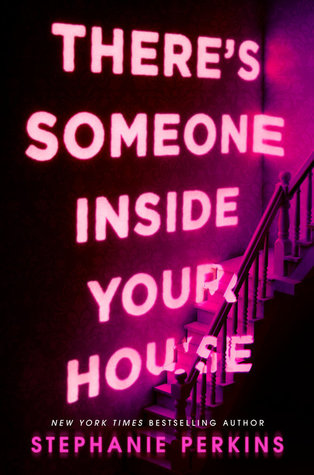
Review: There’s Someone Inside Your House

15797848

Review for "There's Someone Inside Your House" by Stephanie Perkins (2017)

Rating: 2 out of 5 stars

Whew Lawd this was bad

First off, I love YA thriller/horror. If you spent your high school days reading R.L. Stine and Christopher Pike, then you know what I’m talking about. So when this book came out, I was on it faster than a speeding ticket.

This is my first Stephanie Perkins novel. From my understanding she mostly writes YA romance and this was her first foray into horror. After reading this drivel, it’s my determination that she should probably stick to writing romance.

The run-down: Makani Young, the main character, is sent to live with her grandmother in a small Nebraska town following her parents’ divorce and after a mysterious incident in her Hawaii hometown that’s not revealed until the end of the novel. She has eyes for Ollie, a pink-haired emo kid, and after they meet they make like rabbits for most of the book. While Makani and Ollie are exploring each other’s anatomies, meanwhile, there’s a psycho running around killing members of their high school student body for reasons unknown.

So where do I begin? For the whole “Who will be next?” hook, this book had only about 5 deaths and still turned out to be 99.9% romance. The book pivots between Makani and Ollie’s relationship and the killer’s next victim, which we follow in a brief chapter as it happens. We’re never told why the killer is picking people off, and his identity is fully revealed at about 60% into the book. What happens after this? Nothing. For me, it’s was a hazy blur of wtf moments and skipped pages.

And Makani and Ollie…what a mess. For a romance writer, the author manages to make their relationship strictly about lust and nothing else. Despite all the physical fun these two are having, it’s mindlessly boring. Even an old pervert like me started flipping pages after awhile. On to the next slashing please…

I was expecting more blood and gore here. Two stars.

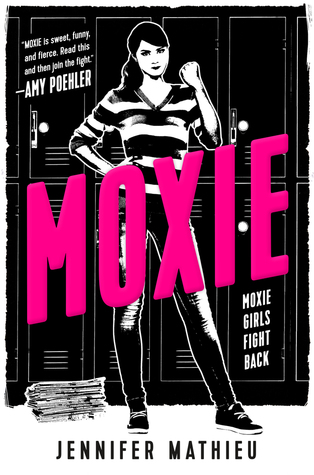
Review: Moxie

33163378
Review for "Moxie" by Jennifer Mathieu (2017)

Rating: 3 out of 5 stars

I know this book has gotten glowing praise from many of its readers, but I was underwhelmed with this one. I know I’m jumping off a cliff by saying this, but this book was just ok for me.

Vivian is an average teen living with her single mother in a small town in Texas. Aided by her mother’s Riot Grrl memorabilia and fed up with sexist administrators, Vivian makes an anonymous zine to protest the unfair treatment of girls at her high school and empowers them to fight back. The zine catches on, and most of the girls at the school eventually join in her fight. In the middle of all of the brouhaha, Vivian manages to snag the hottest artsy guy in school, who, it turns out, is sympathetic to her feminist goals.

My main concern with any feminist text is how it addresses intersectionality. As a woman of color, I’m critical of any text that claims to be feminist, yet focuses exclusively on the voices of White middle class women. Fortunately the author does address the issue, about midway through the novel when Vivian reveals that her mother once said that “Riot Grrls weren’t as welcoming to other girls as they could have been.” Well, no ma’am, they weren’t. There is a Latina and and Black girl at Vivian’s school who join the Moxie movement, yet we’re supposed to believe that their perspectives and concerns (jerky football players and dress code checks) are the exact same as Vivian’s. Sorry, but I simply don’t believe this. Where is race here? How does the author manage to make women of color so one-dimensional in this book? Gimme a break.

Which brings me to the last issue: race. While she does addresses the problem of inclusivity, Mathieu’s fictional small-town Texas world is devoid of any mention of racism. I praise the author for addressing the elephant in the room, but I just don’t think it goes far enough. As far as gender, there is a reference to a lesbian character, albeit a brief one. The problems that arise from race, class, sexuality, and gender will always overlap (hint: why it’s called intersectionality), and I simply wanted more from the Black, Latina, and LGBTQ characters here. What you get instead with this book is a lot of romanticizing on the 90’s Riot Grrl movement, which, let’s face it, was not as inclusive to race and gender as it should have been.

Overall, not a bad book, but not a great one either. Three stars is my best recommendation here, though I look forward to (possibly) reading more of this author in the future.