Review: We’ll Fly Away

35959354
Review for "We'll Fly Away" by Bryan Bliss (2018)
Rating: 4 out of 5 stars

A very well written, hard hitting YA book.

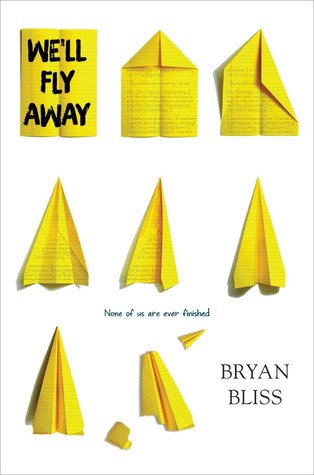
“We’ll Fly Away” is the story of two boys, Luke and Toby, who have been friends for most of their lives. Luke, the stronger of the two, is an athlete who dreams of college success through wrestling, while Toby, aimless and a victim of his father’s physical abuse, relies on Luke to protect him. Both boys long to escape their rural North Carolina town (ironically, the setting of which is only about an hour away from me) and bond over a broken down airplane they discover in the woods as kids. Interestingly, the theme of flight is all throughout this book, even though it is apparent early on that neither of these boys are going anywhere. Escape, it seems, is only possible through death and/or violence.

When the story opens, we discover that Luke is in prison, writing letters of apology to his friend Toby. We are not told why he is on death row, but it is obvious that he is there for a horrible crime. In his letters, Luke struggles with his morality, getting along with inmates, and other adjustments to prison life. The story switches between his letters to a third person narrative of the events leading up to Luke’s imprisonment. In the third person flashbacks, we learn that Luke’s life isn’t free of dysfunction either. When he isn’t wrestling, Luke is taking on way more responsibility than he should, watching over his younger twin brothers while his mother takes up with different men. Toby’s father, a local criminal, physically and emotionally abuses him, leaving him with a lack of social skills that lead him into conflicts at school. Luke, ever Toby’s rescuer, comes to his defense time and time again.

I won’t go into too many of the details of this story to avoid spoiling it. I will say, however, that this is a fairly solid book that examines male friendship, difficult choices, and the criminal justice system in a very meaningful way. Even though there was a bit of a lull in the middle of this, the ending was shocking enough to make up for everything it lacked in between.

Definitely recommended.

Review: Calling My Name

34541786

Review for "Calling My Name" by Liara Tamani (2017)

Rating: 5 out of 5 stars

I loved this YA book. The cover’s cute and the writing is quite gorgeous.

“Calling My Name” is the beautiful story of a young Black girl named Taja, growing up in a middle class, Southern Baptist family in Texas. The story begins with Taja as a young girl and follows her through her senior year of high school through a world of ‘firsts’–social awkwardness, wearing a bra, friendship drama, sibling and family relationships, her first kiss, losing her virginity. Each chapter is named and presented vignette style, with quotes from various Black women authors (Toni Morrison, Zadie Smith, Zora Neale Hurston) interpolated throughout the text as themes for what follows. I also loved the lovely ambiguities here: we’re never told explicitly how old Taja is, though the passage of time as the novel progresses is evident. Also nebulous is the exact time frame in which Taja’s childhood takes place, surrounding references to pop culture and relics such as acid-wash jeans allude to the late 80’s through the mid-90’s. I loved, however, that time really didn’t seem to matter here: Taja’s life could be today, 20 years ago, or even as far back as 40 years ago. I’ve always maintained that the best books do not have to explicitly state everything they’re made of, and this book knows that and much, much more.

Religion, specifically the Black Southern Baptist tradition, plays a prominent role in this book. Taja’s parents are ultra conservative and tightly control her behavior, not wanting her to fall into “sin” or become “used goods” before marriage. Taja’s identity as a Christian influences much of her thoughts and actions, leading to several conflicts as a teenager until she eventually finds her own voice as an individual, shortly before leaving for college.

Reading this book was emotional for me. It is the first book that so closely mirrored my own experiences as a Black girl in the 80’s and 90’s, growing up in very much the same middle class, conservative Southern Baptist family dynamic. The stereotypical ‘problems’ that we typically associate with the narratives of people of color (you know, incidents of racism, poverty, substance abuse, economic struggle) were largely absent here, which I have to admit that I appreciated for a change. This is not a story about any of those kinds of traumas–it’s a story about soul-searching, Black girl style. Throughout the reading of this book I wanted so much to simply applaud because finally, someone got it RIGHT.

It goes without saying that I completely and totally recommend that you read this book.

Top Ten Tuesday: Books I Decided to DNF

Ok, it’s 11:28 pm Eastern Standard Time…and I know where my official Top Ten Tuesday is. A couple of weeks ago I discussed the intricacies of the DNF (book-speak for one that you willfully choose not to finish); this week I’ll list a few books that I’ve DNF’d over the years and the reasons why they ended up that way.

As I’ve explained before, I DNF books quite often for a variety of reasons. If I got over halfway through it and I can put together a somewhat coherent review, I’ll post it here. Often, however, I don’t. I just move on to another book.

So here’s my playlist of skipped books whose reviews I’ve never posted here and I’ve never mentioned to anyone but myself. You always get the latest hits, so here’s:

29chapters.com’s List of Not-So-Famous Misses

  1. Bastard Out of Carolina, Dorothy Allison. This book is actually quite good. I’ve read other books by Dorothy Allison and her work is taught in a lot of Women’s Studies classes, especially at the college level. The reason I DNF’d this book, however, is because of its graphic depictions of the sexual and physical abuse of the main female character by her stepfather. I’ve tried many times to just grit my teeth and read it, but I can’t get past the highly disturbing content here. I just…can’t.
  2. The Lovely Bones, Alice Sebold. Another wildly popular book whose disturbing content I just couldn’t stomach. The horror comes on very early in the book, around page 12 when the main character is raped, killed, and dismembered by a neighbor. After 3-4 times of pulling it off my shelf, reading it, only getting to page 12, and DNF’ing it, this book sat on my shelf for years until I finally got rid of it in a used book exchange last summer. It’s safe to say that I will probably never attempt to read it again. I also refuse to watch the movie version.
  3. Your Heart is a Muscle the Size of a Fist, Sunil Yapa. This is a historical fiction novel that examines several sides of the 1999 Seattle WTO protests from different perspectives–a riot cop, a politician, protesters. Somewhat decent, I just couldn’t get into this.
  4. Her Last Death: A Memoir, Susanna Sonnenberg. One of the few nonfiction books here that I’ve quit. Basically this is a book about a very dysfunctional mother-daughter relationship, which morphs into the author largely blaming her mother for many of her poor choices, including becoming promiscuous at an early age, being a pathological liar, her drug use. I got half way through this book before I just said enough already, I can watch this Dr. Phil episode on any given day of the week…
  5. Paint it Black, Janet Fitch. After her first novel “White Oleander,” I thought author Janet Fitch was untouchable. Au contraire. Her second novel was such a snoozefest that I put it down and never looked back.
  6. The Tsar of Love and Techno, Anthony Marra. This book had glowing reviews, but I kept falling asleep on this one. It’s a set of interconnected short stories, all centered around various characters during the history of modern Russia. Perhaps I also hated this because it brought back bad memories; I fell asleep during the Russian section of World History during high school too. Oh welp.
  7. The Dog Stars, Peter Heller. Post-apocalyptic story. About a man and his dog. And a plane. But the writing style. Was such a fucking distraction. That I put it down. (<— The whole book’s written like this, mates. It is an absolute pill to read.)
  8. Sing, Unburied, Sing, Jesmyn Ward. First off, I love Jesmyn Ward’s writing. I’ve read another nonfiction book of hers, Men We Reaped, and I absolutely loved it. This book, however, not so much. I found the plot kinda tedious and I just couldn’t get into the characters. I’m not surprised that this book won the National Book Award, because there is something special here, but the specialness is simply not for me.
  9. Severance, Robert Olen Butler. This book has an interesting premise: that human consciousness is maintained for 90 seconds immediately after one is decapitated. Therefore, this book is a collection of the “final thoughts” of many people (some famous, some not) who have ‘lost their heads’ throughout history. It’s a really morbid book, and the premise alone should have been enough to carry me through it, but for some reason the writing here was just plain weird. The friend who suggested it to me told me to read it like poetry, but that didn’t help, because I hate bad poetry. Blech.
  10. Blood Meridian, Cormac McCarthy. I’ve read my fair share of Cormac McCarthy over the years: The Road, Outer Dark, Child of God, No Country for Old Men. His writing is typically very dark and violent in nature, but that’s what makes him so special to me: that he can explore darkness and evil in such meaningful, creative ways. Anyway, Blood Meridian was just sloooooow. It’s also a Western (the other four novels I’ve read by him are not), and Westerns are just not my preferred genre.

There’s tons of other books I’ve DNF’d that could discuss here, but these are the ones that stood out most. Stay tuned!

xoxo, Kellan

Review: After the Shot Drops

31179039
Review for "After the Shot Drops" by Randy Ribay (2018)
Rating: 3.5 out of 5 stars

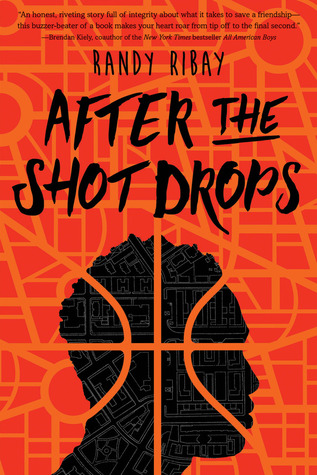
“After the Shot Drops” is the story of two friends, Bunny (affectionately named so because he’s got ‘hops’) and Nasir. When the novel begins, Nasir and Bunny are not on speaking terms, mostly because Bunny has recently transferred to an upper crust private school to play basketball without talking to him about it first. While Bunny realizes he’s out of place among his wealthy, mostly White peers, Nasir remains at his inner-city school and finds kinship with his cousin, Wallace, a troubled young man facing eviction. To earn quick cash, Wallace bets against Bunny in a final championship game–leading to very serious, life-altering consequences for all three young men.

I gave this three and a half stars because there are some issues here. For one, the pacing was entirely too slow. It took me nearly a month to finish this book, and that was because it failed to really maintain my interest for more than 50 pages at a time. We don’t find out until nearly page 150 that Wallace is up to something sinister that will ultimately change the rest of the book. Second, this book is written in dual narration, switching back and forth between Bunny and Nasir. While I’m not criticizing this method of storytelling, I was a little weary of the characterization here. The voices of Bunny and Nasir seemed indistinguishable, I couldn’t tell one from another. If the author hadn’t labeled who was speaking before each chapter, I wouldn’t have known who was saying what.

Third, during certain scenes of this book, there’s a lot of very technical, play-by-play basketball talk. While personally I like bball, there may be other readers that get kinda lost here. While I don’t think you have to love basketball to read this, liking it sure does help you get through those pages.

Overall, I think this is a fairly decent book. I love how it focuses on Black male friendship, a subject that I don’t think gets a lot of play in YA literature. As a matter of fact, I can’t think of a book that I’ve read in the past 5 years where a friendship between two young Black men was front and center, to the exclusion of other subjects. There are short, quick chapters here too, which tends to engage those students who are reluctant to read.

Definitely recommend this book!

Review: Sex Money Murder

36236094
Review for "Sex Money Murder: A Story of Crack, Blood, and Betrayal" by Jonathan Green  (2018)
Rating: 4 out of 5 stars

Like a good pair of heels, every gal needs a good ol’ fashioned true crime book. The ones I prefer tend to be concentrated in urban environments and focus on fantastical tales of violence, drug dealing, and hip hop martyrdom. It’s great stuff, and this is a great book.

Before beginning this book I knew only vaguely about Sex Money Murder, a notorious gang that controlled the drug trade in the Bronx in the late 1980s and 90’s. Aside from a lone episode of the weekly documentary Gangland from The History Channel several years ago and a couple mentions in hip hop songs, the history of this group has been mostly unknown to those outside of the urban realm. The story of SMM revolves around three childhood friends–Peter “Pistol Pete” Rollock, Emilio “Pipe” Romero, and Shawn a.k.a. “Suge.” They come of age in a particularly violent NYC housing project, the Soundview Homes. Eventually Pete turns to the drug trade and he and his two lieutenants’ operation take over the area, mostly through intimidation of residents, extortion of other dealers, and brutal violence. They also traffick crack to other markets, mostly in cities on the East Coast. Like a Shakespearean tragedy, all three live out their wildest fantasies of success until pride, greed, and disloyalty eventually take them all down and cause them to turn on one another. While one of the original three members of SMM is a free man, Pipe is currently serving time and “Pistol” Pete has been in jail since 2000, serving a 100+ year sentence in isolation for several murders and racketeering in one of the most secure federal prisons in the nation, ADX Florence.

Author Jonathan Green brings new life to the tale of Sex Money Murder with fair and balanced research of his subjects. It is evident that he spent extensive time with the people whose stories that he tells. Also profiled are the cops who brought SMM down, as well as an examination of the urban de-industrialization and the racist housing practices that created SMM in the first place.

Be forewarned, however, that this is not an easy book to read. There is all manner of violence, tales of drug dealings, shootings, and a lack of remorse by all involved that permeates this book. However, it is a story that begs to be told, and the author does a great job here. I definitely recommend this book.

Review: The Weirdness

18050224
Review for "The Weirdness" by Jeremy Bushnell (2014)

Rating: 4 out of 5 stars

I hate that it took me two months to finish this book. Not because it was bad, but because I have severe book ADD and I own this copy, so the task of finishing it kept getting pushed farther and farther to the back of my reading pile. Anyway, this is a great book. I read Jeremy Bushnell’s other novel “The Insides” and loved it so much that I decided to go for this one too. I’m glad I did.

“The Weirdness” is about a 30-year-old schnook named Billy Ridgeway. He’s a wannabe writer looking for his big break and working part time in a sandwich shop. Him and his girlfriend have drama, he has no money for rent, his roommate’s gone AWOL. Billy doesn’t think his life could get any worse until he encounters the devil in his apartment one day, with freshly brewed coffee and ready to make a deal with him. Retrieve the devil’s lucky cat, the Neko of Infinite Equilibrium, from a dangerous warlock and he’ll make sure that Billy’s book is published to rave reviews.

I don’t want to get too far into the plot with this one because there are hella twists and turns. There’s also a lot of fantastical elements (time portals, God machines, hell-wolves), so you have to step outside of realm of the rational and relax just for a little while. There’s also a healthy dose of black humor, which I appreciated.

This is definitely a fun read. Four stars.

Review: All God’s Children

2624807
Review for "All God's Children: The Bosket Family and the American Tradition of Violence" by Fox Butterfield (2008 reissue, originally published in 1995)
Rating: 4 out of 5 stars

This book is fascinating. It’s a shame that the original hardcover edition is out of print and quite hard to find at any library in my city. In the end, I had to order it through interlibrary loan.

Anyway, “All God’s Children” traces five generations of the Bosket family, from their days as slaves in rural South Carolina all the way to Willie Bosket’s incarceration in 1978 as one of the youngest murderers in New York City’s history. At 15 years old, Willie, recently free from a reform school, killed two subway riders in cold blood and shot another. Under the laws of the time, the maximum he could get was 5 years. The public outcry was so great against this that the Juvenile Offender Act was passed later that year, making it possible that children as young as 13 could be tried as adults.

Fox Butterfield uses Bosket’s family history as a way to discuss the history of violence in America. Willie’s great grandfather was a violent man, his grandfather, as well as his father. Details of all of their lives and crimes are given here. He avoids the typical fluff arguments about the causes of violence (poverty, television, etc) and instead characterizes it as something deeply embedded into the fabric of American life, a product of the White slave-holding class, the pre-Civil War South. He also discusses the violence of reform schools and prison institutions whose function is to “correct” violent individuals. Willie believes he is merely the product of these institutions in its grossest form. I can’t disagree.

The amount of research in this book is exhaustive. I commend the author for writing this book. I just wish that it was more available in 2018.

Review: Emergency Contact

35297272

Review for "Emergency Contact" by Mary H.K. Choi (2018)
Rating: 3 out of 5 stars

This book is wildly popular right now. I follow the author, Mary H.K. Choi, on Instagram. A Facebook book club I’m in spoke in glowing terms of this and recommended it. I’ve gotten three emails in the past month from Kirkus Reviews, they also recommended this. Hell, even Rainbow Rowell recommended this. It’s like God himself was screaming at me to read IT, so I did.

And errr…this book was kinda meh for me.

Without giving away too much of the plot: Penny is a introvert with a MILF-y mom that annoys her immensely. She goes off to college an hour away and meets Sam, a tattooed hipster dude who works and lives in a local coffee shop. They bond over their personal crises, texting each other as they deal with their respective family and personal issues. Penny discovers her love of writing fiction, Sam nurtures his desire to be a filmmaker. In the end, exactly what we expected to happen between these two happens–they fall for each other.

I said I wasn’t going to give away the plot, but I actually kinda just did. I’m sorry. But honestly, that’s like, it with this book.

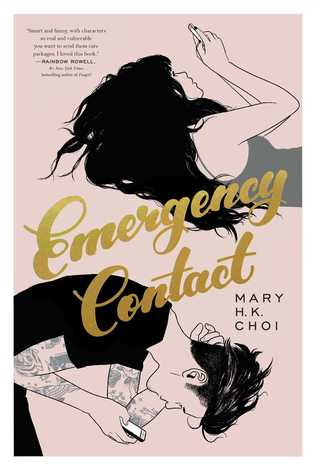
This book is sweet and the language is kinda cool, but there’s nothing here that I haven’t read before. I suspect that one of the reasons why this book is so popular is because it has a rose gold toned, super cute Forever 21-ish looking cover. I know that sounds harsh, but dude…seriously, what’s really here? It’s just a run-of-the-mill YA love story. While I appreciate the way that the author does try to give the protagonist some depth, I realized that after I close this book I probably won’t remember much about Penny anyway. What I most remember about Penny is her annoying tendencies, i.e., her hopeless fascination with Sam at first sight. No less than 5 times we’re reminded by Penny of Sam’s tattoos, ooooh ahhhh, as if we’ve never seen a tattooed man before. Is Penny’s fawning, otherworldly reaction to Sam even real? Of course not. Girl, have a seat please.

Once again, not a bad book, but one that didn’t really excite me either. Three stars.

Top Ten Reasons I DNF Books

Let’s talk about the DNF today, beloveds…

For those that don’t know, DNF is book-speak for a book that you start and, for whatever reasons of your own, decide not to finish. I’ve been rather outspoken about the fact that I DNF and that I do it quite often, with no absolutely no shame and no apologies for it. Some readers are outspoken for the opposite, that they never DNF a book, no matter what the reason. Other readers/book bloggers I encounter do DNF, but don’t speak about it publicly.

To DNF or not to DNF is a complex thing. There are many, many reasons why I stop reading a book, which I’ll explain below. Generally as a rule I give a book 50 pages to capture my interest and if it fails to do so, I’ll stop reading. These days, however, I find that my 50 page rule has gone wayyy down–hell, it’s 40 pages, in some cases, 25. Sometimes I will review the book here if I got past the halfway mark, but I will not give it a rating. I will certainly tell you why I didn’t like it though.

There’s a couple of factors that make me DNF-friendly, which I have to admit here. For one, I rarely buy books. About 85% of the books I read come from the library, so 86’ing it is no big deal, I just take it back and get another. I also find that I tend to DNF fiction much more often than nonfiction. Probably because it’s so author-driven, while non-fiction–not so much. With NF you are welcome to disagree with the author, skip pages and see if they change their mind. I usually don’t DNF memoirs though.

So here goes…

Top Ten Reasons I DNF (do not finish) a Book

  1. It’s boring. ‘Nuff said. If I wanted to fall asleep, I’d put on my Sleep Sounds playlist on Spotify. Seriously. I steadfastly maintain that if you are reading for pleasure, it should engage you and make you want to pick it up and keep going. If it’s nothing but a chore to read it, then put it down. Pleasure reading does not = boredom.
  2. Not in the mood, dawg. Sometimes I will pick up a book, read a few pages, then gauge my feelings. If it’s a nahhhh, then I’ll put it aside. This is not to say that I will never read it again at some other point in time, it just means that I am simply not feeling it in that current moment, right then. I will usually keep these books in my TBR pile but save them for later.
  3. I don’t get it. I’d rather have bad writing than confusing, incoherent, or just plain weird writing. If I can no longer (or I never did) discern what’s happening, then I’ll leave it in the dust. I don’t have time for code-cracking, it ain’t that deep.
  4. Large amounts of gratuitous, objectionable content. I don’t necessarily mind sex, drugs, and violence–but there is a point (and I’ve posted on this before) where such scenes just become, well…too much. It’s like a cheap horror film–we know the killer kills with an ax, but do we really need the camera to linger on the severed head for 5 minutes? We get it, he’s dead. Cut to the next shot. More of the same? Well, forget it. I have no interest in being “shocked” into reading further. If ultra-violence is the only rabbit they can pull out of their hat, then they’ve lost me.
  5. There is NO plot. None whatsoever. Nada. Zilch. Just pages and pages of no action, no character building, no dialogue, no nothing at all. Or there’s pages and pages of all of the things I just mentioned, but it’s a downward spiral into a yawning, mind-numbing void. I would have left this under the label ‘boring,’ but this is so bad it deserves its own category.
  6. I’m not connecting to the character. This is not the same as not liking a character. There are quite a few book bloggers that say that they will stop reading if they don’t like a character. Nah, I’m not that petty. I can stick through disliking a character’s actions and thoughts, but I can’t stick with one who I don’t find compelling. Strong dislike is a compelling reason to read further, it’s the macaroni to my cheese. It’s kinda like that Morrissey song “The More You Ignore Me, The Closer I Get.” Damn right.
  7. It’s too familiar, I already know what’s going to happen. The girl dumps the boy, but you know they’ll get back together in the end. Nerd boy falls in love with manic pixie dream girl. An abused wife leaves her husband, but you know he’s not dead, so a showdown will occur, somewhere in the last 50 pages. Do I need to go on? Let’s find more plots here…
  8. Writing style is too difficult to follow. No capitalization, no quotation marks, heavy use of parentheses, run on sentences, wordsthatruntogether. I know that some authors employ these devices for artistic reasons, but sometimes I just can’t be bothered with trying to decipher between thought and dialogue, which character is which. GTFOH…
  9. It ain’t gettin read, no matter how hard I try. I tend to read several books at once, so if there is a book lingering in my “currently reading” pile that’s been there for 3 months or more, I will usually extinguish it. It usually means something else has gotten my attention and my own behavior indicates that I’m avoiding it for a reason. Whether or not I come back to it later depends, though if I do, I will usually start the book over again.
  10. Not my cuppa joe. Sometimes I will stop reading because I just don’t believe I’m the right audience that the book was intended for. It’s not a bad book, it’s just not for me. Therefore my reading it won’t matter, the writer probably ain’t talking to me in the first place. I’m ok with that. So rather than reading it, wasting my time, and being pissed off, I’ll just stop reading it. Blah.

So what do ya’ll think? Do you DNF? Why or why not?

Review: Passage

33911047
Review for "Passage" by Khary Lazarre-White (2017)

Rating: 3 out of 5 stars

“Passage” is a short novel set in NYC in the winter of 1993. Warrior, the main character, is a highly intelligent young Black man who personifies the rage and pain of his everyday existence. He hates cops (cleverly called “blue soldiers”), school has little usefulness to him. It is not hard to imagine why, as this story lays bare much of the reasons for Warrior’s nihilism. He is also fighting the demons from the past and present that threaten to take his soul, literal and figurative battles that come up in this text time and time again.

It is interesting that 1993 is the date given for this novel; it is about a year after the world saw the rage of the Los Angeles riots. Even though it is set in Black America’s collective past, this story definitely could have been the present, or even the future. Despite talk of a post-racial society where things are said to be “equal” and every person can still achieve their dreams, it is quite clear that racism still exists, that the legacies of slavery still exist. The title “Passage” alludes to multiple themes: the Middle Passage, the dehumanizing journey that Africans were forced to take by ship to the New World to be sold as slaves, Black men’s rites of passage invoked as means of everyday survival. Even the cover art calls your attention–it’s of a young Black man in profile, a hoodie covering half of his face. Echoes of the 2012 killing of Trayvon Martin are still very much alive in this novel.

In the end, I still gave this book three stars. It wasn’t because this book was bad, but because, in theory, I liked the idea of it more than its actual living form. There’s a hazy mix of mysticism, magic, and spiritualism here that, in my opinion, should not have been so hazy. Reading this took massive amounts of effort, mostly due to frequent interpolations of various plot points. Clearer storytelling would have helped immensely.

I definitely recommend this book, however.