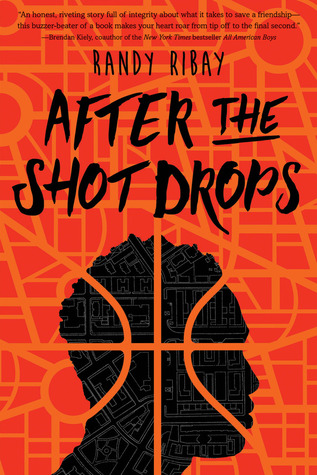
Review: After the Shot Drops

31179039
Review for "After the Shot Drops" by Randy Ribay (2018)
Rating: 3.5 out of 5 stars

“After the Shot Drops” is the story of two friends, Bunny (affectionately named so because he’s got ‘hops’) and Nasir. When the novel begins, Nasir and Bunny are not on speaking terms, mostly because Bunny has recently transferred to an upper crust private school to play basketball without talking to him about it first. While Bunny realizes he’s out of place among his wealthy, mostly White peers, Nasir remains at his inner-city school and finds kinship with his cousin, Wallace, a troubled young man facing eviction. To earn quick cash, Wallace bets against Bunny in a final championship game–leading to very serious, life-altering consequences for all three young men.

I gave this three and a half stars because there are some issues here. For one, the pacing was entirely too slow. It took me nearly a month to finish this book, and that was because it failed to really maintain my interest for more than 50 pages at a time. We don’t find out until nearly page 150 that Wallace is up to something sinister that will ultimately change the rest of the book. Second, this book is written in dual narration, switching back and forth between Bunny and Nasir. While I’m not criticizing this method of storytelling, I was a little weary of the characterization here. The voices of Bunny and Nasir seemed indistinguishable, I couldn’t tell one from another. If the author hadn’t labeled who was speaking before each chapter, I wouldn’t have known who was saying what.

Third, during certain scenes of this book, there’s a lot of very technical, play-by-play basketball talk. While personally I like bball, there may be other readers that get kinda lost here. While I don’t think you have to love basketball to read this, liking it sure does help you get through those pages.

Overall, I think this is a fairly decent book. I love how it focuses on Black male friendship, a subject that I don’t think gets a lot of play in YA literature. As a matter of fact, I can’t think of a book that I’ve read in the past 5 years where a friendship between two young Black men was front and center, to the exclusion of other subjects. There are short, quick chapters here too, which tends to engage those students who are reluctant to read.

Definitely recommend this book!

Review: The Weirdness

18050224
Review for "The Weirdness" by Jeremy Bushnell (2014)

Rating: 4 out of 5 stars

I hate that it took me two months to finish this book. Not because it was bad, but because I have severe book ADD and I own this copy, so the task of finishing it kept getting pushed farther and farther to the back of my reading pile. Anyway, this is a great book. I read Jeremy Bushnell’s other novel “The Insides” and loved it so much that I decided to go for this one too. I’m glad I did.

“The Weirdness” is about a 30-year-old schnook named Billy Ridgeway. He’s a wannabe writer looking for his big break and working part time in a sandwich shop. Him and his girlfriend have drama, he has no money for rent, his roommate’s gone AWOL. Billy doesn’t think his life could get any worse until he encounters the devil in his apartment one day, with freshly brewed coffee and ready to make a deal with him. Retrieve the devil’s lucky cat, the Neko of Infinite Equilibrium, from a dangerous warlock and he’ll make sure that Billy’s book is published to rave reviews.

I don’t want to get too far into the plot with this one because there are hella twists and turns. There’s also a lot of fantastical elements (time portals, God machines, hell-wolves), so you have to step outside of realm of the rational and relax just for a little while. There’s also a healthy dose of black humor, which I appreciated.

This is definitely a fun read. Four stars.

Review: Emergency Contact

35297272

Review for "Emergency Contact" by Mary H.K. Choi (2018)
Rating: 3 out of 5 stars

This book is wildly popular right now. I follow the author, Mary H.K. Choi, on Instagram. A Facebook book club I’m in spoke in glowing terms of this and recommended it. I’ve gotten three emails in the past month from Kirkus Reviews, they also recommended this. Hell, even Rainbow Rowell recommended this. It’s like God himself was screaming at me to read IT, so I did.

And errr…this book was kinda meh for me.

Without giving away too much of the plot: Penny is a introvert with a MILF-y mom that annoys her immensely. She goes off to college an hour away and meets Sam, a tattooed hipster dude who works and lives in a local coffee shop. They bond over their personal crises, texting each other as they deal with their respective family and personal issues. Penny discovers her love of writing fiction, Sam nurtures his desire to be a filmmaker. In the end, exactly what we expected to happen between these two happens–they fall for each other.

I said I wasn’t going to give away the plot, but I actually kinda just did. I’m sorry. But honestly, that’s like, it with this book.

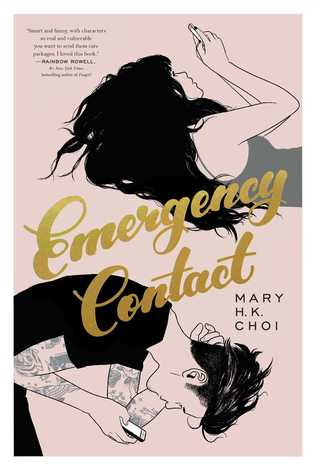
This book is sweet and the language is kinda cool, but there’s nothing here that I haven’t read before. I suspect that one of the reasons why this book is so popular is because it has a rose gold toned, super cute Forever 21-ish looking cover. I know that sounds harsh, but dude…seriously, what’s really here? It’s just a run-of-the-mill YA love story. While I appreciate the way that the author does try to give the protagonist some depth, I realized that after I close this book I probably won’t remember much about Penny anyway. What I most remember about Penny is her annoying tendencies, i.e., her hopeless fascination with Sam at first sight. No less than 5 times we’re reminded by Penny of Sam’s tattoos, ooooh ahhhh, as if we’ve never seen a tattooed man before. Is Penny’s fawning, otherworldly reaction to Sam even real? Of course not. Girl, have a seat please.

Once again, not a bad book, but one that didn’t really excite me either. Three stars.

Review: Passage

33911047
Review for "Passage" by Khary Lazarre-White (2017)

Rating: 3 out of 5 stars

“Passage” is a short novel set in NYC in the winter of 1993. Warrior, the main character, is a highly intelligent young Black man who personifies the rage and pain of his everyday existence. He hates cops (cleverly called “blue soldiers”), school has little usefulness to him. It is not hard to imagine why, as this story lays bare much of the reasons for Warrior’s nihilism. He is also fighting the demons from the past and present that threaten to take his soul, literal and figurative battles that come up in this text time and time again.

It is interesting that 1993 is the date given for this novel; it is about a year after the world saw the rage of the Los Angeles riots. Even though it is set in Black America’s collective past, this story definitely could have been the present, or even the future. Despite talk of a post-racial society where things are said to be “equal” and every person can still achieve their dreams, it is quite clear that racism still exists, that the legacies of slavery still exist. The title “Passage” alludes to multiple themes: the Middle Passage, the dehumanizing journey that Africans were forced to take by ship to the New World to be sold as slaves, Black men’s rites of passage invoked as means of everyday survival. Even the cover art calls your attention–it’s of a young Black man in profile, a hoodie covering half of his face. Echoes of the 2012 killing of Trayvon Martin are still very much alive in this novel.

In the end, I still gave this book three stars. It wasn’t because this book was bad, but because, in theory, I liked the idea of it more than its actual living form. There’s a hazy mix of mysticism, magic, and spiritualism here that, in my opinion, should not have been so hazy. Reading this took massive amounts of effort, mostly due to frequent interpolations of various plot points. Clearer storytelling would have helped immensely.

I definitely recommend this book, however.

Review: Heads of the Colored People

35297351
Review for "Heads of the Colored People" by Nafissa Thompson-Spires (2018)

Rating: 4 out of 5 stars

Short story collections are always hit or miss. You end up either liking some or none of the stories at all. The stories are either too long or too short, the plots are too much of the same or too loosely put together with little overall theme. “Heads of the Colored People” was an exception, I liked every last story in this volume.

Nafissa Thompson-Spires hits the ball out of the park with this one. All of these stories are of Black people living on the fringe of what’s considered “normal” behavior. In this volume, there are Black men who cosplay, Black women who do AMSR (yes–even I had to look it up), Black men and women with anxiety issues, Black women at war with their bodies, Black men professors who passively aggressively war with coworkers, Black millenials obsessed with social media attention. Some of the stories were connected, with several selections detailing the ongoing saga between two Black girl frenemies, Fatima and Christinia. Some of the stories were funny, some of them were quite cringe-inducing, but it was alright because it’s clear that they were meant to be that way. Clearly, Thompson is a writer who is not afraid to write with honesty and just go there.

In the end, I believe this book is effective because it achieves exactly what the title suggests. The author gets deep into what’s in the “heads” of Black people, which, we find out, are a multitude of pressures–the pressure of being the only Black person in their environments, the pressure of being a representation of what non-Black people think of when they conceptualize typical Black “behavior,” the pressure of being Black in American society. Questions like: how does one cope with being angry–without being perceived as the stereotypical “angry” Black man/woman? characterize this book, and I’ll be thinking about the answers for a long time after I read it.

I loved reading this from start to finish. I will definitely watch for future efforts by this writer.

Review: This is How You Lose Her

13503109
Review for "This is How You Lose Her" by Junot Diaz (2012)

Rating: 3 out of 5 stars

I downloaded and read this back in 2012 when it first came out, due to my overwhelming support and respect for Junot Diaz as a writer at that time. I gave it 5 stars because I thought that the writing was fresh and engaging, but the sexism of the male characters bothered me immensely. Man, I thought at the time, he really hates women. I even remember hitting up Google to see if Diaz was married or had a girlfriend, because I could not imagine the jerk he probably was at home. I didn’t speak on it further though. I did not write a review either. I just moved on.

After allegations of sexual misconduct and verbal abuse came out about Junot Diaz last week, I decided to take another look at this book. I read it in a few days and I have to say that I am even more troubled by the male characters’ sexism than I was the first time I read it. On a scale of 1-10, Yunior’s sexism is somewhere in the Outer Limits. He cheats and cheats and treats women like shit and feels only a vague sense of remorse about it. Even though the book is about relationships, in story after story, Diaz’s women characters are always empty and never fully fleshed out. Their bodies exist for the male characters to use and abuse them time and time again. When women characters are somewhat fully realized (“Otravida/Otravez,” the ubiquitous presence of Yunior’s mother) they are always saintly, sad, and long suffering through the perils of their men’s choices.

So what is this, other than your run-of-the-mill, heteronormative misogyny? It does not surprise me that Junot Diaz has been called out as a jerk in his offline world, because in reading this I never felt that normal kind of separation between the person and the art. These stories are too real, and it is quite apparent that Yunior’s experiences are clearly Diaz’s. Diaz addresses some of this criticism in an article from The Atlantic, in which he states that he wrote this particular book to address sexism that pervades our culture. I get that, sir. But simply calling out sexism and portraying it in all of its nasty glory does not challenge it. There is nothing in this book about male hetero privilege that we don’t already know or haven’t seen before.

I’ve changed my rating to 5 stars to 3 stars now. I don’t mind writers writing about sexism, but I need more complexity before I read something else by Junot Diaz.

Review: The Closest I’ve Come

Skipping Top Ten Tuesday (again)….hehe.

33914005

Review for "The Closest I've Come" by Fred Aceves (2017)

Rating: 4.5 out of 5 stars

This book is a giant YES. I loved everything about this book.

Marcos Rivas is a 15-year-old Latino growing up in the Maesta neighborhood of Tampa, Florida–a community riddled with crime, drugs, and few economic opportunities. His mother is present but emotionally absent from his life, either drunk on her days off or working long hours away from their apartment. For the past year, she has allowed her racist, alcoholic boyfriend Brian to live with them, who physically and verbally terrorizes Marcos on a daily basis. For all intents and purposes, his mother is aware of the abuse but does nothing to stop it. Because most of the money in the household is spent on booze, Marcos seeks out meager job opportunities to earn enough cash to be presentable for school and to his friends.

At school, Marcos spends his time hanging with friends and playing pranks on teachers. He is failing all of his classes and doesn’t see the point in doing better or thinking about his future. He has a crush on a girl named Amy and quietly begins to pursue her romantically after they are both selected to participate in a mentoring program called Future Success. Little by little, as he begins to turn his life around, he begins to realize that by getting his life together, he can be better than the circumstances that his life situation brings.

This story is told in the first person POV and had an excellent sense of the main character’s voice all throughout. There was never a time when I didn’t understand Marcos, I definitely felt his feelings and saw his world view through his eyes. Marcos’ story was compelling and powerful, and even though the ending didn’t resolve his many issues, I was ok with it. Poverty and familial dysfunction aren’t easily solvable, and in many cases, cannot be physically escaped. What is important is that Marcos develops a sense of hope, a new way of being in a world that does not intend for his success.

This is my (3rd or 4th?) foray this past month into YA books with Black and/or Latino male characters, by Black and Latinx writers. I can’t stress to you how important that I feel that diverse YA books are, particularly those that are written in the language and the contexts that minority kids are culturally familiar with. “The Closest I’ve Come” is definitely one of the books that’s re-imagining a diverse new world of literature.

4.5 stars. Loved this!

Review: Tyrell

421338
Review for "Tyrell" by Coe Booth (2006)
Rating: 4 out of 5 stars

Meet Tyrell. He is a 15 year old Black kid living in a roach-infested homeless shelter in the Bronx with his cracked-out mother and little brother. To make a living and supplement his mother’s SSI checks, he scams riders at subway stations. His father is incarcerated, he has long since given up on going to school. He refuses to sell drugs and doesn’t have much but a detailed knowledge of the streets, a fierce desire to protect his brother, a girlfriend that he loves, and a plan to make a lot of money by DJing at a party to get his family out of the shelter.

What I like about this book is that Coe Booth makes Tyrell a deeply flawed, multifaceted character. I could not help but to love him despite his bad (and sometimes very violent) choices, many of which reflect a sexist attitude toward women. He gets it right and he gets it wrong–but I always understood the “why” of Tyrell, as he reflects the manifestation of a life not lived but survived, a boy grown up too fast. This novel is the thought process of a man-child with no role models or people that he trusts. The streets have nurtured him, he’s raising himself. The empathy you feel for Tyrell carries you through this novel and make his life and his motivations understandable.

This book will shock those who are not familiar with (or, who simply choose to ignore) the lives of Black and Latin urban teenagers. There’s lots of cursing here, along with casual drug use, sexual situations. There’s also non-standard English, constant use of the word “nigga.” Get over it. Although “Tyrell” is YA, this is clearly not White suburban YA. It should not be controversial, then, that a story about a Black urban teenager is appropriately written in a language that is familiar to that audience. Given the realistic subject matter here, the language simply is what it is. It fits the novel perfectly.

Needless to say, I loved this book. There’s a sequel to this, I’ll be picking that up too.

Review: The Comedown

Back home in good ol NC. I’m skipping Top Ten Tuesday to review a book that comes out today, so enjoy!

35020354
Review for "The Comedown" by Rebekah Frumkin (to be published on 17 Apr 2018)
Rating: 3 out of 5 stars

This book’s ok.

“The Comedown” centers on a missing yellow suitcase full of cash and a drug deal that went wrong in Cleveland on May 8, 1973. Leland Bloom-Mittwoch, a drug addict, witnesses the killing of his dealer, Reggie Marshall, and absconds with the suitcase. The story then follows three generations of the families of the two men involved, one White (the Mittwochs) and one Black (the Marshalls), from the early 1970’s to 2009. Over the years, members of both families search for the yellow suitcase. The suitcase is a bit of a MacGuffin here, taking on a kind of mythic quality as each character doggedly pursues it for reasons of their own.

For me, this book is a compilation of character studies. For that reason it’s heavily populated, with various family members of the major players going in and out of the main narrative. Although the characters are all relevant and connected to one another, it was a struggle for me to stay interested here. This novel definitely explores race, class and addiction, but I don’t know…maybe I just wasn’t the right audience for the ensemble cast approach it uses. Once I began to like, hate, or empathize with someone it was off to another person, time, and place. For me this book just seemed too broad, too many bits and pieces.

The quality of the writing is decent, so Frumkin is definitely a writer to watch. This book will probably get good reviews from other people, so maybe my issues here are simply ones of personal preference.

3 stars.

[Note: A digital copy of this book was provided by the publisher, Henry Holt Co., and NetGalley in exchange for an honest review. ]

Review: Let’s Talk about Love

Hey folks!

I’m writing this from a hotel in Manhattan. I’ve been here for 5 days now for an education conference and so far I’m totally in love with the city. Anyone who would like to see my NYC adventures can follow me on my IG: kellythegreat.

Anywho, on to the review:

31625039
Review for "Let's Talk About Love" by Claire Kann (2018)

Rating: 2 out of 5 stars

I’m sad to say that I didn’t really like this book.

It’s disappointing because I wanted to love it, to grab it and go out and buy my own instead of a library copy. I did finish it, but honestly, after 25 pages, I knew this wasn’t the book for me.

Alice is a bi-romantic, asexual Black girl college student. As the story opens, she is being dumped by her girlfriend Margot because her gf believes that she doesn’t want to have sex with her. Heartbroken, Alice moves out of their shared space and into an apartment with another friend, Feenie, and her boyfriend. Meanwhile, she develops an intense romantic attraction for one of her co-workers, Takumi. The remainder of the book details Alice’s romance with Takumi and her struggles with her asexuality, as well how she deals with a whole host of family problems to boot.

I liked this novel because it is the first book I’ve read in which asexuality (or “ace,” as some asexual individuals call themselves) is discussed like the very real thing that it is. It is not ‘weird’ or a mental illness. Although there are a wide variety of perspectives on sexual activity within this community (some do have it, some don’t), it is widely accepted by people who identify in this manner that it is an orientation, not a “choice.” Even though they may lack interest in sex, they do indeed have romantic inclinations. Alice, the main character of this book, is featured in this way. I appreciate the fact that this book’s purpose was to allow people to understand asexuality without the long-winded explanations of an academic paper or a textbook. It’s timely and informative.

My dislike of this book, however, was in the characterization of Alice. While she’s not the worst character I’ve ever encountered, I loathed the way the author portrayed her–less like a real college student and more like a 12 year old. For example, Alice has mental categories called “Cutie Codes” to describe her attractions to people. She constantly refers to this all throughout the novel: Cutie Code Orange, Cutie Code Red, Cutie Code Yellow, all the way to Cutie Code Black (Takumi, according to Alice, is the ‘perfect’ black). She also has the nerve to refer to a tv character on pg. 48 as a ‘cutie patootie badass.’

((*eyeroll*))

Are you serious? What adult (or, as I said earlier, anyone over the age of 12) in 2018 talks this way? While I can understand making character relatable and giving the protagonist some quirks, the author was trying entirely too hard for this angle. Alice’s wide-eyed, child-like nature was problematic for me, because I don’t think real ace people go around acting like a bubbly 12 year old. It’s completely ok for an ace character to say someone’s hot or that someone they like is sexy without resorting to infantile language associations.

And the writing…while it’s not bad, it’s nothing to write home about. This book is plagued by an overuse of parentheses, usually employed between paragraphs to represent Alice’s thoughts. This is weird, because this book is written in 3rd person. If there is so much emphasis on the thoughts of the main character (which there is) why not use the 1st person and make it official? Reading this book in a 3rd person POV seemed unnecessarily awkward, because I always had the sense that it was a 1st person narrative.

Once again, I appreciate the diversity of racial representation in this book (a Black ace female, an Asian male), as well as what it attempts to do when it comes to portraying a sexual orientation that few people understand. I just wish it could have been executed better.

2 stars.

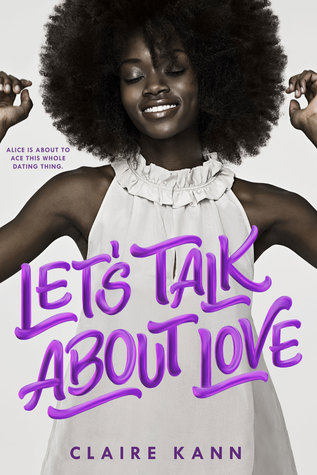
P.S. – The cover is Cutie Code Black.