Review: Detroit: An Autopsy

3 inches of snow here today in Charlotte, North Carolina. Any kind of snow accumulation of over an inch is fairly rare here, so naturally the city shuts down. Major roads are ok but side streets are impassable, schools close, and necessities like grocery stores aren’t open. I’m huddled under a blanket on the couch with hot tea, because cold weather is a great time to read.

15811520
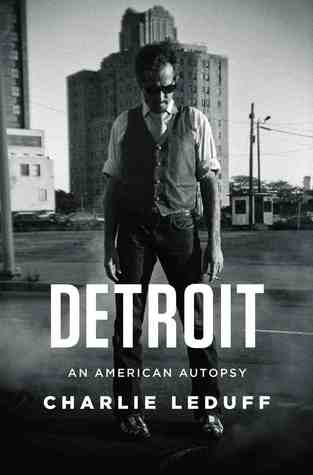
Review for "Detroit: An Autopsy" by Charlie LeDuff (2013)

Rating: 4 out of 5 stars

Today’s review takes me to a cold weather place: Detroit.

I liked this book. It’s written by a native of the city who comes back home after spending years away as a reporter and finds it gone completely to hell.

The scenes of this book are what make it interesting. There’s a homeless man the writer finds frozen solid inside an abandoned house. There’s the city’s woefully underfunded fire department, who spends most of its time putting out the work of arsonists because it’s cheaper to start a fire than it is to go to a movie. There’s a porn-style tv political ad with a corrupt lady politician at the center. There’s the author’s brother, who, after being laid off from a well-paying car manufacturing job, is doomed to put together useless parts for a low wage. And, because this is Detroit, there’s all manner of political corruption. Failing schools, corruption, racism, corruption. It’s depressing as hell. But such a good read.

Charlie LeDuff positions Detroit as a microcosm of America, when consumerism, debt, aging infrastructure, and just plain bad policy decisions go wrong. He’s sympathetic toward his city but he pulls no punches as he calls out politicians, local leaders, family members, and even himself on his own bullshit. His premise? Want to know what’s wrong with Detroit? Look in the mirror.

I wholly recommend this book.

Review: The Line Becomes a River

34818440

Review for "The Line Becomes a River: Dispatches from the Border" by Francisco Cantu (2018)

Rating: 4 out of 5 stars

In keeping with #NonfictionNovember, I really liked this book. I am glad that I did not read the many negative reviews of this before picking it up, much of which is not about the content but full of personal rancor towards the author, a former Border Patrol officer. Did these reviewers even read the book? Apparently not.

What the author does do is present a pretty fair and balanced view of U.S. and Mexican lives on both sides of the border. The first section covers his early days on patrol, catching people who activate sensors in the desert. There are many stories here–desperate immigrants wishing for a better life who are deserted by their coyotes (smugglers), people who live on the border whose properties are continually trashed and broken into by immigrants, those who aid cartels through drug smuggling. Both criminals and non-criminals are almost always rounded up and deported. There are also some pretty shocking accounts of Border Patrol agents being cruel and just plain racist (destroying immigrant water sources, calling them “wets”). In addition to this, the author describes countless dead bodies, those not fortunate enough to make it out of a scorching desert hell. The middle section of the book deals with Cantu’s moral conflicts and eventual disillusionment with the work after he is assigned to a desk job. The desk job involves profiling cartels, their victims almost always killed through unimaginable violence. Border Patrol officers have a particularly high turnover rate, which, for a morally conflicted person such as Cantu, is wholly understandable.

The last section of the book is the most poignant, in my opinion. After his departure from the Border Patrol, Cantu befriends a Mexican man from Oaxaca named Jose. Although he is undocumented, he is a hardworking man with a wife and three sons. Returning from a trip to visit his mother in Oaxaca, he is caught by Border Patrol attempting to cross back into the U.S. Cantu assists the family by showing up to his trial, getting him a lawyer, taking his sons to visit him in detention. I won’t tell you Jose’s fate, other than to say that the last part of this book is not the author’s but the voice of Jose himself.

Nowhere in this book does Cantu position himself in favor of U.S. Border Patrol policies. While participating in their enforcement as an officer, he is a part of the institutional violence against immigrants, which he acknowledges. The story of Jose is a good balancing act for the critics to show that immigration presents an ever present challenge with no easy solutions. People on both sides of the border ultimately suffer.

I recommend that you don’t read the negative reviews and read this book for yourself.

Four stars.

Review: Dear America

36544614

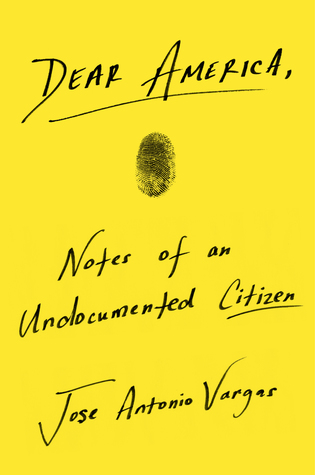
Review for "Dear America: Notes of an Undocumented Citizen" by Jose Antonio Vargas (2018)

Rating: 4.5 out of 5 stars

This is a great book. It is about life as an immigrant, but it is not about politics. Through his connection to journalism, Vargas wrote an op-ed in 2011 outing himself as undocumented. He also wrote a Time magazine cover story on the subject in 2012.

“Dear America” is mostly a story about the author, Jose Antonio Vargas, whose mother hastily put him on a plane from the Philippines to join his grandparents in America at 12 years old. He grows up in California and does not realize until he attempts to apply for a driver’s license that the paperwork provided by his grandfather was fake. He confides in several trusted colleagues and administrators, who eventually get him to college and into several prestigious journalism gigs, despite his undocumented status.

Vargas explores how the “path” to citizenship does not exist for him and many, many other people. He cannot simply apply for legal citizenship, because he came here illegally and risks deportation. Leaving the U.S. and returning to the Philippines effectively bans him from coming back for 10 years, and even then, approval for U.S. citizenship is not guaranteed. He could attempt to pull off a sham marriage (i.e., marrying a U.S. citizen for a green card), but Vargas refuses to do this because he is gay. As a result, he discusses a sense of constant homelessness even though he considers America his country. Many aspects of American life are continually out of reach for him because he is undocumented. Though he pays taxes through his job, in many states, he cannot drive or legally work. He cannot travel overseas and has been effectively cut off from his extended family. He also faces constant fear of detainment and deportation, which he goes through later on in the book.

Overall, this is a short book that puts a human face on the argument around illegal immigration, which is far more complex than building walls and talk about caravans. What does it mean to be an American? If it is simply a matter of being born on U.S. soil, then I, as a ‘natural’ resident, did not “do” anything to earn my status. Why do we as citizens feel the need to make people like the author do the same? Lots of complex arguments here, many of which have no quick answers.

Definitely recommend this book.

Review: In My Father’s House

I’m back, guys. I’ve been busy. Dissertation, fellowship applications, conferences. Le sigh.

But anyway, let’s celebrate. It’s November, lovelies! The days are short, there’s a crisp in the air. I’m going to try something a little different here,  in observance of #NonfictionNovember I am going to attempt to review only nonfiction books this month. I’ve got quite a healthy backlog, so here goes…

38395060

Review for "In My Father's House: A New View of How Crime Runs in the Family" by Fox Butterfield (2018)

Rating: 5 out of 5 stars

This well-written nonfiction book begins with a very interesting statistic: that ‘5 percent of American families account for half of all crime, and 10 percent of families account for two thirds.’ This point is driven throughout the entire book with Mr. Butterfield’s multi-generational documentation of the Bogles, an impoverished White family who moved from the Reconstruction South to Texas in the early 1900’s. The story begins with the marriage of Louis Bogle and Elvie, two young people with a propensity for cons and swindles who become hard drinkers and carnival workers. They eventually have seven children, all of whom end up in prisons or reformatories for various crimes–drinking, stealing, fighting, and beating their wives.

The narrative then shifts to one of the sons of the original Bogle family, the youngest and most particularly troublesome son, nicknamed Rooster. Enabled by his mother, Rooster terrorizes his own family through physical and sexual abuse. He “marries” two women and keeps them in the same house, occasionally beating them and having several children by both. He does not allow his children to socialize outside of the family and takes them on his various criminal schemes, encouraging them to steal and even going by the state prison and telling them that they will end up there one day. Eventually all of Rooster’s children do go to either jail, prison, or state reformatories, only this time for more serious crimes–drugs, burglary, theft, rape, and murder.

Butterfield is still not finished, continuing to trace the stories of cousins, uncles, aunts, and other Bogle family members. He goes into the next generation of Rooster’s grandchildren and describes their history of meth use, burglaries, child endangerment, and more crimes. In the back of the book is an exhaustive list of over 60 Bogle family members, all of whom have either spent time in a prison or jail for various crimes.

This book does end on a bright note, with the story of one of Rooster’s grandchildren, Ashley. With strong social ties through her mother (not a Bogle), community support, and education, she graduates from college and pursues a career in the medical field. She is the first Bogle family member to graduate from college in 150 years.

This is a good book but it is somewhat depressing, as it forces you to consider how much the role of family and upbringing is overlooked in the modern theories of crime. Butterfield is careful with this argument, however. He acknowledges over and over that leaning too heavily on the link between family upbringing and crime reinforces racism, with Blacks and people of color typically being demonized and incarcerated as if they are the sole perpetrators of crime. I think this is why he chooses a White family to illustrate his point in this particular book (though his previous book I’ve reviewed, “All God’s Children,” deals with crime in a Black family).

This is an excellent read if you are interested in the criminal justice system, theories of crime/criminology, and the “nature vs. nurture” argument. It’s also cool if you just like narrative nonfiction too.

Five stars.


Review: We Built the Wall

39849489

Review for "We Built the Wall: How the U.S. Keeps Out Asylum Seekers from Mexico, Central America and Beyond" by Eileen Truax (2018)

Rating: 4.5 out of 5 stars

As an educator, I hold the steadfast opinion that until everything’s equal (money, wealth, opportunity), we’ll continue to grapple with the same issues: race and gender inequality,  poverty, crime, and a failing criminal justice system. So when it comes to nonfiction, naturally, these are the topics that I usually find myself reading about.

The other big one–immigration.

We Built the Wall  is a very well written book about Mexican and Central American (Guatemala, Honduras, and El Salvador) immigration. The author interviews immigrants living on both sides of the border and in detention centers, as well as the lawyers and organizations that help them.

I must admit that reading this book helped me understand what a complex issue both legal and illegal immigration really is. To those who simply tell immigrants to “go home” because they are here illegally, this book details how going home is nearly impossible, with violence, police corruption, extortion, and threats by criminal gangs making the lives of ordinary people there a living hell. Applying for legal immigration is an option but not very likely to happen for many. For one, it can last years. When a gang threatens to kill your whole family unless you pay them extortion money and your preteen son agrees to join them, there’s an urgency to your movement. Second, legal immigration usually carries with it a highly complicated set of criteria (you must have $$$ to apply, a U.S. citizen to sponsor you, or an employer in the U.S., etc.) that make the process damn near inaccessible to poor people. Therefore, it is understandable that many come illegally, and when caught, attempt to apply for political asylum. This rarely happens, and most are detained during this months-long process.

This book also discusses how much of America’s political asylum policies are still deeply attached to Cold War politics. Cubans who come to the US usually get their asylum request granted, due to the fact that their country is not a democracy. Mexico and much of Central America, however, does not fit this criteria. This policy has gone unchallenged for many years, and upholds a certain status quo that privileges people from certain countries (usually European-influenced) over others and leaves Mexicans, Central Americans, and people from poorer, less industrialized countries at the bottom.

The “Wall” to keep undesirables out of America is not physical but a political one, and has been firmly in place since the Cold War. I won’t give away the whole book here, but I will agree that this is a highly detailed and readable book about the current politics of immigration that I would definitely recommend to anyone.

Review: Stamped from the Beginning

25898216
Review for "Stamped from the Beginning: The Definitive History of Racist Ideas in America" by Ibram X. Kendi (2016)

Rating: 4 out of 5 stars

This book is all about racism, specifically, how racist ideas about people of African descent led to the institution of slavery and became a unique history, woven into the fabric of American life.

This book is nearly 600 pages. I listened to it on audio. Unless you have time to really go through it and make notes and annotations, I recommend that you keep this on audio. I will probably go back through and read this when I have more time, just because of how excessively detailed the information is. That’s a good thing, though.

Anyway, Dr. Kendi makes his argument fairly plain–that racism is more than simple “ignorance.” If racism were as simple as people behaving “ignorantly,” Kendi asserts, it would not have persisted for thousands of years, nor would it be the institutional scourge that continues today. Racism is actually a very complex system of ideas, drawn from a number of highly complex sources. Kendi uses five guides into his argument who we’ve all probably heard about in our American history classes in school–Puritan minister Cotton Mather, founding father Thomas Jefferson, abolitionist William Lloyd Garrison, author W.E.B. Dubois, and the Black feminist radical, Angela Davis. He separates these figures into three camps to trace the development of anti-Black, racist ideas: segregationists, people who believe that Black people are to blame for their own inferiority, assimilationists, people who believe that both Blacks and racial discrimination have equal part in beliefs surrounding Black inferiority, and anti-racists, people who reject both of these ideas. Kendi spends a great deal of time with each one of these arguments, and all five of these historical figures who play some part in either building or dismantling racist ideology.

All in all, I found Stamped from the Beginning to be a very complex and nuanced book. It’s also exhaustively researched. Even though I knew that Cotton Mather and Thomas Jefferson were not all that my high school history teacher were telling me they were, this book breaks down their racist ideas in a way that I’ve never quite seen before. This is a book that begs to be read by all people, especially in today’s times. I will definitely also say that I have learned much from this book, I highly recommend it.

Review: In a Day’s Work

36921281
Review for "In a Day's Work: The Fight to End Sexual Violence Against America's Most Vulnerable Workers" by Bernice Yeung (2018)
Rating: 4 out of 5 stars

This is a very timely, informative read about sexual harassment and assault in the workplace among those whose jobs we rarely see–night office building custodians, farm workers, domestic workers. Many of these workers are female, and many of them are undocumented. They are often afraid to pursue legal action against the men who violate them due to their undocumented status, fear of losing their jobs, or because they simply do not think that they will be believed. In addition to the threat of rape from male bosses at work, these workers are also taken advantage of in other ways, like being forced to work for no pay, working in dangerous conditions, unpaid overtime, not allowed to take breaks, etc.

It is obvious that the Ms. Yeung has been working on this topic for a long time, and her knowledge of this topic shows brilliantly in her writing. There was a documentary that came on PBS’s “Frontline” about 2 years ago which reported on the plight of female farmworkers, another that came on about a year ago that reported on the sexual harassment of female custodians. I watched both of these programs. Much of the reporting on both of those stories (both excellent) were completed by this author as well. I also liked how the author gives solutions on how this problem is being tackled by new legislation and oversight committees that are currently in place, attempting to protect and make a difference in the lives of female workers.

An impactful, well-researched book. Highly recommend!

Review: Another Day in the Death of America

29502379
Review for "Another Day in the Death of America: A Chronicle of Ten Short Lives" by Gary Younge (2016)
Rating: 4 out of 5 stars

“Another Day in the Death of America” is a look at the effects of gun violence on children in the United States. Younge, a British reporter, picks a random day (November 23, 2013), and identifies 10 children who died of gunshot wounds around the country within that 24 hour period. He follows up with their families and acquaintances, interviewing them and seeking insight into the victim’s short lives.

All of Younge’s subjects are male. The youngest victim was 9 years old, the oldest, 18. They hailed from large cities and small towns, inner cities and suburbs. Seven of the victims were Black, one was White, and two were Hispanic. Some of their deaths were accidental and some were intentional. In at least four of the cases, the killer (or killers) is still unknown. What matters the most, however, is that all of them were loved by their family, the majority of which agreed to be interviewed for this book.

The author puts a very human face on the tragedy of gun violence. He also probes, quite extensively and justifiably, issues of race and social class, which play a part in the prevalence of violence in some communities more than others. While he says that this book is not a plea for gun control, I’m not sure how this book can be read by anyone as anything but. It is clear that the point the author is making is that Americans are not inherently more violent than the citizens of any other country, yet the availability of guns make deaths more likely and more prevalent.

This book was written in 2016, and yet, two years later, it is still a timely one. The author admits that he began the research and writing on this book shortly after the Sandy Hook shooting. I read this in 2018, and we’re only several months removed from yet another school shooting, this time in Parkland, Florida. The questions raised in this book two years ago are the same questions we face today over gun control, and we’ve done absolutely nothing since.

I try to refrain from getting overtly political on my site, because, well, it’s all about the books, right? However, I realize more and more that the books I choose are political, and that every time I post my thoughts about them it is clear where I stand on certain issues. I’m OK with that. I am not a Democrat or a Republican, but I am a mother who sends my 14-year-old son off to school every morning with a hug and a kiss, just like everyone else.

I pray every single day that he comes home without a bullet in his body.

Review: Tyler Johnson Was Here

35604682
Review for "Tyler Johnson Was Here" by Jay Coles (2018)
Rating: 3 out of 5 stars

From the moment I saw this book I knew I had to have it. I’m always down for YA books by and about people of color that are overtly political in nature, as well as books that challenge young people to think critically social issues. And yes, THAT cover. Gor-juss…

“Tyler Johnson Was Here” is just such a book that is destined to provoke conversation, particularly on police killings and the role of Black Lives Matter movement. The novel centers on the lives of twins, Tyler and Marvin, growing up in the fictional town of Sterling Point. The twins are raised by their single mother while their father, who is incarcerated, makes frequent appearances throughout the book in the form of letters written to Marvin.

Even though this is the story of twins, the story is told through Marvin, the more grounded of the two. Marvin hangs out with his friends Guillermo and Ivy, makes decent grades, watches reruns of “A Different World” and hopes to get into MIT. Tyler is the more restless twin, directing his energies toward social pursuits and hanging with a tough crowd. Much to Marvin’s dismay, he notices a rift between him and his brother and cannot convince Tyler to stay away from trouble. One night, after a party thrown by a local drug dealer, Tyler does not return home. Several days later, he is found deceased. A leaked video reveals that Tyler was unarmed when he was shot by police. As Marvin deals with his grief and anger over his brother’s death, he turns his efforts to protest and making sure that his brother’s memory isn’t forgotten.

What’s wrong with this book? A lot. Hell, I’m just going to bullet point here:

— The pacing of this novel was a problem for me. We’re told on the front flap of the book that Tyler is going to disappear and later be discovered dead. However, the characters do not discover Tyler’s death until well over halfway into the book. I felt as if the author could have skipped the ‘missing’ part, because it slowed the pace of the novel significantly. You’re literally just sitting around waiting for the inevitable for the first 150 pages. That’s not fun.

— Characterization fell a bit flat in this book as well. Even though I felt I understood Tyler, when I finished this I realized that I really didn’t. The limitations of a single perspective (Marvin’s) is apparent here. We know he was a good kid who got mixed up in a troubled crowd, but we’re never told the exact nature of his last days, his dealings with his friends. The author spends a great deal of time making the point that although Tyler may have been troubled, this was no reason for the manner of his death. While this is true, I think this point would not have required so much emphasis with more character-building as far as Tyler was concerned.

— There’s also a side character that goes absolutely nowhere: an aunt who’s a police officer, mentioned several times in the novel, who’s “always on the phone” with Marvin and Tyler’s mom. Considering that the police are the bad guys here who murdered Tyler and all of law enforcement in this book is portrayed as the epitome of evil, a relative of Marvin’s who happens to be a cop may have added to the complexity of this book. But that’s never explored. Weird.

— Marvin meets a girl, Faith, through his attempts to discover his brother’s whereabouts after the fateful night at the party. They eventually become involved with one another, but I never got a sense of their chemistry, her relevance to the story beyond the standard YA romance requirement, or really why she is in the book at all.

— The multitude of references to the tv show “A Different World”: Marvin is obsessed with this show, viewing it as a way to “understand” diverse Black characters. I’m not sure why this is, especially when there are more modern (and diverse!) shows with Black characters that could have been referenced here. I’m an 80’s baby, so I watched “A Different World” as a teenager (it went off the air in 1993, right as I went into high school). A teenager in 2018 still fixated on characters from a show from well over 25 years ago seemed strange, kinda like a kid who watches a dated show like “Hogan’s Heroes” expecting to find enlightenment. Yikes.

Comparisons to “The Hate U Give” are inevitable (both have Black main characters, both are about the subject of police violence), and if I had to pick between the two I’d say in a heartbeat that “The Hate U Give” is the much better book. Despite my criticisms, however, I won’t go lower than 3 stars for “Tyler Johnson Was Here.” I also wholeheartedly recommend this to other people to read. Even though TJWH has problems in its execution, I respect what it does accomplish successfully, and that’s place the narrative surrounding police violence in the hands of Black youth, within the context of their own language and culture. The value of those things in and of itself is immeasurable, respectable, and deserves notice.

And yes, the cover. It’s quite beautiful.

*sigh*
Review: Ghettoside: A True Story of Murder in America

13153693

Review for "Ghettoside: A True Story of Murder in America" by Jill Leovy (2015)

Rating: 3.5 out of 5 stars

Before I begin this review I have to commend the author, because there really is no easy way to write about the subject of Black on Black crime. How do you talk about the very real issue of Black homicide rates without pathologizing an entire race? At the same time, one has to recognize that Black homicide is indeed a problem and even though poverty, racism, and decades of neglect by law enforcement play a consistent role in its existence, you can’t “excuse” it either. Even though crime rates have dropped in recent years, the murder rates among Black men remain relatively high. Violent homicide still remains the number 1 cause of death among Black males ages 15-34 in America.

Jill Leovy starts off great in this book. For her setting, she chooses inner city Los Angeles, a city long plagued by Black homicides. She describes a crippling bureaucracy, as well as homicide detectives struggling for resources–lack of computers and cars, even buying their own “murder books” (binders in which to keep case files). They didn’t even get tape recorders, many detectives had to buy their own. Leovy argues that the LAPD and the entire criminal justice system has not placed a high priority on solving Black murders. This has created a lack of trust in the police among Black citizens, tendencies toward vigilante-style justice, witnesses afraid to talk, and a “no-snitching” culture that makes closing murder cases notoriously difficult. Names go in files to be forgotten, detectives get bogged down with even more cases.

“Ghettoside” is a broad narrative, though it focuses on the specific case of an LAPD homicide detective’s son who was gunned down in 2007 while walking down the street. A long chapter is dedicated to describing his family life and how much of a “good” boy he was (not a gangster, followed rules, etc). You almost have to wonder if the author is following the same kind of rationale that many people feel toward murder victims: an unspoken sentiment that a person’s morally questionable behavior in some way should “justify” what happened to them. Another problem is the large amount of biographical information on not just one but several LA detectives and their careers, which, honestly, I just didn’t care about. It was hard to remember who was who and after several chapters of this I started skipping pages.

Another problem with this book is that, through the case of the detective’s son, Leovy seems to make an argument that if all cases were solved by dedicated detectives like the one who solved this one, there wouldn’t be any unsolved Black homicides. Well, not really. For one, the circumstances of every case is different and second, you have to revisit the idea that (perhaps) one of the main reasons why this particular case continued to stay visible was because of who the victim’s father was. You can’t take socioeconomic status, which governs so much of our lives, out of the death equation here.

Overall, a clunky but ok book for me. 3.5 stars.