Review: Heads of the Colored People

35297351
Review for "Heads of the Colored People" by Nafissa Thompson-Spires (2018)

Rating: 4 out of 5 stars

Short story collections are always hit or miss. You end up either liking some or none of the stories at all. The stories are either too long or too short, the plots are too much of the same or too loosely put together with little overall theme. “Heads of the Colored People” was an exception, I liked every last story in this volume.

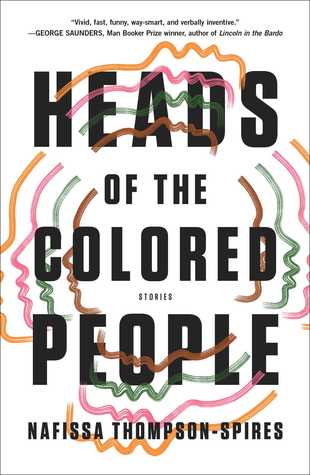
Nafissa Thompson-Spires hits the ball out of the park with this one. All of these stories are of Black people living on the fringe of what’s considered “normal” behavior. In this volume, there are Black men who cosplay, Black women who do AMSR (yes–even I had to look it up), Black men and women with anxiety issues, Black women at war with their bodies, Black men professors who passively aggressively war with coworkers, Black millenials obsessed with social media attention. Some of the stories were connected, with several selections detailing the ongoing saga between two Black girl frenemies, Fatima and Christinia. Some of the stories were funny, some of them were quite cringe-inducing, but it was alright because it’s clear that they were meant to be that way. Clearly, Thompson is a writer who is not afraid to write with honesty and just go there.

In the end, I believe this book is effective because it achieves exactly what the title suggests. The author gets deep into what’s in the “heads” of Black people, which, we find out, are a multitude of pressures–the pressure of being the only Black person in their environments, the pressure of being a representation of what non-Black people think of when they conceptualize typical Black “behavior,” the pressure of being Black in American society. Questions like: how does one cope with being angry–without being perceived as the stereotypical “angry” Black man/woman? characterize this book, and I’ll be thinking about the answers for a long time after I read it.

I loved reading this from start to finish. I will definitely watch for future efforts by this writer.

Top Ten Tuesday: Fiction Pet Peeves

Oh, fiddlesticks…the wtf topics keep occurring over at Top Ten Tuesday, so I’m making my own today. Since I did nonfiction last week, I’ll delve into fiction today. Here goes:

Top Ten Pet Peeves in Fiction

  1. The “woman of stone.” I love kick-ass women characters, but sometimes, in the pursuit of the ultimate bad-ass gal, the author will create a woman character so devoid of emotion that she is, in many ways, psychologically a man. Just the trophe the writer seeks to avoid by making the character a woman. I think it is ok to make women characters that do kick ass and take the time to do other things, like pause and cry, for instance. Nothing wrong with that.
  2. Atypical boys = homosexuality. I love quirk, but all too often quirk (lack of sports interest, nerdiness, awkwardness around girls, etc) in male characters is imagined as a gay character. I don’t have a problem with gay characters, but I do have an issue with the perception that there is only one way to be a straight boy, and anything beyond an interest in sports and chasing girls means he must be gay. I find this a lot in YA. Ugh…stop it.
  3. Contrived diversity/tokenism. Of course in the whitest of all White settings, the main character manages to have two chatty, Black girl best friends. Like, of course. For example, in the novel Moxie, we’re talking a very small Texas town that’s nearly 98% White. How, then, does the main character happen to find the only Latina, Black, and lesbian girls in town and befriend them in the name of feminism? Beats me. This is why tokenism sucks–it appears to be ‘diverse’ on the surface, but there’s no yielding of the dominant narrative and absolutely no knowledge of a different perspective is gained. The “color” here was for the purpose of symbolism only.
  4. Rape/torture porn. I’ve written about this a lot here, so I won’t go into super detail because you already know how I feel about this, but it goes like this: we don’t need any more excessively detailed descriptions of rape, torture, violence, sexual abuse, etc. on paper. We know what these horrors are and what they do psychologically and physically to a victim. If a writer does choose to explore those subjects in a book, I feel like it should be political/critical in nature or to emphasize the development or growth of a character. Simply writing about a woman getting raped over and over does not challenge the abuser or the act, it just assents to the notion that women should be somewhere suffering for the sake of good storytelling. Not cool.
  5. Love at first sight. I don’t know about ya’ll, but I’m tired of YA characters finding their soulmate on the first day of school as their lab partner in bio class. They have no chemistry, but he’s “hot” and after dating only once, they’re hopelessly and endlessly in love. Bitchhhhhh….please.
  6. Change through abuse. This is kinda related to torture porn, but in a different direction. Here, the love interest from bio class is an abusive jerk whose function is to change or “soften” the strongly-willed (usually female) main character. It’s a sad and very old, sexist trope–that “change” must occur through domination, the breaking of someone’s will. Also not cool.
  7. Forgiveness, always. I love the idea of forgiveness as much as the next gal, but sometimes the person hurting you is just so plain nasty that I don’t think forgiveness is possible. And that’s ok, Dr. Phil, because not everybody deserves to be forgiven. I’ve found this kinda kumbaya, “let’s-hug-it-out-at-the-end” b.s. in a lot of books where family dysfunction is at the forefront and it sucks, because let’s face it, sometimes family members will do more fucked up things to you than a stranger. It’s ok to say no to abuse and mistreatment, even by family members.
  8. Books where the writer describes the main character’s appearance. Yep, this is still happening. I always maintain that a good book need not describe the character’s looks–if the writer is doing their job right, details on their appearance never need to be explicitly shared. You can still have a fleshed out character without going into detail about how he’s a Harry Styles clone, ma’am. LOL.
  9. Very slow action. Like, reeeaaalll slow. Like, we’re on page 50 and the main character is just now leaving the house. Molasses in the plot, snails in the dialogue. First I’ll flip ahead, then it’s a quick DNF, next.
  10. Side characters with no real purpose. We all know this: books with a evil side character whose only purpose for existing seems to be to foil the main character’s intentions. Why are they so bitchy? Well, this is never explained. I understand that the novel isn’t from their perspective, and that’s fine, but if you’re going to make a side character psychopathic in their badness, a little insight is warranted, yanno?

Ok, back to studying…

Review: This is How You Lose Her

13503109
Review for "This is How You Lose Her" by Junot Diaz (2012)

Rating: 3 out of 5 stars

I downloaded and read this back in 2012 when it first came out, due to my overwhelming support and respect for Junot Diaz as a writer at that time. I gave it 5 stars because I thought that the writing was fresh and engaging, but the sexism of the male characters bothered me immensely. Man, I thought at the time, he really hates women. I even remember hitting up Google to see if Diaz was married or had a girlfriend, because I could not imagine the jerk he probably was at home. I didn’t speak on it further though. I did not write a review either. I just moved on.

After allegations of sexual misconduct and verbal abuse came out about Junot Diaz last week, I decided to take another look at this book. I read it in a few days and I have to say that I am even more troubled by the male characters’ sexism than I was the first time I read it. On a scale of 1-10, Yunior’s sexism is somewhere in the Outer Limits. He cheats and cheats and treats women like shit and feels only a vague sense of remorse about it. Even though the book is about relationships, in story after story, Diaz’s women characters are always empty and never fully fleshed out. Their bodies exist for the male characters to use and abuse them time and time again. When women characters are somewhat fully realized (“Otravida/Otravez,” the ubiquitous presence of Yunior’s mother) they are always saintly, sad, and long suffering through the perils of their men’s choices.

So what is this, other than your run-of-the-mill, heteronormative misogyny? It does not surprise me that Junot Diaz has been called out as a jerk in his offline world, because in reading this I never felt that normal kind of separation between the person and the art. These stories are too real, and it is quite apparent that Yunior’s experiences are clearly Diaz’s. Diaz addresses some of this criticism in an article from The Atlantic, in which he states that he wrote this particular book to address sexism that pervades our culture. I get that, sir. But simply calling out sexism and portraying it in all of its nasty glory does not challenge it. There is nothing in this book about male hetero privilege that we don’t already know or haven’t seen before.

I’ve changed my rating to 5 stars to 3 stars now. I don’t mind writers writing about sexism, but I need more complexity before I read something else by Junot Diaz.

Review: Ghost Boys

35959634

Review for "Ghost Boys" by Jewell Parker Rhodes (2018)
Rating: 4 out of 5 stars

“All children, except one, grow up.”
-Peter Pan

Jerome is a likeable 12 year old boy living in Chicago with his parents, grandmother, and sister. He is bullied at school, so a friend gives him a toy gun to brandish for protection. During a visit to a local park to play with the gun, Jerome is shot and killed by a police officer, who felt as if Jerome was a “threat” to his life.

Once dead, Jerome remains in the world of the living, watching his parents grieve and visiting places he used to go. No one sees him, until he encounters the young daughter of the police officer who killed him. They strike up an unlikely friendship. Ghost boys, we learn, are young Black boys killed by racially motivated violence. Emmett Till, Tamir Rice, and Trayvon Martin all make appearances in this book. We’re told that there are hundreds of ghost boys, walking around in the world of the living, making sure we don’t forget them.

This is a sad, heartbreaking book. I will admit that I went into the reading of this book angry on the subject matter. I won’t say I liked it either, because it deals with an all-to-real horror that I, as the mother of a 14-year-old Black boy, hope to never, ever encounter. Yet mothers are still dealing with the pain of their children shot dead by police with no consequences, legal or otherwise. Ghost boys continue.

This is geared toward middle grades readers. I’d definitely use it with that age group to discuss issues of empathy and racism.

Review: The Poet X

33294200
Review for "The Poet X" by Elizabeth Acevedo (2018)
Rating: 4 out of 5 stars

This is a beautiful book.

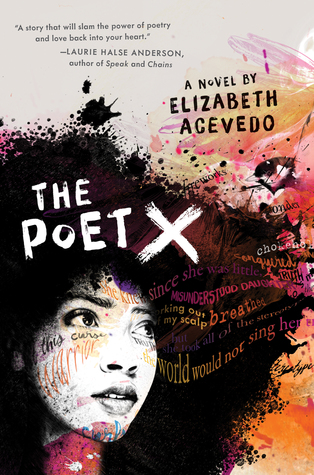
Xiomara Batista is a Dominican teenager growing up in present-day Harlem, NYC. She writes poems in her notebook to express her honest thoughts, mostly on her best friend, her twin brother, her father, and her ultra-religious, overbearing mother. Outside of her brother and her best friend Xiomara does not have much of a social life, she is forced to attend church services and confirmation classes by her mother. Her life changes, however, when she falls in love with a boy from her school and is encouraged to pursue her poetry by one of her teachers.

A lot of the trophes in this book are a bit cliche: first love, parental misunderstanding, the questioning of religion, discovering one’s voice through poetry. Oddly though, while reading this I never really considered these things as ‘done before,’ I just found myself getting lost in the book and letting Xiomara’s words shine through. I loved the poetry here, I loved Xiomara.

I normally don’t care too much for novels in verse, I find most poetic narrative styles kind of stuffy and trite. Not so with this book, I could have read this for another 100 pages. Very well done, highly recommend.

Review: The Closest I’ve Come

Skipping Top Ten Tuesday (again)….hehe.

33914005

Review for "The Closest I've Come" by Fred Aceves (2017)

Rating: 4.5 out of 5 stars

This book is a giant YES. I loved everything about this book.

Marcos Rivas is a 15-year-old Latino growing up in the Maesta neighborhood of Tampa, Florida–a community riddled with crime, drugs, and few economic opportunities. His mother is present but emotionally absent from his life, either drunk on her days off or working long hours away from their apartment. For the past year, she has allowed her racist, alcoholic boyfriend Brian to live with them, who physically and verbally terrorizes Marcos on a daily basis. For all intents and purposes, his mother is aware of the abuse but does nothing to stop it. Because most of the money in the household is spent on booze, Marcos seeks out meager job opportunities to earn enough cash to be presentable for school and to his friends.

At school, Marcos spends his time hanging with friends and playing pranks on teachers. He is failing all of his classes and doesn’t see the point in doing better or thinking about his future. He has a crush on a girl named Amy and quietly begins to pursue her romantically after they are both selected to participate in a mentoring program called Future Success. Little by little, as he begins to turn his life around, he begins to realize that by getting his life together, he can be better than the circumstances that his life situation brings.

This story is told in the first person POV and had an excellent sense of the main character’s voice all throughout. There was never a time when I didn’t understand Marcos, I definitely felt his feelings and saw his world view through his eyes. Marcos’ story was compelling and powerful, and even though the ending didn’t resolve his many issues, I was ok with it. Poverty and familial dysfunction aren’t easily solvable, and in many cases, cannot be physically escaped. What is important is that Marcos develops a sense of hope, a new way of being in a world that does not intend for his success.

This is my (3rd or 4th?) foray this past month into YA books with Black and/or Latino male characters, by Black and Latinx writers. I can’t stress to you how important that I feel that diverse YA books are, particularly those that are written in the language and the contexts that minority kids are culturally familiar with. “The Closest I’ve Come” is definitely one of the books that’s re-imagining a diverse new world of literature.

4.5 stars. Loved this!

Review: Brave

35068683
Review for "Brave" by Rose McGowan (2018)
Rating: 3 out of 5 stars

Oh dear, three stars here. And that’s being generous.

I’ve always been a fan of Rose McGowan–I loved her in the films “Scream,” “Jawbreaker,” the tv show “Charmed,” and when I saw that she had written a book I decided to take a peep. Overall, it’s not a horrible book, it’s just one that espouses an obnoxious brand of feminism that I find problematic. I’ll get to this later though.

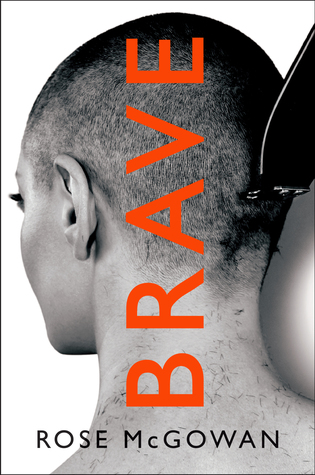
Rose gives a lot of details into her early life. She grew up in a commune with the Children of God, a religious cult that would be later known for its physical and sexual abuse of women and children. She manages to escape with her father and move to America, where she moves around often. She eventually reunites with her mother, whose boyfriends were abusive to Rose. She later auditions for an extra in a movie and her career as a Hollywood actress begins.

About midway through the book, McGowan details a meeting with a well-known movie industry executive who sexually abuses her. She never names the exec but we know she’s obviously talking about Harvey Weinstein. She also talks about her relationship with Marilyn Manson, whom she started dating because, in her words, he was a really “sweet” guy. Fair enough, I thought. I never fell for his contrived, shock-rock bs either.

Anyway, toward the last quarter of the book, McGowan spends a great deal of time dishing on her relationship with another famous film director known as “RR” (obviously Robert Rodriguez). She characterizes him as an emotionally abusive man who allowed her to be seriously injured on a movie set, among other bad things. After this she lectures us on and on about cults, groupthink, the virtues of #RoseArmy (her social media followers who can’t get enough of her), why men continue to abuse women, etc. When she started to plug some EDM music album she’d created, I stopped reading. Zzzz.

Which brings me back to Rose’s “feminist” problem. I place “feminist” in quotes because before this book came out, Rose has been noted on the record multiple times with negative statements about trans women, commenting that “they don’t live in this world as women.” This is false. It’s also terribly ignorant. Trans women are raped, discriminated against, murdered, abused, and beaten quite often–exactly because they do live as women. Fortunately, Rose does not get to decide who is and isn’t a woman. It’s also exactly why I, as a feminist myself, can’t embrace her exclusionary brand of “feminism,” which seems to privilege being straight and cisgendered above all else.

So I’m giving this three stars. I like to think I’m a person who can separate the person from the book, but both of these had issues. Meh…

Review: Lockdown on Rikers: Shocking Stories of Abuse and Injustice at New York’s Notorious Jail

Skipping Top Ten Tuesday again…I’ve got a backlog of reviews, so enjoy!

23848584
Review for "Lockdown on Rikers" by Mary E. Buser (2015)

Rating: 2 out of 5 stars
I went into this book based solely on its title, thinking it would be a critique of one of the largest and most dangerous prisons in America, the notorious Rikers Island jail complex located in New York City. The author spent time as a mental health therapist on the Island, a site of continuous controversy over its bureaucracy, officer corruption, violence, and the inhumane treatment of inmates. I also thought that this book would discuss solutions on what we could do as a society to reform jails and prisons. With both of these things in mind, I had high hopes for this book. However, this book does none of those things. What you get here is a therapist-in-training’s daily account of her interactions with inmates and her frustration with system bureaucracy and its treatment of mentally ill inmates.

I certainly understand Ms. Buser’s point in writing her story. It is a fact that many jail and prison inmates are mentally ill, and should be getting treatment and care for their conditions instead of jail time. However, this story is not particularly new or unique. We know that prisons aren’t good places for the mentally ill, and there’s been numerous exposes already written and filmed on this subject. While I commend the author for staying so long on this job and her compassion for the inmates, I am a bit disappointed that the focus of this book wasn’t more solution-based. If jail isn’t the place for the mentally ill and locking them in asylums aren’t either, then what, according to her professional opinion, is? Ms. Buser never tells us and stops far ahead of offering any kind of insight into this problem. Also disheartening is that the events here took place in the 90s, yet she is telling this story over 20 years later (this book was published in 2015). Wouldn’t this story have had much more of an impact 20 years ago? She does write an update of sorts in the epilogue, telling us very generally that “abuse on Rikers continues” but she cites few examples to back up this point.

The writing here is nothing special. I wouldn’t be surprised if the author took her therapy notes, copied them, and reconstructed it as the dialogue and events that you read about here. Overall, this is a very underwhelming story that could have been a lot more, had new insights been presented.

Review: Tyrell

421338
Review for "Tyrell" by Coe Booth (2006)
Rating: 4 out of 5 stars

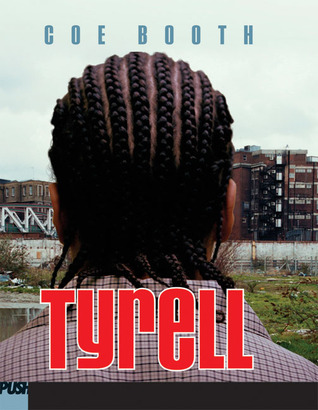
Meet Tyrell. He is a 15 year old Black kid living in a roach-infested homeless shelter in the Bronx with his cracked-out mother and little brother. To make a living and supplement his mother’s SSI checks, he scams riders at subway stations. His father is incarcerated, he has long since given up on going to school. He refuses to sell drugs and doesn’t have much but a detailed knowledge of the streets, a fierce desire to protect his brother, a girlfriend that he loves, and a plan to make a lot of money by DJing at a party to get his family out of the shelter.

What I like about this book is that Coe Booth makes Tyrell a deeply flawed, multifaceted character. I could not help but to love him despite his bad (and sometimes very violent) choices, many of which reflect a sexist attitude toward women. He gets it right and he gets it wrong–but I always understood the “why” of Tyrell, as he reflects the manifestation of a life not lived but survived, a boy grown up too fast. This novel is the thought process of a man-child with no role models or people that he trusts. The streets have nurtured him, he’s raising himself. The empathy you feel for Tyrell carries you through this novel and make his life and his motivations understandable.

This book will shock those who are not familiar with (or, who simply choose to ignore) the lives of Black and Latin urban teenagers. There’s lots of cursing here, along with casual drug use, sexual situations. There’s also non-standard English, constant use of the word “nigga.” Get over it. Although “Tyrell” is YA, this is clearly not White suburban YA. It should not be controversial, then, that a story about a Black urban teenager is appropriately written in a language that is familiar to that audience. Given the realistic subject matter here, the language simply is what it is. It fits the novel perfectly.

Needless to say, I loved this book. There’s a sequel to this, I’ll be picking that up too.

Review: The Comedown

Back home in good ol NC. I’m skipping Top Ten Tuesday to review a book that comes out today, so enjoy!

35020354
Review for "The Comedown" by Rebekah Frumkin (to be published on 17 Apr 2018)
Rating: 3 out of 5 stars

This book’s ok.

“The Comedown” centers on a missing yellow suitcase full of cash and a drug deal that went wrong in Cleveland on May 8, 1973. Leland Bloom-Mittwoch, a drug addict, witnesses the killing of his dealer, Reggie Marshall, and absconds with the suitcase. The story then follows three generations of the families of the two men involved, one White (the Mittwochs) and one Black (the Marshalls), from the early 1970’s to 2009. Over the years, members of both families search for the yellow suitcase. The suitcase is a bit of a MacGuffin here, taking on a kind of mythic quality as each character doggedly pursues it for reasons of their own.

For me, this book is a compilation of character studies. For that reason it’s heavily populated, with various family members of the major players going in and out of the main narrative. Although the characters are all relevant and connected to one another, it was a struggle for me to stay interested here. This novel definitely explores race, class and addiction, but I don’t know…maybe I just wasn’t the right audience for the ensemble cast approach it uses. Once I began to like, hate, or empathize with someone it was off to another person, time, and place. For me this book just seemed too broad, too many bits and pieces.

The quality of the writing is decent, so Frumkin is definitely a writer to watch. This book will probably get good reviews from other people, so maybe my issues here are simply ones of personal preference.

3 stars.

[Note: A digital copy of this book was provided by the publisher, Henry Holt Co., and NetGalley in exchange for an honest review. ]